Political instability is seen due to the intention of the current leaders of Nepal to institutionalize corruption in the name of democracy, the slogan that the problem is caused by the constitution is only bankruptcy and hypocrisy.
We use Google Cloud Translation Services. Google requires we provide the following disclaimer relating to use of this service:
This service may contain translations powered by Google. Google disclaims all warranties related to the translations, expressed or implied, including any warranties of accuracy, reliability, and any implied warranties of merchantability, fitness for a particular purpose, and noninfringement.
When the KP Sharma Oli-led government was formed nine months ago, the main slogan was to amend the constitution and maintain economic development and good governance for political stability. There was little hope that the Oli government, which received nearly two-thirds of the votes of Congress and UML, would advance in all three aspects.
But in nine months people are getting frustrated and angry. Hope for the future in the country is weakening. Instead, 'hypocrisy' is taking root.
constitutional amendment
How false the slogan of constitutional amendment is, it is clear from the expression of UML leaders. Now the point of amendment is lost. The issue has been postponed until Congress-UML has a majority in the National Assembly. This fact was certainly known to all when the government was formed. But at that time, the lie that the amendment of the constitution was talked about to forget the people by saying political stability has now become a lie.
Is the constitution an obstacle for political stability, economic development and good governance? There is a proverb in Nepali - 'The yard that does not know how to dance is crooked.' When the intention of the person in power is limited to the constitution and the abuse of power, the economic and power interests of a bottom class, then even if Pashupatinath himself made a new constitution, it will be useless. Is the constitution responsible for the political instability, unbalanced economy and corrupt administration seen in Nepal or is it the power grab and corruption obsession of the so-called party leaders?
Even the government that got the majority in the past fell not because of the constitution, but because of the corruption within the party and the division of positions. Despite bringing the majority, the power was unstable due to splits. Not only within Nepal, there are examples of neighboring Bangladesh and Sri Lanka, where the majority government will not only collapse. In India, even though there is no majority, the government is strong. So if you get sick, do you blame the fever or look for the cause?
Political instability is seen due to the intention of the current leaders of Nepal to institutionalize corruption in the name of democracy. Until you think about it, the slogan that the problem is caused by the constitution is just bankruptcy and a hypocritical state of mind. It is visible. Now the expression that nothing can be done without the majority is a terrible example of this. It's just a trick to fool people.
economic development
In terms of economic development, the Oli government is like a crow lost in the fog. The problem of the economy is not understood or has been digested. When the Prime Minister and Finance Minister themselves pretend that the country is progressing in all areas, they immediately complain that the economy is in crisis.
There are some strong points in the current economic situation. The first is to have adequate reserves of foreign currency. But what is important to remember is that this is not the product of the combination of Nepal's capital and labor and internal employment. This is the product of the situation where the poor Nepalis who do not find work are forced to go abroad to earn a living in the country.
If the rulers of Nepal could make good use of it, build national capital assets and develop agriculture and industry, new possibilities of economic development would open up. On the other hand, no party or government has made a meaningful effort to raise republican slogans. The present government is also following the same tradition. Villages are falling apart. The imbalance between labor productivity and wages has increased. The competitiveness of the economy is weakening. Naturally, Nepali industries are drying up and industrialization is on the decline. According to
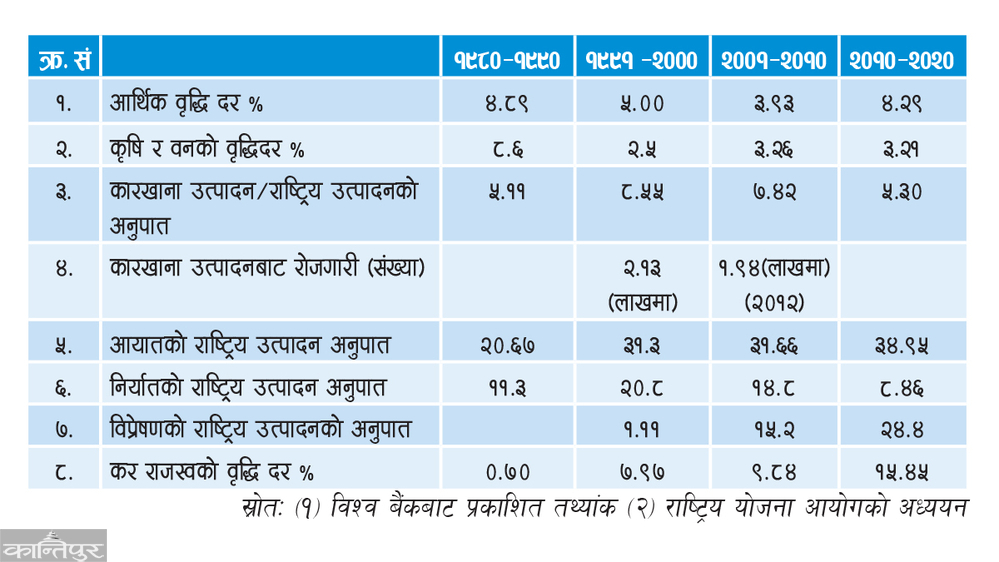
data, Nepal's average economic growth rate was around 5 percent between 1980-90 and 1990-2000. But the development of agriculture and forestry sectors was 8.6* percent till 1980-90, then the growth rate of Nepal's agriculture sector has decreased. The impact of the declining agricultural sector growth has been reflected in the increased import of agricultural produce. Today, Nepal is insecure in the food sector and has turned from an exporter of agricultural products to an importer.
Second, Nepal's industrialization process has stalled. The ratio of factory output/national income was 3.11 in the 1970s (1971-1980) and reached 5.11 in 1980-1990. Industrialization thus expanded but then declined and the contribution of factory production fell to the level of 30 years ago. Its impact has been seen in the employment available in factory production. Employment in factory production declined.
Thirdly, the effect of relaxation in agriculture and industry was seen in increasing imports and decreasing exports. In 1990, the import/GDP ratio was 20.6 percent and by 2020, it had increased to 34.9 percent. At that time, the percentage of exports decreased from 20 percent in the decade up to 1980 to 8.46 percent. The management of this imbalance of import and export piled on remittances available from the export of labor to various countries of the world.
Therefore, the ratio of remittances to national income rose from 1.11 in the 1990s to 24.4 percent in the 2010s. From this combination of import-export and remittances, the growth rate of revenue to the state increased from 0.70 percent in 1980 to 15.45 percent in 2010s and Nepal has become a new model of economy based on remittances and now it has emerged as a country that is insecure even for basic needs.
There was a good increase in revenue from imports supported by one-time remittances. But instead of making good use of it, wasteful spending and corruption increased. Now the revenue growth is not seen as before. Naturally, the country is falling into debt trap. The 'hypocrites' have yet to understand this.
is actually becoming established as a process of creating confusion among the public with the apparent difference between what the government says and what it does. Let's look at the 15th Five Year Plan. It was promoted with great fanfare. In the fifteenth plan, the economic growth rate was set at 10.5 percent, the agricultural growth rate was 5.5 percent, and the industrial growth rate was 13 percent.
Similarly, the revenue growth rate is projected to reach 30 percent by 2023/24 and foreign investment to reach 3 percent national productivity. The points on the basis of which such imaginations were made are now a matter of surprise. In the name of making plans, the practice of talking big and deceiving people was seen not only in politicians, but also in professional economists.
It was clear that the politicians had forgotten their scriptures. Planned development is limited to weeding. No one is responsible for the set goals. There is a complete lack of discipline at the government level for plan makers and plan implementation. Politics focuses on sharing power, wealth and position. Management reforms and capacity building have been finalized.
6 constitutions have been made in 70 years. There have been armed conflicts only twice and thousands of people have been martyred. The capacity of the country's ruling class as political lying herds has increased. But the rulers are failing to transform the political process for development.
The unannounced major task of running the country by sending the youth force abroad for the transformation of the country's economy is bringing the economic development of Nepal to the 'Sukulgunda' level. In other words, ``Sukulgunda'' looks very smart when it comes out, but there is nothing but Sukul to sleep inside the house. There is concern and disappointment that the country will go in that direction.
The agricultural sector is booming. Villages have started to become deserted. Food insecurity is increasing. The factory is closing down. The government is now worried about how to pay the salaries to the employees who said they will increase the revenue by 30 percent. Unable to pay the contractor. The corruption seen in education has crossed the limit. Higher education institutions in Nepal have reached the point of closing due to lack of students.
As soon as they pass Dus Joad 2, thousands of students are now leaving the country saying that there is no future for us in the country. There is no sign of stopping this process. The children of Nepal's ruling class are ahead of the curve when it comes to going abroad. Naturally, reforming education is no longer a priority for Nepal's policy makers after they are sure that their children will study abroad and have a future abroad.
If not, how to explain the anarchy of party-run student organizations? Instead of paying attention to such problems, the government is now forming a new commission on how to do good governance. Unfortunately, reports prepared to improve the sector, cut costs and leverage government investment have been put on hold. The government does not look at such reports, nor does it openly discuss it in the country. Now the Prime Minister himself is forming a new commission like a pilgrimage that has never happened.
Enemy of democracy
It is not difficult to make classical suggestions for economic development. There are no experts who give such suggestions. The prime minister's economic adviser is a former governor of the National Bank and finance minister. Similarly, there are many other such people within the structure of Nepal government. So the question here is not about expertise. The main condition is that the people focus on the foundation of politics for the economy to accelerate.
There are many examples of the government coming from the election bringing democracy and economy to the Aryaghat. There is hypocrisy in the country where corruption gets priority in practical politics but people get priority in theoretical interpretation. A new version of neo-feudalism, which destroys democracy in the name of democracy and pro-people economy, is oppressing the country.
means that there are many problems for development in the country today. But the main problem is the political dishonesty and hypocrisy that is developing in the name of democracy. As a solution to this, the fact that the current incumbents have nothing but police shootings and repression of the administration is a strong indicator of the coming crisis.
The people of Nepal have not said that the situation of the country should change overnight. But at least now, if the government that claims the support of the people in the country can create an atmosphere of hope and possibility in education, health, employment and productivity growth for the future, the people will be patient. But no matter how much tear gas and bullets are fired by the neo-feudalists who see people's patience as a highway for loot and corruption, the voice and anger of the people will not stop. Eventually change is inevitable. Those in power should quickly understand this fact.
– Former minister Lohani is the chairman of RPP Central Steering Committee.
*of agriculture and forestry The growth rate should be 8.6 percent, so it has been corrected. - Editor

