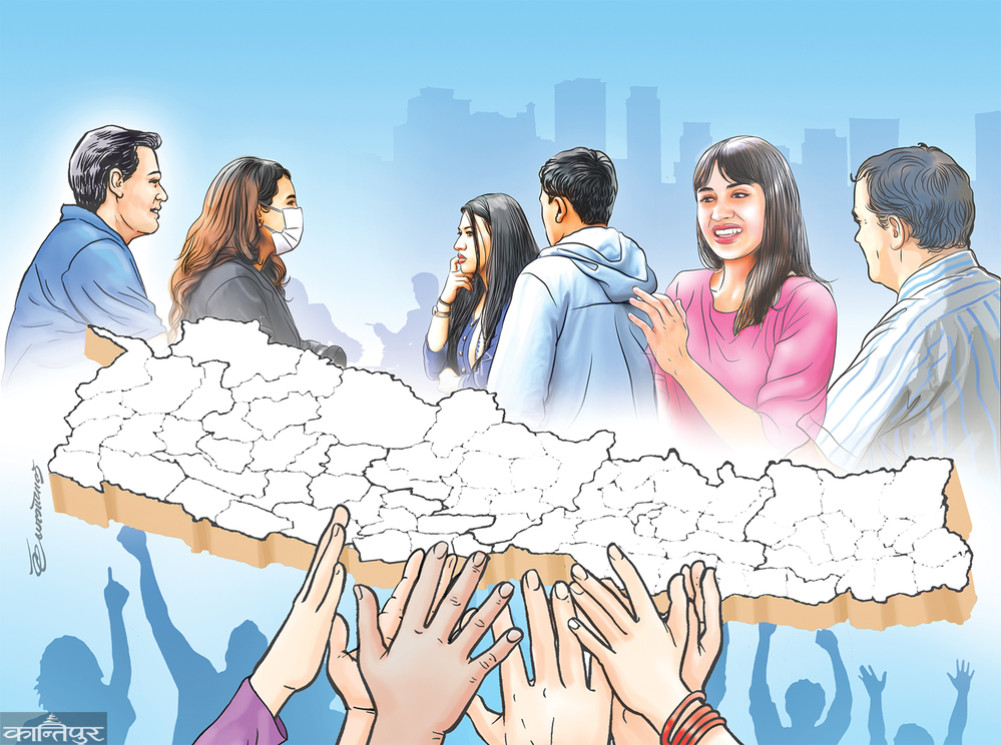
With the current complicated process discouraging many NRNs, the government should facilitate the citizenship process through a digital system and facilitate document verification.
We use Google Cloud Translation Services. Google requires we provide the following disclaimer relating to use of this service:
This service may contain translations powered by Google. Google disclaims all warranties related to the translations, expressed or implied, including any warranties of accuracy, reliability, and any implied warranties of merchantability, fitness for a particular purpose, and noninfringement.
Nepal is a country with immense potential to accept its citizens who are scattered around the world as important partners in nation building. Non-Resident Nepalis (NRNs) who have gone abroad in search of study, employment, business and new opportunities have made a significant contribution to establish Nepal's cultural, social and economic identity on the international stage. If their knowledge, skills, capital and extensive network can be used effectively and structurally, a revolutionary change can be brought about in the overall development of Nepal. However, to realize this potential, it is inevitable that the government of Nepal should take policy reforms, structural changes and practical steps.
Established in 2003, the Non-Resident Nepali Association (NRNA) is a common platform to unite the Nepali diaspora scattered around the world in a common thread. Currently active in more than 80 countries, this organization has become a symbol of social and cultural unity. It has been established as a powerful means of attachment and contribution to Nepal. The main objective of NRNA is to unite Nepalis from all over the world and provide solid support in the social, cultural, economic, educational and technological development of Nepal. In the past two decades, NRNA has been successful in strengthening the relationship between Nepal and the diaspora by contributing in various fields such as investment, disaster relief, cultural promotion and community development.
During this period, NRNA has completed works such as hydropower projects, construction of schools, health camps and relief distribution during natural disasters in Nepal's rural areas. These efforts have highlighted the potential of utilizing the resources and skills of NRNAs for the benefit of Nepal. Such activities demonstrate the social responsibility of NRNs and their commitment to Nepal, which can become the cornerstone of nation building.
constitutional and legal basis
Article 14 (1) of the Constitution of Nepal 2072 provides for the provision of citizenship with social, economic and cultural rights to non-resident Nepalis. This provision provides an opportunity for non-resident Nepali citizenship to people who have taken citizenship of a foreign country but are of Nepali origin. Which creates a legal basis to connect them with Nepal. Also, the Non-Resident Nepalese Act, 2064 and Regulations, 2066 have tried to ensure their citizenship, investment, institutional participation and rights.
However, there is a major challenge in the full implementation of these legal provisions. The non-resident citizenship process is extremely complicated and slow, which has discouraged many NRNs. Delays in obtaining citizenship, problems with document verification and administrative complications have hindered their contribution. Until such deficiencies are rectified, the potential contribution of NRNs may be overshadowed.
policies and programs
Point 139 of the Policy and Program of the Government of Nepal 2082/083 mentions the goal of enhancing the identity and respect of the country through cultural diplomacy to enhance the capacity and network of non-resident Nepalis. Similarly, Article 8.15 of the Foreign Policy, 2077 presents a strategy to mobilize the knowledge, skills, capital, technology and network of Nepali immigrants in economic development. These include plans to connect experts through 'Braingain Centre', cultural promotion, mobilization of diaspora in economic diplomacy and establishment of Nepali language training centre. While these policies look attractive on paper, there are serious weaknesses in implementation. Due to the effective operation of 'Braingain Center', the knowledge of experts from abroad has not been able to come to Nepal. There is a lack of adequate budget and structural coordination for cultural diplomacy and tourism promotion. NRNs want to see these policies implemented in practice, which will boost their confidence and participation.
contribution
Through NRNA, about 7 billion rupees worth of investment has been brought into Nepal so far. Non-resident Nepalis seem willing to make long-term investments in tourism, agriculture, hydropower, education and health sectors. For example, investments in small hydropower projects have expanded access to electricity in rural areas. However, due to unfavorable investment environment, many potentials have not been utilized. Investment protection, effective implementation of Double Taxation Agreements can encourage NRNs to invest more. Nepalis living abroad are established as academicians, scientists, technicians and researchers. Their knowledge and skills can be used in Nepal's education, research, technology and innovation. For example,
Technical field experts can be connected to Nepal's universities and research institutes to contribute to the development of technology. Effective operation of 'Braingain Center' can turn such a possibility into reality. But the government should come up with a solid plan and incentive package for this.
NRNs are active as cultural ambassadors of Nepal. They have promoted the art, culture and heritage of Nepal to the world by organizing language training centers, digital museums and cultural festivals. These activities have contributed greatly to the promotion of tourism. NRNs have also provided considerable support during natural calamities, epidemics or emergencies. Their exemplary contribution is to collect PPE, oxygen and medicines and send them to Nepal during the covid-19 epidemic and to distribute relief materials during earthquakes and floods. Strengthening this network will greatly help in disaster management.
unity convention
The recently concluded Ekta Congress has revealed the future of NRNA and the path of unity. This convention, which was held in Kathmandu on 20-22 Baisakh, 2082, resolved the long-standing dispute and laid the foundation for moving the organization in a new direction. Coordinator Dr. Sesha Ghale said that according to the Supreme Court's advice, the reform process will proceed on the basis of fairness. The new leadership elected by the convention will maintain unity in policy formulation and implementation and provide inspiration to NRNs to move forward as one. The recent judgment of the Supreme Court has paved the way for structural reform and transparency of NRNA. This judgment has resolved the long-standing dispute and laid the foundation for making the institution dispute-free and reliable. The new leadership elected by the convention will maintain unity in policy formulation and implementation and make NRNs more active in nation building. This decision and convention will establish NRNA as a more effective partner in Nepal's development.
policy expectations
The non-resident Nepalese association has expectations of policy and structural reforms from the Nepal government. If these expectations are met, their contribution will be more effective. It has been strongly recommended to the Government of Nepal to implement the Non-Resident Nepali Association (NRNA) identity card distribution program as soon as possible. The Constitution of Nepal provides citizenship to non-resident Nepalis with social, economic and cultural rights. However, various limitations are imposed on economic rights, which in some cases creates a sense of discrimination. Therefore, it seems necessary to review the legal system so that there is no such discrimination and ensure the full use of economic rights. In addition, even after the state has granted dual citizenship to non-resident Nepalis, the provision that those persons must obtain a visa to enter Nepal has created a legal contradiction. This arrangement has created traffic problems. Therefore, it seems necessary to amend the laws and regulations related to non-resident Nepalis to provide easy and orderly movement.
This program will ensure the identity and rights of NRNs as well as strengthen the emotional and legal ties that bind them to Nepal. Identity cards will play an important role in making their participation in nation building more effective and structured. The government should take immediate steps to make this process simple, transparent and fast, which will win their trust. NRNs have demanded to make the process of non-resident Nepali citizenship simple and fast. The current complicated process has discouraged many NRNs. The government should facilitate the citizenship process through a digital system and assist in document verification. Equally important is the demand for a safe environment for
investments. The government should introduce the Investment Protection Act and implement the investment guarantee and double tax exemption agreements. Effective implementation of 'One Window Policy' will facilitate the investment process and encourage NRNs to invest in Nepal. NRNs have demanded to make the 'Braingain Center' effective to transfer their knowledge and skills to Nepal. The government should conduct a special program to connect expert NRNs to Nepal's universities, research institutes and the private sector. Incentive packages, tax exemptions and housing facilities can attract them. NRNA expects structural coordination with the government. "NRNA Government Strategic Council" should be formed and coordinated in policy formulation, investment cooperation and knowledge transfer. Such a council would institutionalize cooperation between the NRN and the government and ensure their participation in policy decisions. The demand for 'Global Nepal e-Platform' highlights the need to have a database of expertise, investment capacity and experience of NRNs. This digital platform will help the NRNs to systematically mobilize for the development of Nepal. The government should invest in technology and make this platform operational as soon as possible. How to deploy
?
Nepal should adopt a solid strategy to mobilize NRNs effectively in nation building. Government should make investment friendly policy and encourage NRNs to invest in tourism, hydropower, agriculture, health and education. For example, tax breaks, investment opportunities in special economic zones and priority projects may attract them. The technical and educational expertise of NRNs should be linked to Nepal's universities, research centers and startups. Their skills can be mobilized by conducting schemes like 'NRN Expertise Exchange Programme'. This program can contribute to the technological development of Nepal by engaging experts in short-term projects.
NRNs can be mobilized as cultural and tourism ambassadors of Nepal. The government can organize international cultural festivals, tourism fairs and digital art exhibitions in collaboration with NRN. Such activities will make Nepal's cultural heritage known to the world and boost the tourism industry. Structural mechanisms should be created to involve NRNs in disaster management and relief work. By establishing 'NRN Disaster Response Network', their network can be mobilized during natural calamities, epidemics and humanitarian crises. This network can play a major role in the collection, distribution and coordination of relief materials. Government should create a mechanism like 'Diaspora Development Board' for regular dialogue and coordination with NRN. This board will include NRNs in national policy, planning and development projects. The Board can organize annual conferences, workshops and dialogue programs to use their suggestions and resources for policy.
Conclusion
Non-resident Nepalis are important partners in Nepal's pride and prosperity. They are contributing to the development of the country as well as increasing the recognition and respect of Nepal around the world. However, this power should not be limited to emotional relationships but should be made an integral part of nation building structurally, legally and politically. The government should make a solid strategy to mobilize NRNs in nation building while meeting the policy expectations of NRNs. Nepal's dream of becoming a prosperous and self-sufficient nation will come true if NRNs are involved in investment-friendly environment, knowledge transfer, cultural promotion and disaster management. Steps like Ekta Congress, Supreme Court judgment and distribution of NRNA identity cards will make this golden opportunity a reality. The collaboration between NRNA and the government will make Nepal a stronger, prosperous and independent nation on the world stage.
Finally, the government should pay immediate attention to these reforms and embrace NRNs as partners in nation building. If their resources, skills and networks are not utilized, Nepal may miss a great opportunity for its development. Hence, the need of the day is to prioritize collaboration with NRNs from policy formulation to implementation.