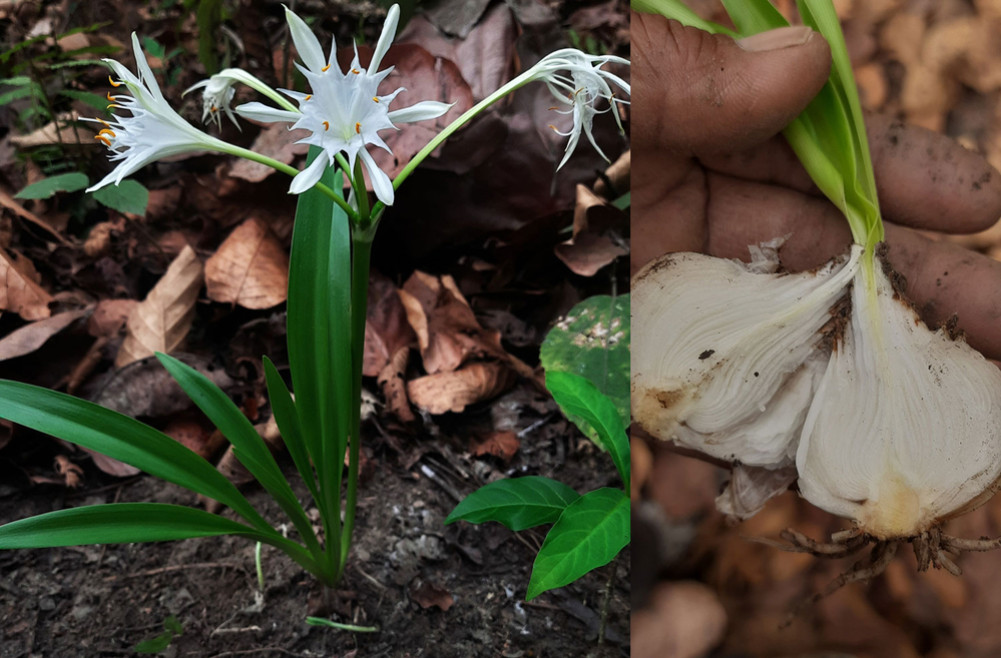
The flowers and leaves of Pancratium triflorum are different from onion. The shape of the underground fungus is like a chopped onion except for the color. When cut, the inner part is like an onion but a little thin. And one plant has 3 flowers.
We use Google Cloud Translation Services. Google requires we provide the following disclaimer relating to use of this service:
This service may contain translations powered by Google. Google disclaims all warranties related to the translations, expressed or implied, including any warranties of accuracy, reliability, and any implied warranties of merchantability, fitness for a particular purpose, and noninfringement.
In the month of Baisakh, we walked for 4-5 hours in the Charkose forest of Sunsari district. The purpose of this trip was to take pictures of flowers and fruits of plants and to collect samples if new species were found.
This time I saw two species of plants blooming that I had never seen before. Collected specimens - one of which was a wavy plant hanging 8-10 feet from a safflower tree that exuded a milky sap. After studying it, it came to know that its scientific name is 'Diskidia bengalensis'.
This species has been published in 2016 by Praveen Bhandari and Krishna Kumar Shrestha for the first time in Nepal from Kaski. In Kaski it is called 'Aunele Hadchur'.
Another plant with attractive white flowers blooming on the ground, smelling a lot, locals call it 'forest onion' is new to Nepal. I have sent this information to be published in a journal for scientific records.
What is Onepage?
The plant family related to onion is 'Amaryllidaceae'. There are 71 genera and about 1,600 species under this plant family. Most of the species in the 'Amaryllidaceae' family have underground stems that are transformed into rhododendrons. A book titled 'Plants of Nepal' by Krishna Kumar Shrestha and others lists 4 genera and 17 species under Amaryllidaceae family (2022, p.130-132). Onion is a plant under the genus Pancratium. About 2 dozen species have been found around the world. One of the species 'Pancratium Verekunm' is listed in the botanical list of Nepal.
The species that blooms white in the month of Baisakh in the forest of Sunsari is 'Pancratium triflorum'. While looking at the research history of this plant, William Roxburgh collected a specimen from the Coromandel coast of Tamil Nadu province in India and named it scientifically.
The first book in which 'Pancratium triflorum' was published is in Flora Indica Vol. 2 (c. 1832, p. 126) by William Roxburgh. Roxburgh is known as the father of Indian botany as he was the first to write a book on the flora of India. On the other hand, in Nepal, Bukhanan Hamilton is called the father of Nepal's botany. Because he started the scientific study of plants in Nepal in 1802.
Plants of the genus Pancratium have an underground tuber or bulb, which lives for several years. Although the song is in the ground, it is not a root but an underground stem. Leaves and flowers will come out from that song in the month of Chait-Vaisakh. The adjective 'Cynanthus' is used to denote the simultaneous growth of leaves and flowers from the stem.
The flowers and leaves of Pancratium triflorum are different from onion. The shape of the underground fungus is like a chopped onion except for the color. When cut, the inner part is like an onion but a little thin. And one plant has 3 flowers. The
was observed to bloom first at the tip. The remaining two tip flowers are blooming when they start to fade. In very few, 4-5 flowers were also seen. The flower is large, attractive, the flower blooms first at the tip, the leaves are spear-like, the root grows from the bulb, and the plant is included in the genus Pancratium under the Amaryllidaceae family.
In Latin, tri means three and 'florum' means flower. Based on this, the name of this species was kept as 'Pancratium triflorum'.
emergence and expansion
'Pancratium' plants are found in most countries of Africa. The plants of this species are found in Europe, Greece, Italy, Spain, Portugal, Yugoslavia, West Asia/Southwest, Asia/Midwestern countries including Oman, Yemen, Saudi Arabia, South Asia and some Southeast, some Asian countries. The plant spreads from Southeast Asia and rarely reaches African countries. An example of this is the Japanese persimmon plant, which is widely planted in Kathmandu. The Japanese persimmon belongs to the diaspiros family of plants.
evolution is believed to have occurred in Southeast Asia. Its fossils have been found in Africa. From here, this plant must have reached Africa a few million or millions of years ago. It is believed that the plant of the genus Pancratium developed in South Africa or the Mediterranean region (Southern Europe, Northern Africa and Western Asia). It is estimated that the flora of this species evolved 3 to 50 million years ago.
According to the 'Plate Tectonics Theory', 50 million years ago, the South Asian landmass started to collide with the Tibetan landmass as it flowed from the south. In that sequence the Himalayas and Mahabharata ranges arose. They were tall only one and a half/two million years ago.
Most of the species of the genus Pancratium are found in some cooler and open forest areas with sand. 'Pancratium triflorum' was in the mixed forest of Kumarakhat community forest located in Ramdhuni municipality-7 of Sunsari district. The dump was about 30 to 40 meters west of the river.
Probably, the same river used to flow there until a few hundred years ago. Nowadays, where the trees are thinned and the bushes are less, they were growing sporadically in an area of 50 square meters. Its attractive flowers are visible from afar. The size of the flower was about 10 cm in diameter. When you get closer, you can easily feel that it emits a lovely scent.
From forest to garden
The last ice age on Earth ended about 11,500 years ago. Then the atmosphere became warmer. The vegetation started to grow well because of the warmth. Humans began to move from a nomadic lifestyle to permanent residence.
They abandoned the hunting and gathering lifestyle and started agriculture. At about the same time, wheat and legumes began to be cultivated in West Asia, corn in Central and South America, and rice in the Yangtze River Valley (Yunnan, Sichuan) in China. In Egypt, Mesopotamia, Greece, Rome and China, people started planting medicinal plants about 8-10 thousand years ago.
Wild flowers were first planted at home in Egypt. Those wild flowers were gradually transformed into domesticated flowers. Flowers were widely planted in monasteries in the 5th–15th centuries. Gardens were widely established in Europe in the 16th–18th centuries. During that time, beautiful flowering plants from all over the world were collected from the wild and brought to Europe. From the 19th century, flowers began to be planted in households. But there is still work to be done to transport rare plants from the forest to the garden.
Pancratium triflorum is one of them. The Europeans probably did not pay attention to this plant because it cannot survive in the cold. Because its flowers are very soft, it is not possible to make a bunch of flowers by picking them. Another thing is that this plant, where it is found, is so rare that it must have escaped the attention of florists. However, it is suitable for indoor planting as a flower. For this, first attention should be paid to its seed production.
Researchers have found 'alkaloids' with anti-cancer, anti-viral and anti-bacterial properties in some species of plants under the genus Pancratium. Pancreatium triflorum also contains alkaloids with medicinal properties. It was known that 'Pancreatium triflorum' is found only in India and Bangladesh till today. 193 years after this plant was found in India, it was confirmed to be found in Nepal. Now what is its importance, it is necessary to study.