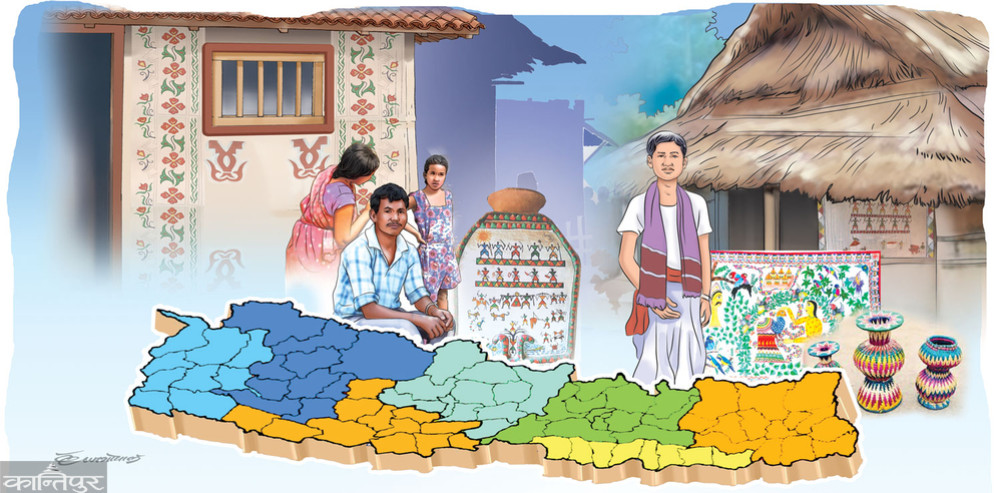
Although federalism has brought with it the dream of inclusive identity and prosperity, have the state apparatus and political leadership been able to resolve the conflict of priorities of losing heritage in the pursuit of modernity and overriding accountability in the name of prosperity?
We use Google Cloud Translation Services. Google requires we provide the following disclaimer relating to use of this service:
This service may contain translations powered by Google. Google disclaims all warranties related to the translations, expressed or implied, including any warranties of accuracy, reliability, and any implied warranties of merchantability, fitness for a particular purpose, and noninfringement.
Nepal's federalism is not just a sheet of paper or a collection of political slogans. It is a living story born out of decades of struggle against a centralized state with its search for identity and expectations of dignity. The constitution made in 2072 opened the door to a new era by envisaging a state structure with a union, seven provinces and 753 local levels and decentralized power.
This structure was not just a reorganization of governance. It was a promise to give a platform to long-neglected voices. Through this, the power could go out from the dome of Kathmandu and reach the mountains of Karnali, the mountains of Far West, the plains of Madhesh, the fields of Lumbini, the villages of Gandaki and the corners of Koshi. It was a dream where Raute, Tharu, Madheshi, Limbu, Chaudhary, Gurung, Dalit etc. could paint their language, art and story on the canvas of the nation.
These communities could resist the monocultural image imposed by the unitary state. But, in the journey of a decade of federalism, a deep question arises, has this dream come true? Why is there such a big gap between heritage protection and the race for prosperity? That is, have we managed the pace of modernity while preserving our rich heritage, or are we risking losing our souls in the race for prosperity? Various stories spread from the mountains of Karnali to the Terai of Madhesh have forced us to ask these questions.
Karnali, where the peace of Buddha and the mysterious light of Bon Dharma blend in the arms of the mountains. It is a vivid picture of Nepal's cultural heritage. The Raute community here leads a nomadic life in the bosom of the forest. They are not just characters in Karnali's history, they are history itself. The 'Theki' and 'Madal' made by them are not only useful items but also heritage of cultural memory passed down from generation to generation.
Federalism has given such communities the opportunity to preserve their identity. However, the population of the Raute community is decreasing. Their itinerant lifestyle is struggling to keep up with modernity. The Khas language of the Sinja Valley is still alive in Jumla, but it has not been linked to livelihood. Some local levels like Tatopani and Sinja Rural Municipality have started trying to tell folktales and stories of Khas civilization in local schools in order to preserve Khas culture.
This initiative of the local government is to make the new generation understand their roots and maintain cultural continuity. Due to lack of teaching materials, teacher training and budget, such activities have not been regularised. In some schools, teachers tell these stories on their own initiative.
Local leaders organize a cultural festival for the renaissance of a special language and culture. Khasan dances and Deuda songs resound in these festivals, but the youth here are fleeing from Thatathalo in search of employment and other opportunities. A local teacher said, 'Culture is our soul, but our children also need bread.'
This statement is not only from Karnali. Local initiatives have not been effective due to lack of systematic policies and resources. Farmers here demand irrigation and roads to transport their apple crops to the market. We got the slogan to preserve the culture, but why is the effort of the farmers going to waste if Jumla apples do not get the market?
The Tharu community in Kailali in Far West has brought their Ashtimaki painting to the market. This art is not only their spiritual expression. It is also becoming a symbol of economic potential. However, while the same Tharu community is disproportionately afflicted with sickle cell anemia, the local government is mired in lack of budget and planning.
These scenes show that federalism opened the door to identity, but who will take the responsibility of creating a path to prosperity? Mithila painting of Madhesh province is becoming known in the world market. Local women have made this art a means of livelihood. But they lack training and market access.
Leaders here talk about Madhesi pride while celebrating 'Dhoti Diwas' but their manifesto also has a dream of creating jobs for one million people. To fulfill this dream, agricultural innovation and industry are needed, which are not in the priority of the local and state governments, the federal government is still far away.
The Kirat community of Koshi tries to protect its Sakela and Yakthung, but its youth are migrating abroad in search of employment. It is the gap between cultural preservation and lack of economic opportunity, which is not a comparison but two sides of the same coin. The Tharu community sings their Horiya song at Dang in Lumbini region. But their fields lack irrigation. Gurungs celebrate Tamu Lhosar in Gandaki's Lamjung, but their village lacks a health post. These stories reveal one truth, it is not enough to preserve identity, it must be linked to prosperity.
This journey of federalism was not only political, it was born out of the search for respect against humanity. For a long time, Kathmandu's Nepali-speaking, Hindu elite wrote the nation's story, and the rest of the communities were alienated in their own land. The Constitution promised to correct this mistake. In the Tharu-dominated local level of Sudurpaschim Province, Tharu, Bhat and Khas schools in Mugum Karmarong Rural Municipality of Karnali have been taught in Nepali language, Magar Kham language has been started in Sunchahari Rural Municipality of Lumbini Province. Research shows that children learn faster in their mother tongue. However, parents here demand an English-medium school. They understand that
English brings opportunities. The Buddhist community at Humla in Karnali wants to preserve the Lama dance and the Mane Chakra, but they also need roads and electricity. In Madhesh province, the 'Beti Padhau, Beti Bachau' program made a dream of educating girls. But the program could not be continued due to mismanagement such as misuse of budget and lack of priorities.
This kind of tension raises a question that, even though federalism has come with the dream of inclusive identity and prosperity, have the state apparatus and political leadership been able to resolve the conflict of priorities of losing heritage in the pursuit of modernity and overshadowing accountability in the name of prosperity?
Federal government reluctance has compounded these challenges. It is a story of union apathy towards decentralization of constitutional rights and unequal distribution of resources. Due to the reluctance of the center, the creation of urgent laws is also being delayed. The constitution gave the provincial and local levels the right to education, health, culture, etc. But why didn't Kathmandu leave the budget and policy control in those areas? In Humla of Karnali there is a matter of cultural preservation but the budget is not enough to build a road.
There is a slogan of women's empowerment in Madhesh, but why is there no policy to encourage Mithila art? Why is the limited budget allocated for cultural preservation in Koshi, Lumbini and Gandaki always cut? At the core of these questions, the constitutional promise to share power and resources should be turned into results. To fulfill the dream of federalism, Kathmandu should share power and the provinces should be able to use it.
The biggest challenge in this gap is the balance of wealth and prosperity. Villages near the She-Foksundo National Park in Dolpa, Karnali, have embraced the tourism business to preserve the ancient monastery. They have made the monastery not only a spiritual center but also a source of economic opportunity.
Tharu Homestay in Bardiya, Lumbini region offers both cultural experience and financial benefits. Madhesh's Mithila art has the potential to change the lives of local women while making its mark in the global market. Gurung villages in Lamjung of Gandaki are earning income from cultural tourism. These small efforts have conveyed the message that wealth and prosperity can go hand in hand. However, the Huthuti political leadership is not seen to turn these efforts into a nationwide strategy.
Then where is the next departure? First, let us find a clear account of our federalism journey and practice. The architects of federalism sold it only as a cure for exclusion, but it is not a separate magic wand. Cultural heritage is not saved by sentiment alone, it requires money and strategy. Provinces should think bigger, rise above the tradition of spending budgets on organizing a festival in the name of cultural preservation. For example, cultural tourism can support schools and clinics through performances of Sakela and Tharu dance or Thakali cuisine.
In the same way, training centers can be made to employ local people to spread Mithila art, which has the potential of the world market. Secondly, education should become a bridge to wealth and prosperity. Language is heritage. The discussion of teaching and learning should be through language. In order to increase cultural confidence, children's education should be in their own language and should be combined with Nepali and English. So that they become competitive in global opportunities.
For example, a system of teaching science, mathematics, social studies in Tharu language but teaching computer coding in English can connect them to both their floor and future. In schools in Karnali, cultural pride can be taught to children by including Khas and Bhot languages according to the local society. Also, they can be engaged in innovation in apple cultivation and animal husbandry by teaching them digital literacy and agricultural technology.
In Madhesh, by learning the history of Mithila art in the local languages like Maithili, Bhojpuri, Awadhi, as well as design software, they can become competitive in the world market. Sakela dance can be turned into an economic asset by teaching Limbu children literature in the Yakthung language as well as tourism management. Thus, according to the locality, traditional knowledge can be paralleled with modern skills.
This system keeps heritage alive and opens the door to prosperity. Third, the budget should be reconsidered so that resources are distributed to projects such as Limbuwan Cultural Center becoming a vocational school.
Federalism has provided an opportunity to weave our heritage into progress. A Tharu youth from the Far West told me, “My art is my soul, but I need a job for livelihood.” A woman from Madhesh added, “Mithila art is my soul, but my children need school.” These voices do not conflict, they are the colors of our common dreams. If we get this balance right, Nepal can fly towards the future while remembering its past. This is not possible without state accountability.
– is a researcher from Democracy Resource Center Nepal.