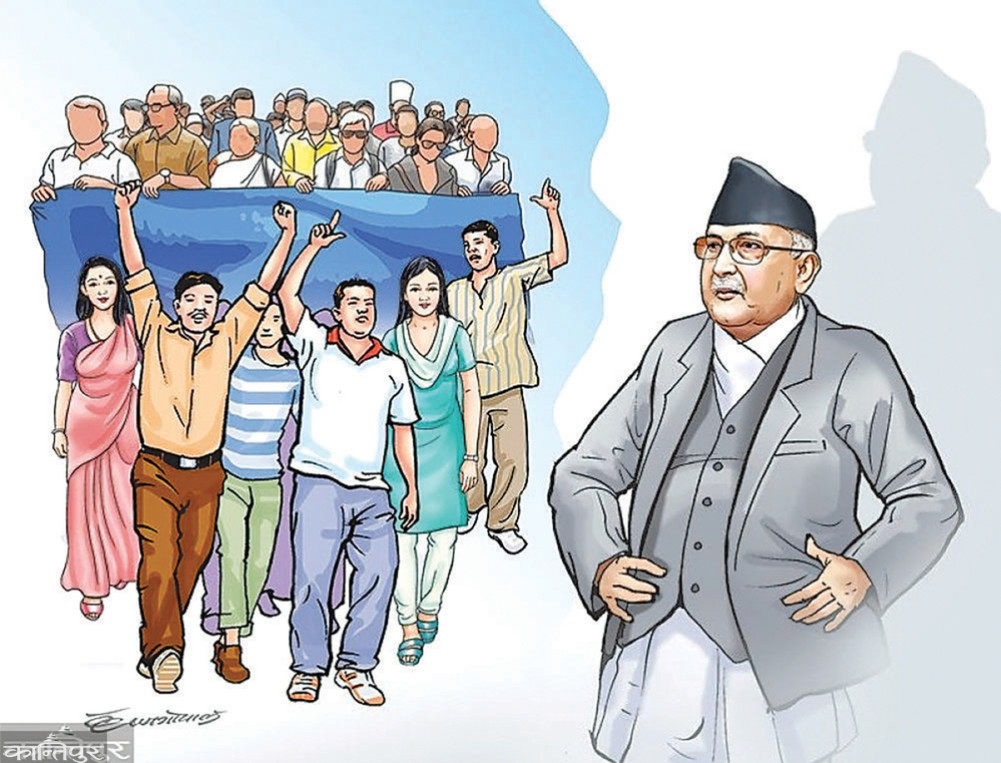
After the people's movement, the country got bogged down in the formulation of the constitution, after the promulgation of the constitution, the whole country focused on earthquakes, blockades, epidemics, overthrowing/establishing power, and the agenda of solid development was lost.
We use Google Cloud Translation Services. Google requires we provide the following disclaimer relating to use of this service:
This service may contain translations powered by Google. Google disclaims all warranties related to the translations, expressed or implied, including any warranties of accuracy, reliability, and any implied warranties of merchantability, fitness for a particular purpose, and noninfringement.
Most of the managerial goals, rights and systems sought by the Nepali people under the politics and political agenda of Nepal have been obtained from the latest constitution. In a short period of time, there were movements in Nepal, these movements brought changes in the political system and system of Nepal. In the past, there was a common belief among the political parties of Nepal - due to the wrong political system, we were lagging behind in the competition with the world.
If there is a political system as desired, we will also enter the stage of prosperity and development. On the strength of the people's movement of 2062/63, we brought the system we wanted. The constitution written by the representatives of the people is also active now. It has been 20 years since the people's movement. It has been 10 years since the new constitution came into force. However, looking back towards economic development and progress, there are no grounds for much excitement.
After 2047 to the present, nothing has happened. There have been positive changes in the indicators of the economy. In 2047, Nepal entered an open economy from a closed economy. The average annual economic growth rate in recent decades has been above 4 percent. The poverty rate fell from 42 percent in 2052 to 20 percent in 2080. According to World Bank data, extreme poverty has fallen from 55 percent to 0.37 percent. Which is a historical achievement in South Asia. Significant progress has been made in many development indicators including road network, communication and access of citizens to banking services. But we must ask – is this the maximum progress we can make? Or is it just a result of natural continuity? When we think about what we did, we should also look back at what we could have done and where we went wrong.
In 2023, more than 1.6 million Nepalese left the country, the Immigration Department has released. For foreign employment alone, 7 lakh 71 thousand and 7 lakh 41 thousand youths left in the financial year 2079/80 and 741 thousand in 2080/81 with work permits. According to the data of the Customs Department, Nepal has suffered a trade loss of 8 trillion 61 billion 38 million rupees in the 7 months of the current financial year. According to the data of the World Bank, the per capita income of Nepal in 2047 was 185 dollars, but today it has reached 1400 dollars. But in the same period, Singapore's per capita income increased by 74 thousand US dollars and reached around 85 thousand.
We need to seriously analyze these data. As we come to this point, we cannot and must not go back to political agendas and struggles. From our grandfathers to our grandchildren, we have struggled for political change. How many more struggle with similar things? The next struggle should be for economic progress and development.
Even if the government is formed or collapsed, a party loses or wins the election, no matter which political party comes to power, we need the common opinion, determination and commitment of all the parties to achieve the goal we have set. To address those who criticize that the current system is bad, people should feel the pleasant change brought by this system, that too within 10 years.
Had such a commitment been made immediately after 2062-63, the current environment would have been different. Even if it had been done after the promulgation of the constitution, now our discussion, thinking and approach would have been towards development. After the people's movement, we got confused in the constitution as a formula. After the promulgation of the constitution, the whole country was confused about earthquakes, blockades, epidemics, overthrowing power, etc. And the development agenda is lost.
development and development infrastructure are two different subjects. Our current focus is on preparing the infrastructure for development. Considering some projects as more important, they have been listed in the 'National Pride'. Thus the completion date of listed projects often slips. There are 82 percent of the projects that could not be completed within the stipulated time. In the financial year 2080/81, 17 projects of national pride were supposed to be completed, but only three of them were completed. The reasons for this have been identified. But the work for the solution has not been done.
There are problems with the criteria such as lack of coordination between inter-agency, inter-level, compensation issues are not resolved, the needs of the country are not taken into account when selecting projects, the lahad of the minister-prime minister is given priority, even in the selection of construction companies, the most qualified is 'accepting the lowest cost'. Projects have been stalled even though they have promised to take the contract with a low budget. Now our focus should also be on 'quality and completion of projects on time'. The goal of
is to prepare infrastructures for development, increase production based on those foundations and increase the country's income. The goal is clear. The process is fine. But the implementation of this process is most disappointing. Now we have nothing to call our own. We are also dependent on agricultural products. Regarding exports, we are now unable to produce agricultural products even for ourselves. Currently, the country is developed mainly by exporting semi-skilled and unskilled workers. In the last fiscal year, 14.5 billion remittances were received.
This 14 and a half billion has become the basic foundation of Nepali economy. "How can a country be built by sending all the youth abroad?" is prevalent in Nepali society. In this era of globalization, people go to new destinations in search of opportunities. There is a need for some revision in the debate about not being sent for foreign employment. More importantly, how much do Nepalese workers earn on average abroad? is to say Most of the workers going to the Gulf, Malaysia are unskilled, semi-skilled. There is no need to do much, if we can send at least skilled workers abroad, there can be a big change in this figure of remittance inflow. An unskilled worker goes to Gulf, Malaysia and earns 40/45 thousand while a skilled worker can easily earn 1.5 lakh per month. As many Nepalese workers have gone abroad today, if all of them were skilled, 45/50 billion remittances would have entered Nepal. This is not a matter of wild imagination. It is possible. What is needed is a shared political commitment. But the attention of major leaders has not gone beyond being prime minister. When there is a problem in the country, instead of going to the root of the problem and solving it, the tendency to procrastinate has prevailed.
One of the reasons for the current economic recession was the provision of subsidized loans to businessmen to pay their debts during the pandemic. Which increased the burden of debt. Production could not increase. Business did not increase. As a result, even those who are doing business properly could not pay the bank installments. Now there is a lot of liquidity in the bank, there are no people to take loans. A loan-to-pay policy was a tad too much, not an appropriate solution to the crisis.
After forming a new government, each prime minister calls the heads of subordinate agencies. And he recites a list of things to be done. Then give instructions. In fact, the biggest problem is the direction itself. The Prime Minister should run to fulfill the goals decided by the nation. And the system is forced to move. If the Prime Minister starts walking on his own, the system sits, then sleeps. Now our system is sleeping. No one is afraid of this sleeping system.
We have been reading that hydropower, agriculture and tourism are the potential areas of our country. We have been conveying the same idea. Due to some general policy reforms in hydropower, now Nepal's hydropower production has increased somewhat. In winter, electricity has to be imported. Therefore, there is no point in saying that hydropower production has increased. Some recent studies report that there is a potential for hydropower generation up to 72/73 thousand MW. There is a possibility, but the trouble and confusion faced by those who invest for the product is worse than that. Investors are tired of land acquisition, roundabouts required to cut even one tree, time taken to reach the file from one agency to another agency etc. Until 20 years ago, 36 percent of the area was covered by forests. Now 45 percent forest area. But timber is also being imported from Malaysia. Just as crops can be harvested season after season, forests can be harvested regularly. This is what Scientific Forest Management is all about. If we consider this fact and make policy reforms, the wood that will reach us is with us. When Krishna Prasad Bhattarai was the Prime Minister, he used to say that 'Nepal should have a hydropower revolution'. Unfortunately, violence in Nepal is understood as a revolution. Leaders limited the talk of revolutionizing development to speech.
Now a large part of the country's budget is spent abroad for fuel imports. In the financial year 2080/81, petroleum products accounted for 18.87 percent of the total import of 15 billion 92 billion rupees. That is, in the financial year 2080/81, there is a data of Trade and Export Promotion Center that imported petroleum products worth 3.54 billion rupees. Therefore, policies should be adopted to promote the use of electric vehicles widely to curb fuel procurement. The fact that Dailekh contains petroleum products has recently been discovered through a long search and research with the help of Nepalese government and Chinese technicians. Similarly, feasibility studies have been conducted in more than a dozen other places in Nepal. But the state has no intention of using it.
Everest, Lumbini and Pashupatinath. These three are the destinations of Nepal, which can take Nepal's tourism to new heights. People from all over the world are ready to come to see Everest or our Himalayas. However, it is safe to reach the Himalayas. How many of us Nepalis have personally seen Mount Everest? More than half of the population lives in Terai-Madhesh. That population has not reached the mountains. Because getting there is difficult and risky. Thailand, with a population of seven million, will bring in three million and five million tourists in 2024. For us, two million tourists have become like a dream. There are 100 million Hindus in India. 60/70 crores are capable of doing pilgrimage. If only half percent of that population Indian tourists come to Nepal, our GDP can jump. There was no policy or concrete program to attract tourists from Southeast Asia, including China and Japan, which have a significant population of Buddhists.
Only talk of agricultural revolution happened. Policies, investments and programs to use the land for 12 months were formalized. It is the current reality that the real farmer should always remain oppressed, the comfort of those who have access to agricultural subsidies. There is a difference in the speech and behavior of even the political leaders who speak loudly in favor of agriculture or farmers.
We cannot proceed simply by presenting a list of problems. If we are not able to do concrete work to break the frustration prevalent among the people, then the people's trust in the political achievements can be broken. Our dreams will remain as dreams again.
– Karna is a member of the Constituent Assembly and a Congress leader.