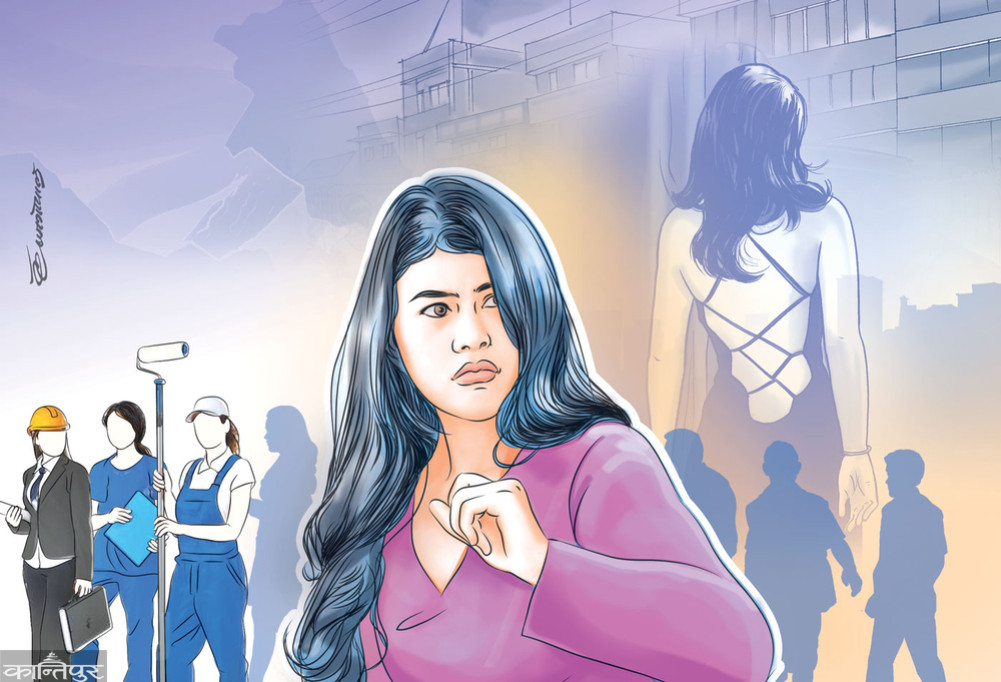
Sex work is hazardous forced labor. Will it be properly managed and gradually given options to the workers, or will it be pushed towards the stick, ethics and 'red light' license?
We use Google Cloud Translation Services. Google requires we provide the following disclaimer relating to use of this service:
This service may contain translations powered by Google. Google disclaims all warranties related to the translations, expressed or implied, including any warranties of accuracy, reliability, and any implied warranties of merchantability, fitness for a particular purpose, and noninfringement.
One of the few labors that generate uninterrupted profits is sex labor. And touching the bottom of society's understanding of sexuality is sex work. Sex work is also used to create misleading concepts such as ethical and unethical about labor. In this sense, the interrelationship between sexual labor for human livelihood, individual's sexuality, society's consciousness and socio-cultural morality, as the famous anthropologist Laura Maria Augustine said, is very complex.
Complexity is also evident when analyzing the later studies she has done, including forced labor, sexuality and gender discrimination in the context of the European capitalist labor market within the framework of her feminist trend.
This article is not a review of his research. Rather, my research with migrant sex worker women, my objections to Nepali society's understanding of sexuality, and the comments made by some parliamentarians about sex work in the recent parliament. What Laura says is an attempt to dig into the ground of complexity.
Also, the comments made by some MPs in the Parliament are not new for Nepali society. The latest scenes and comments seen and heard in Parliament are the latest in a wave of understanding of sexuality that has been surfacing sporadically for three decades. Such chains are coordinated and led by the class, which considers itself conscious, 'civilized' and 'moral'. The example of three decades is taken here in the sense that the political change of 2046 brought freedom of expression. An open economy along with the political system has created a situation where an adult can make an informed choice of labor for the sake of his livelihood. The latest version of the capitalist system was restored in 2046 and the pace of the market-oriented economy advanced rapidly. As the opportunities for labor migration increased, so did the challenges. As a result of political changes and the disparity between seasonal employment opportunities, employment opportunities became increasingly narrow. As a result, internal, cross-border and international labor migration became the basis of daily subsistence.
And sex work is also marketed as forced labor within the variety of jobs available to migrant workers away from home. Compulsive in the sense that, according to most sex workers, they use sex work as a last resort because of lack of other options or because of labor market brokering syndicates. By doing sex work, they have continued the education of their children. He has raised the expenses of his sick husband and elderly parents. Some people have ended their violent marriages because they could not bear the domestic violence. Others are learning skills needed for labor. On the one hand,
was a blueprint for political equality, but it was for political purposes. Discrimination, violence and abuse on the basis of socio-cultural identity such as gender, caste, class, geography, etc. experienced on a daily basis could not be properly addressed. On the other hand, the role of communication developed over time and easy technology broadened the consciousness of the society, and the access of the common people to employment opportunities in the open market outside the home/village available in the political system had an impact on livelihood options. The traditionally silent voices against
s and multiple discrimination began to resonate as resistance. Among these many, the suffocated voices against gender discrimination are no longer confined to the home. Illusion of fate, especially young women have entered the labor market in order to escape from gender-complicated discrimination and violence in the family, unequal marriages, and sexual violence within the family. Therefore, it is natural to start adopting a livelihood strategy for yourself, your children and the entire family.
Sex work is one of the labors provided by the political system that adjusts the broader labor market over time. Millions of women, men and sexual minority workers support themselves and their families. Laura Maria Augustine as well as studies in the world have confirmed that sex work is more women who choose to or have no choice but to keep the economy running for themselves, their children and the entire family.
The evidence that this is itself the result of a structural error from a gender point of view is enough to understand the relative character of patriarchy in all societies in the form of angeru. Whether it is a feudal patriarchy rooted in the shell of a capitalist political system like ours or a corporate patriarchy protected by extreme capitalism. The form of toxicity may be different but the complexity of attitudes towards female sexuality is the same, as Laura Maria Augustine points out.
It is on this ground that we have to understand the series that shake Nepali society from time to time. For decades, political leaders and social leaders have unwittingly made anti-labor statements regarding sex workers. They represent the culture of Nepali patriarchy that attacks women's sexuality. There is no sign of a positive change in this culture right now. Because it is not limited to parties and individuals. The differential character is embedded in the structure of the state.
, the latest example of which can be understood from the fact that during the preparation of the report of the United Nations Convention against Violence against Women by sex workers and gender minority communities, the reporter did not include the suggestions given by the sex workers network of South Asia in his report and did not even allow them to present their views at the Geneva meeting. However, as mentioned above, due to information technology and awareness, sex workers and labor rights activists advocating for their rights have become so organized that they have begun to challenge such phenomena. The latest confirmation of their organized voice is the intervention from last year's World Social Forum in Kathmandu to the Geneva meeting of the United Nations a few months ago.
The question of who, where, what labor, for what and how did it make no sense. Any labor that is done, wherever, under whatever circumstances, is done for the purpose of earning a living. But when it comes to sex work, why does it make waves in the society? Behind this lie some confusions of theoretical and socio-cultural importance. These aspects are found in all societies.
questions are only found to be related to their understanding and intention to address. And understanding is connected to the surface of consciousness. But in a prejudiced society like ours, it is not difficult to say that the intention is more tied to the intention than the consciousness of the individual. Sex work is one of the dimensions of the fundamental right to live through a strategy of earning a living using the possibilities available in a liberal market protected by a democratic order. Which the workers did not bring by wanting, choosing, looking for. Rather, he has been corrupted by the political system in which he stands. Be it a socialist system or a capitalist system of all natures, after all, political processes and decisions are driven by the patriarchy inherent in that society. Therefore, the market naturally operates according to the decisions of the patriarchy of that society and remains under control.
It is necessary for us to theoretically understand the strong relationship between sexual labor and the market that performs that labor, makes profit from it, and the patriarchal character of the society in which that market thrives. It is the result of this complex relationship that the occasional untruthful expression that shakes the society. But it is not a solution to the question, it is limited to a wave of a few days.
In these turbulent times, we must ask the society in which we live. Why are there no positive signs in society's awareness of sex work even for three decades? And is it the fault of those forced internal migrant sex workers, or the unequal structure of our families and marriages? which condones domestic sexual violence as a patriarchal tool to control female sexuality. Why is social consciousness not expanding with our increasingly liberal political system? There are so many questions, the answer to which we should not be narrow, but to develop a critical consciousness in time.
A consciousness that does not refer to sex workers as a misleading pole of morality and an insulting comment on patriarchy. It is not a permission to bring in sex tourists, it is forced labor and it should be managed by the state. To manage is to decriminalize workers and their clients.
Decriminalization does not mean taking away the livelihood of the workers, nor is it a red carpet for foreign and domestic sex tourists by creating a 'red light area'. Nor is sex labor scourged with the rod of immorality. These are just the prestige tactics of the patriarchy of our age, which is highly toxic in terms of gender and sexuality. Do women workers who are marginalized and excluded from the family due to patriarchy due to various discriminations in the labor market have no right to live? Why can't the state regulate sex work like any other work? Or not doing? Today's major question is this. Three arguments are currently seen in the world as a
theoretical debate. One, creating a 'red light area' and issuing licenses. Another, to punish and close with the stick of morality. It is both baseless and incompatible with the political system and the toxic labor market and the character of a differentiated society. Rather, it should be decriminalized or managed according to the international provisions set for workers and their rights. If
is decriminalized, brokering that currently controls the process and various dimensions of sex work can also end. Thus, criminal activities including fraud in wages, sexual exploitation, violence and abuse of service providers can be properly addressed. Sex work is as complicated as it is dangerous. And will this dangerous forced labor be properly managed and gradually given options to the workers, or will it be pushed towards the stick, morality and 'red light' license?
Although sex workers are of all gender identities and backgrounds, the sex workers covered in this article are those workers who end up in the sex labor market without alternatives. Most are women who have experienced domestic violence and other gender-based violence, and sexual minorities excluded from the household. who need state protection more than other workers. But the state is not only less sensitive to these workers, but also discriminatory, and how is this forced labor managed? What
moralists, decency advocates and 'red light area' advocates need to understand is that while sex work is forced labor, it is labor that is contracted for wages between an adult worker and client. Within this agreement, there is also discrimination in the labor market, as in other non-sexual labor. There is also brokering. There is also fraud. Because the balance of power and decision-making authority between employers, consumers and workers is determined by the differential character of the respective societies. Therefore, sex work needs to be properly managed like any other work, and workers who are caught in an unequal cycle of power need the protection of the state.
The protection of the state should be done from the point of view of gender equality and labor rights. Not with contempt, scorn and exclusionary behavior. Because this working class is a class pushed to the economic, social, cultural and political corner of the society. He has nowhere to go. Therefore, the necessary reforms should be made within the scope of the existing labor policy, not an irrelevant argument and insulting pole like bringing it under the scope of license.
The state and its related agencies should protect the temporary adoption of sex labor by focusing on the fundamental right to live in the society and properly manage it until they find another suitable alternative. To do this, the state has the provisions of the fundamental rights of the constitution, while at the international level, there are provisions of the ILO to which it is a party. The SID convention on gender significance does not regulate this labour. Because the restrictive provisions of CID, more than half a century old, do not match the character of today's labor market. However, that doesn't mean it can't be used as a reference source.