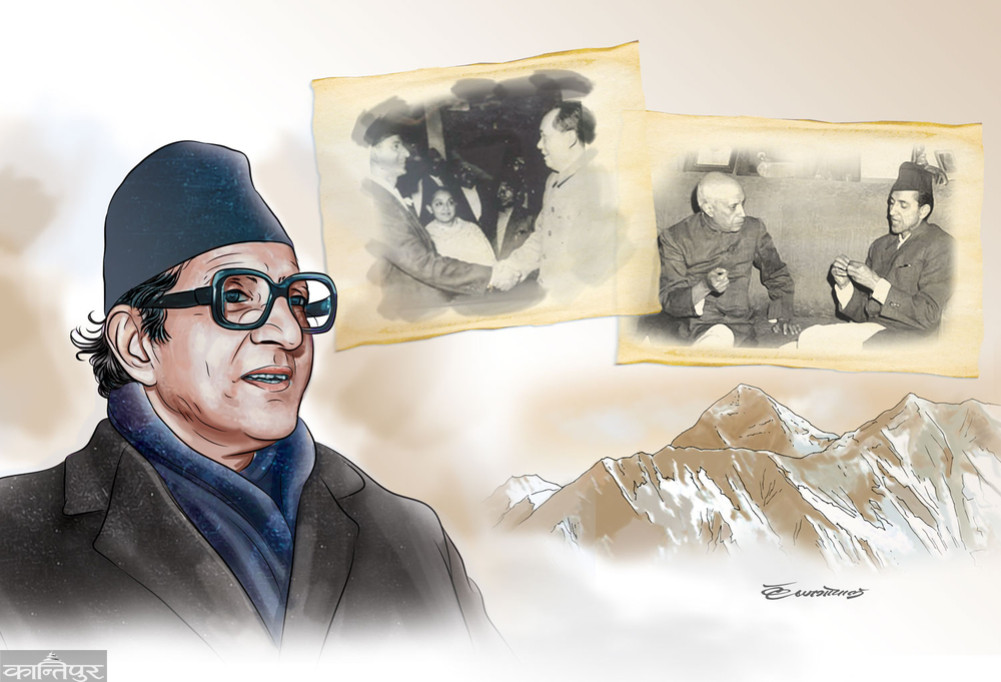
According to BP's roadmap, if the democratic system and the speed of economic development had been advanced, today Nepal would have been politically prosperous, democratic and economically developed.
We use Google Cloud Translation Services. Google requires we provide the following disclaimer relating to use of this service:
This service may contain translations powered by Google. Google disclaims all warranties related to the translations, expressed or implied, including any warranties of accuracy, reliability, and any implied warranties of merchantability, fitness for a particular purpose, and noninfringement.
Infamous dictator Ferdinand Marcos, who became the president of the Philippines in 1965, took refuge in the United States after the 1986 popular uprising toppled him. After Marcos died in 1989, his family was allowed to return to the Philippines in 1991.
After 2015, his son Bongbong Marcos started an aggressive propaganda campaign calling Marcos a 'powerful leader' and his tenure as a 'golden era' through social networks and digital platforms such as Facebook, X, TikTok, YouTube. The younger generation who did not experience the dictatorial regime of Marcos are being confused and influenced by such misinformation, propaganda and sponsored commentary. Therefore, based on nationalism and Marcos' main slogan of 'returning the golden age'
In 2022, Bongbong Marcos was elected president. Analyzing on the basis of the abnormal political developments and sponsored commentary that have developed dramatically in the past, the question has arisen whether Nepali politics has also seen the initial signs of the Philippine syndrome.
King Mahendra's state visit to the US and his address to the joint parliament, the Queen's welcome on his visit to the UK and the brief video footage of King Birendra's foreign visit seem to be hypnotized and thrilled by the Nepali people, especially the young generation. Exaggerated nationalist commentary that the national interest was protected and Nepal's international image was high because of the king is becoming 'viral' on social media and digital platforms.
In the background of corruption, misrule, series of controversial decisions of the government, it seems that the scope of the depressing and confusing commentary that 'the monarchy is better than now' is expanding. But in the period of history, the Prime Minister of powerful countries like India and China was forced to apologize and explain by taking a stand in favor of national interest, sovereignty and national security.
That Prime Minister was – BP Koirala. In the background of the ongoing debate that the government has not been able to protect the national interest and national interest since history, this episode seems like a legend for the new generation. But this is not a legend, it is a glorious history.
which laid the foundation of an independent and balanced foreign policy, the tenure of the first elected government led by BP from May 13, 2016 to December 1, 2017 is considered to be the golden period of Nepal's international relations and foreign policy. Even those who disagree politically and ideologically with BP have acknowledged the fact that it is significant in terms of international relations and foreign policy. BP's tenure is considered successful for three reasons in particular.
First, Nepal did not have an independent foreign policy during the 104-year-old colonial rule. The Ranas maintained power by brutally oppressing the people by surrendering to the British (then East India Company). Even the governments that were formed after the establishment of democracy through the people's revolution of 2007 under the leadership of the Congress were not able to have an independent foreign policy. But BP laid the foundation of independent, balanced and independent foreign policy by clearly explaining the guiding principles of international relations by giving the highest priority to the national interest and national interest.
established national unity, geographical integrity, universal freedom, national security, United Nations Charter, Panchsheel, non-alignment as guiding principles. Similarly, pluralist society, democratic system, rule of law, economic diplomacy, human rights, peaceful coexistence and sustainable peace were the main priorities of BP.
Giving high priority to multifaceted relations with neighboring India and China, he strengthened and deepened diplomatic relations with the wider international world, including the US, on the basis of mutual interests, interests and equality. In fact, it was BP who set the foundation of international relations and foreign policy in favor of the national interest. As a result of the same foreign policy and economic policy, the threat of economic development was revealed when foreign aid came in.
Secondly, he made the diplomatic image high by diversifying international relations. In a short period of 18 months, diplomatic relations were established with 18 countries including Pakistan, Israel, Italy, Philippines, Myanmar, Malaysia, Australia, Thailand, Austria, Netherlands, Poland, Serbia, Sweden. No government has had diplomatic relations with so many countries in such a short period of time and it is unlikely to happen in the future.
In the complex geopolitical context of the time, relations with Israel and Pakistan were risky both politically and diplomatically. BP revealed in his autobiography that even King Mahendra himself repeatedly pressured him not to establish diplomatic relations with Israel. But in view of the developed international situation, he established relations with Israel. It has been confirmed how visionary that approach is.
Professor Leo E. Rose of the University of California, USA, who has done extensive research on Nepal, has explained in detail BP's contribution to international relations and foreign policy in his book 'Nepal Strategy for Survival'.
Thirdly, the end of the Second World War, the beginning of the Cold War, relations with the neighboring democratic India and Communist China in the bipolar international environment and foreign policy were interpreted in terms of national interest. In his address to the United Nations General Assembly on September 29, 1960, BP made a strong statement in favor of a non-aligned foreign policy, China's representation in the United Nations, and small and underdeveloped countries in the Third World.
How far-reaching and realistic BP's historical opinion is, it has now become clear as the sun. Remember, until then, the People's Republic of China (now China) was not represented in the United Nations, but the Republic of China (Taiwan). The People's Republic of China has been represented in the United Nations only since 1971.
BP expressed a clear opinion about the sovereignty, geographical integrity, national security and the role of developed countries in the development of small and underdeveloped countries of the third world. BP's ideas were not only important for Nepal but also for all small and underdeveloped countries.
Everest border dispute resolved by dialogue with Mao
There was a border dispute with China during BP's tenure. Both countries have been claiming the world's highest peak, known as Everest in Nepal and Chomalongma in China. But with a view to solving the Everest border dispute with China, BP had done a long political, diplomatic and technical homework since he became the prime minister. During his state visit to China in 1960, BP had repeated long dialogues and intensive discussions with Prime Minister Chou En Lai to resolve the border dispute. But the dialogue with Chou En Lai was positive but did not reach a concrete conclusion.
On a complex issue like the border dispute, BP adopted the strategic diplomacy of communicating with the powerful leader Chairman Mao, understanding the psychology and political reality that Chou En Lai could not decide alone. As per BP's wishes, a summit meeting was held between BP and Mao at midnight on March 18, 1960. During the historic meeting, there was a detailed discussion about the Everest border dispute as well as the multifaceted aspects of Nepal-China relations. After BP confirmed that Mt Everest is Nepalese land by submitting historical documents, records and evidence along with map of Nepal, Mao also finally agreed.
From the same meeting, the Everest border dispute was resolved forever and the border agreement was signed on March 21 during BP's visit to China. In fact, Mao and Chou En Lai's flexibility and BP's superior diplomatic skills played a major role in resolving the Everest border dispute. Therefore, the BP-Mao dialogue and BP's visit to China are considered milestones in terms of resolving the Everest border dispute.
During the BP-Mao dialogue, Mao not only expressed his happiness over BP's rejection of India's proposal to form a joint security policy against China, but also praised the proposal to invite Indian Prime Minister Nehru and Chinese Prime Minister Chou En Lai to Kathmandu. It seems that BP and Mao communicated with each other with high respect and intimacy, not limited to formal diplomatic etiquette, while this was the first and last dialogue between BP and Mao.
The detailed documentation of the rare historical dialogue between BP and Mao has been published by the Chinese Ministry of Foreign Affairs in the book 'Mao Zedong on Diplomacy' published in 1994 (pages 302 to 307). The book is an integrated document of Mao's 160 speeches, opinionated articles, interviews, high-level dialogues with heads of state and government from 1937 to 1974. Therefore, it has been confirmed that the dialogue was not only from the point of view of solving the border dispute, but also from the point of view of Nepal-China far-reaching relationship.
India's Prime Minister Nehru's explanation
Being an active participant in India's freedom struggle and spending almost three years in prison, BP had intimate and close relations with leaders including Mahatma Gandhi, India's first president Rajendra Prasad, Prime Minister Jawaharlal Nehru. But after questions about Nepal's national interest, sovereignty and national security were raised, BP expressed not only serious disagreement with Nehru, but also objections and disagreements.
On November 27, 1959, while addressing the Lok Sabha, Nehru made controversial and objectionable statements about the political situation and regional security situation of Asian countries. Nehru said - 'If there is any kind of attack on Nepal, Bhutan and Sikkim from anywhere, India will consider it as an attack on itself.' It was mentioned in the statement – 'Nepal is an independent country with complete sovereignty. In any internal or external matter of Nepal, Nepal decides on its own and no country's interference is acceptable.' In a press conference held on December 3 after BP's reply, Nehru admitted that he had made a mistake while addressing the Lok Sabha and said, "Whatever the Prime Minister of Nepal has said, he has said it right." India or any other country cannot unilaterally decide in Nepal. Nepal is also a free and sovereign country like India.
The detailed documents of that historical context are collected in the book 'Nepal-India and Nepal-China Relations' by Avtar Singh Bhasin, a retired senior official of the Ministry of Foreign Affairs of India and a researcher on Nepal, India and China affairs.
BP has mentioned in his autobiography and prison journal that due to his stand in favor of Nepal's nationalism, national interest, sovereignty and national security, the relationship with Nehru has been strained in some respects. Due to BP's nationalist stance and international personality, BP has also revealed that Nehru's silent support for Raja Mahendra's decision to 'coup' the democratic system and impose autocratic panchayat system. But no matter how bad the relationship with Nehru was, BP never made any compromise for the national interest.
Chinese Prime Minister Chou En Lai's apology
On March 25, 1959, the Tibetan capital, Lhasa, was invaded by China and occupied by China. Religious leader Dalai Lama entered India on March 31 and took refuge through the Thwang Valley in the north-eastern Arunachal province bordering China. After the Chinese People's Liberation Army occupied Tibet and the Dalai Lama took refuge in India, the Tibetan army entered the border districts of Nepal and conducted military activities against the Chinese army.
By making Mustang, which is considered important from a strategic point of view, as a base, the commander of the Khampa rebels, Ge Wangdi, set up a temporary "headquarters" in Kaisang of Mustang. With even the US intelligence with the US intelligence, a planting of economic and weapons support were not only questioned by Nepali land, it was coming to a meaningful gem-economic color. Therefore, the government had to mobilize the army to protect the security and so-called sovereign freedom of Nepal. The
Bampparabus was consisted with the Chinese army, the Nepal Army and the Nepali people with armed conflict and clash. The Nepal Army and the population were falling in the fertilizer and chaotic activities of Chinese army and plant rebels. The bumpa rebel did not build the groundworking, the Chinese army had entered the Nepalese land and attacking and attacking the Nepal Army and the Nepal Army and the Nepali people.
in 1960 June 28, 1960 June 28, the Chinese army in Nepali June 28, in Nepali Army and the Nepal Army, and the Nepal Arbitrated, and the general public. The disarray of the Nepal Army was killed by the Association Bancota from the invasion, while Nepali security personnel and the common people were abducted by Chinese army. With information on the information, BP sent strong protests to the Prime Minister to the Prime Minister.
was demanded that Nepal's sovereignty and national security is made by entering Nepal and the captives of the general public, and should be given proper compensation to the families of the deceased. & nbsp; The letter of
Prime Minister Chau Akhti said that our army suffers from the Nepal's independence and has decided to give 50,000 to the family of the deceased. China will now be aware of no apparent such unpleasant event. 'After finishing Mustang event, BP, 1960, in March 10, BP, 1960, BP, 1960, BP, 1960, BP, 1960, in March 10, BP by BP in March 10, 1960.
concluded that Seramoni welcome rich is more than the Protonomic Rule and the President of the President BP by the kings. BP, not just international relations and foreign policy, not only in the view of foreign development and socials, approach and determination and determination. In the 15 years, BP's dreams and resolve the dream of each Nepalese standard of living things.
to complete the dreamer and resolution to fulfill the lifelong & nbsp; unset harsh struggle. If BP, if the speed of democratic systems and economic development had led to the end of democratic system and economic development, it would be political Nepal in view of rich governorism and economic development today. But King Mahendra 'coolected a democratic system' coupon 'and Nibramaratis and Nbsp; After the formatting of
an rule, the fate of Nepal and the Nepalese people had a long time and 30 years. Like the Philippines, Nepal is not a possibility of such sponsors and confusing Provanceaanda. However, some time has become more policious and poisonous for some time.