Extreme violence against women, promotion and protection of the worst caste system against marginalized communities including tribals, Madhesi, Muslims and Dalits is done by the monarchy itself. The country does not move forward from the aimless, upside down and dark path of monarchy that has reached Aryaghat.
We use Google Cloud Translation Services. Google requires we provide the following disclaimer relating to use of this service:
This service may contain translations powered by Google. Google disclaims all warranties related to the translations, expressed or implied, including any warranties of accuracy, reliability, and any implied warranties of merchantability, fitness for a particular purpose, and noninfringement.
Spring naturally brings a ray of hope. Grows on trees and plants. Flowers cover the forest. Occasional rains encourage farmers to plant crops and produce food throughout the year. Hopes for better farming.
Naturally, just as the hope sprouts in the people with the spring season, similarly in the politics of Nepal, this season has a history of bringing the spring of democracy and transformational movement.
The end of the 104-year-old Jahanian autocratic rule was completed around the spring season, i.e. on February 7. In 2017, King Mahendra implemented anti-people panchayat system by 'coup'. The movement in 2046 for the abolition of the Panchayat system and the establishment of a multi-party political system also started in this season.
The then Maoists also started a people's war in this season for the construction of a new political system with the pioneering restructuring of the state. The 2062/63 movement to end the autocratic and dictatorial rule of Gyanendra Shah, who came to occupy the throne with the power frenzy after the overthrow of the then King Birendra, also took place in this season. In other words, with the arrival of spring, there was a movement to change the Nepalese political system.
Nature does not always follow the same rhythm. Accidental disorder occurs. People have to deal with unexpected unseasonal rains and floods. However, contingency is not regular, and occasional accidents cannot stop regular natural processes. A similar contingency was seen this spring.
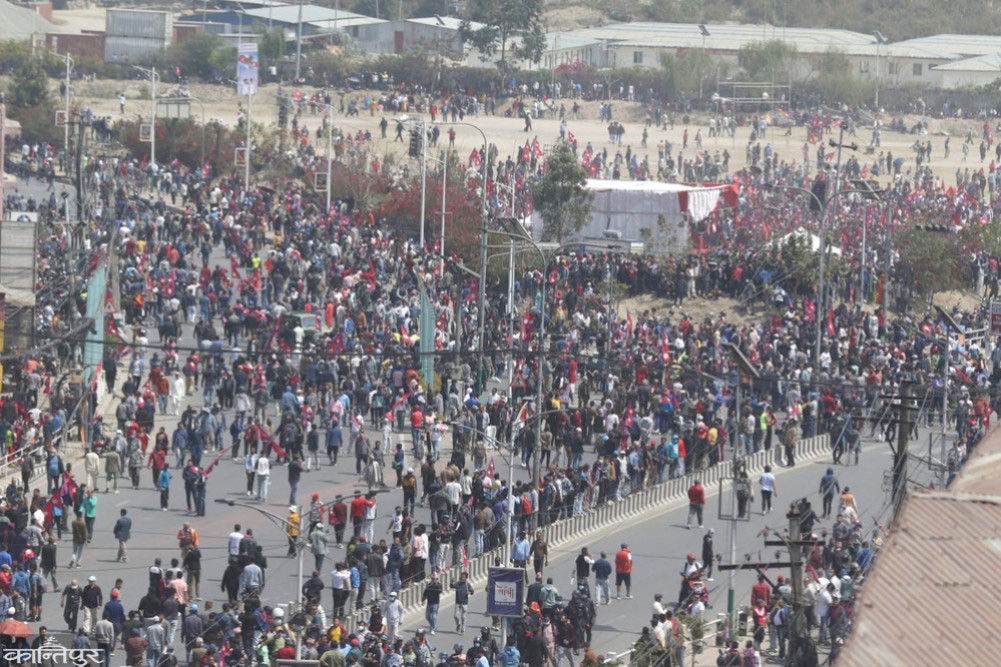
The chaotic demonstration of royalists in Tinkune on Chait 15th against the republic that the people in the country have achieved through long struggle and sacrifice is an example of that. This was not a demonstration for people's rights, freedom, respect and progress. It was simply a demonstration in favor of a rotten dead monarchy that the people had thrown into the trash as useless. The debate about the monarchy has continued in an environment where a seasonless 'ghost' is trying to ride.
Characteristic feature of monarchy
Only a single history was written or written about the monarchy of Nepal. Therefore, no history was written that included the critical characteristic of monarchy. For example, as much as the history of Prithvi Narayan Shah's heroism was written, the countless atrocities committed by him were not covered.
The history of Shah Khalak's dynastic rule pushed back the economic and social development of Nepal. Not only this, why the killer was not found after the Darbar murder scandal, why anti-people Gyanendra Shah was allowed to stay in the country with honor even after the establishment of the republic was not brought to the public. Due to the fact that people are not informed about history and historical events in detail, confusion is created.
Nepal's royal monarchy was never in favor of the welfare and well-being of the people. Prithvi Narayan Shah's expansion of the Gorkha kingdom was the result of his ambition to become the king of a large territory and a large population rather than the welfare of the Nepali people. If his war was on the side of the people, he would not have plotted the murders.
Likewise, there is a history of a series of murders and atrocities during the royal monarchy of about 240 years. Diss. The killing of Bhardars including Ran Bahadur Shah and Damodar Pandey in 1860 was not done to protect the rights of the people, nor was the destruction of Birendra's dynasty in 2058 to strengthen the people. Many of these murders in the palace are just for gaining power and oppressive system on the people There were atrocities committed by Rajamaharaja to impose
. On the other hand, anti-people tactics were used throughout the history of monarchy. For example, Tribhuvan's son Mahendra, who returned to the palace in collaboration with the political party after the Rana was in crisis in 2007, staged an anti-people 'coup' in 2017.
which started an autocratic independent panchayat to oppress the party and the people. Even the 'coup' done by Gyanendra on January 19, 2061 by sacking the Prime Minister and taking over the government was not done in favor of the people. Therefore, the monarchy of Nepal has no history of promoting the rights of the people except for gaining power through numerous bloody murders and anti-people activities.
A monarchy is a dynastic system of government. Monarchy, in which only the first born son of a family can become king, is not only dynastic, but also the protector and promoter of patriarchy. There are many stories of atrocities on women inside the palace. Such a dynastic and patriarchal monarchy was not and could never be democratic. Not only this, the monarchy which continues the fixed lineage tradition is an extremely racist system. A monarchical system never allows even the idea of becoming a king of another caste or community.
Apart from the Shah, neither the brother-in-law can become the king, nor the tribal people. Another feature of monarchy is racist rule. If we look at the history of the past, extreme violence against women, promotion and protection of the worst caste system against marginalized communities including tribal tribes, Madhesi, Muslims and Dalits was done by the monarchy. The racist royal monarchy continuously attacked the language, culture and civilization of the tribal people, and institutionalized the shabby terrorist system of the caste system by making laws, and did not allow the Dalits, who contributed greatly to the labor force, art, skills and culture, to become human beings.
In Prithvi Narayan Shah's political foundation, Jung Bahadur Rana In 1910, the Muluk Act gave legal legitimacy to the caste system and discrimination, which was the biggest crime against Dalits. In 2020, there is a false discussion that the caste discrimination against Dalits has been ended by amending the civil law. Even though Mahendra changed the civil law so that Dalits could not be untouchable in order to stop the resistance movement of Dalits, the fact that the traditional practice was not considered as discrimination was the system that continued untouchability-discrimination.
Hinduism is the religious-political foundation of monarchy. The royal king positioned himself as the alleged 'Vishnu Avatar'. This means that no matter how much mischief or crime the king commits, no question should be raised against them. After being placed above humans, if no one could question the king, their crimes would be forgivable. Not only this, religion is a matter of faith and belief of an individual.
Some are proud to be Hindus, some are Buddhists, Muslims, Christians or atheists. However, there are many instances where the monarchy subjected non-Hindus to extreme torture, from banishment. It was a legal institution that interfered violently with the religious freedom of individuals.
Monarchy has no role to strengthen Nepal's economic situation. Nor did the royal court provide any plan for economic advancement. Instead, it kept making fun of the poor, workers, farmers and laborers. Not only this, the officials and emissaries appointed by the king seized the people's land by force, made the peasants landless and used the scourge of exploitation on them.
On the other hand, employment is a source of income. But who got employment in 240 years of monarchy? If we look at the accounts, it is clear that the king's brothers, Asepase, Chakdibaz were the main drivers of employment. All these facts show that autocracy, criminality, dynastic, patriarchal, Hinduism, extreme casteism and cronyism are the main tendencies of monarchy. That is why the Nepali people brought the anti-people monarchy to Masanghat through agitation and struggle.
A charioteer like Gyanendra
If you look at history around the world, only a few countries have restored monarchy. There are objective political-economic reasons for that too. However, no matter how much force is used in Nepal, there is no possibility of restoring the monarchy. There are three ways to return to the monarchy - one, by amending the constitution with a two-thirds majority in the parliament. In the current situation, there is no chance of the royalists reaching two-thirds of the popular vote in the parliament.
two, by seizing state power with the army in hand. The Nepali army is not the royal army of the past and is not under the control of the king. Since the Nepalese army is under the elected president, there is no possibility that the royalists can support the Nepalese army. Three, popular uprising. The political forces that fought against the monarchy in Nepal are very strong. In such a situation, there is no possibility that the monarchist movement will return to the monarchy. A strong leadership is also necessary to challenge the state with the strength of the movement itself. However, all the faces seen in the royalist camp are people who have been dusted by the people like the king.
Gyanendra himself is a failed ruler. Gyanendra, who could not even hold the municipal election, repeatedly 'coup'd power. He became the Chairman of the Council of Ministers. Neither he could make any contribution to the peace process, nor did any socio-political transformation work. He is always a failed player in Nepali politics, his ambition alone cannot restore the monarchy. The fate of those who say that they will return the monarchy through the movement is also the same. Thugs and people who have failed in the past are leading the royalist movement.
It is strange to think that the monarchy will return under the leadership of Navraj Subedi, who failed in the panchayat, Kamal Thapa, the Nike of the Second Jana Andolan Daman, and Durga Prasai, who was involved in many scandals in the bank and financial transactions. How can such distinguished and failed characters solve the current crisis of the country? These characters neither have a clear idea, approach and vision to solve the problems of the people, nor are they convinced by the people.
People always want economic, social and political transformation. Monarchy itself is an anti-transformation system of socio-economic, cultural system. The characters and tendencies seen in the royalist movement are not likely to solve the basic problems of the country. For all these characters have no vision but the lust to profit immensely from the monarchy.
Corrupt, brokers and middlemen's self-interest is their first priority. It is the reverse path for all who desire progress, advancement and transformation. The country does not move forward from the aimless, upside down and dark path of monarchy that has reached Aryaghat. Instead, people suffer more and have to fight for democracy again. Conscious citizens do not accept the opposite path of suffering.
political homework
is naturally the result of the struggle of the republican people and the political party. A very large number of people have sacrificed for the establishment of a federal democratic republic, proportional inclusion, and the restructuring of the state with secularism. Thousands of citizens have sacrificed. Those struggles and sacrifices in the past for achieving democracy with freedom to speak, write and hold opinions are historic.
However, the political parties have not been able to institutionalize the transformed federal democratic republic. In practice, republican political culture and cultural practices have not been achieved. Federalism has not been implemented in a strong and practical way. Political attention has not been directed towards fulfilling the hopes, expectations and desires of the people with the federal republic. However, the incompetence of political parties and governments is not the failure of the republic itself. Conscious citizens need to constantly warn to make the federal democratic republic stronger, stronger, responsible and accountable to the political party.
It is necessary to analyze the main problems and challenges in the economic-political system of Nepal in a proper manner. The role of political parties and leadership in causing such crisis needs to be seriously reviewed. A political party should be able to work with a clear vision, approach, strategy and action plan to move the country forward.
It is not possible to solve the socio-economic complexity of the country without a political leadership and party that is inherently determined and committed to the people. Therefore, the parties, which are shocked by the monarchist demonstration, must bring to the people the concept of institutionalizing the republic, ending corruption, lawlessness and impunity, and a clear vision of the overall economic-political transformation of the country. If a clear vision to overcome the serious disappointment in the country and the people and move the country forward is not possible politically, there will always be a threat of political anarchism.