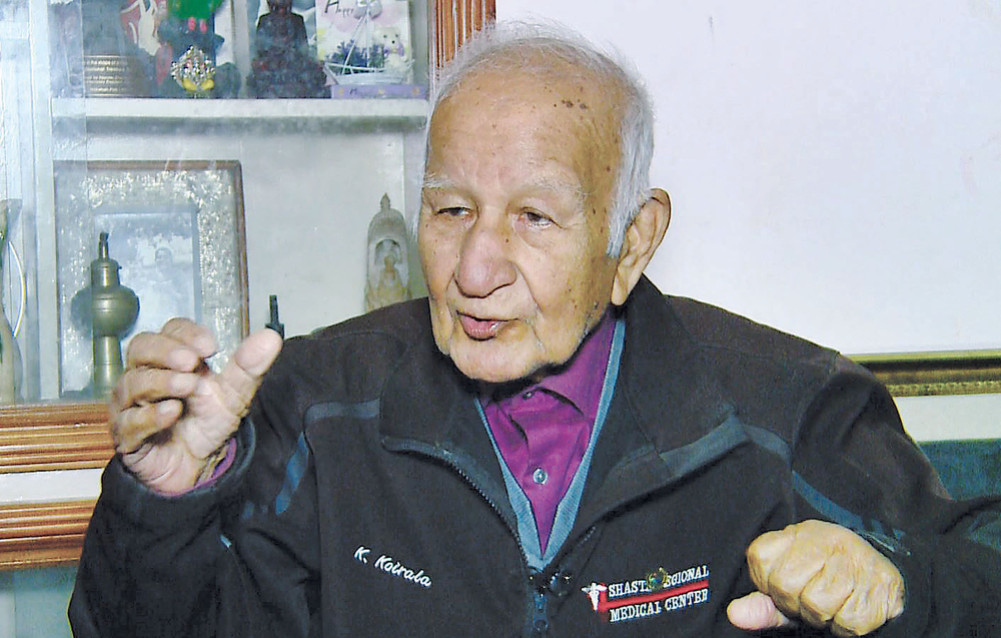
Koirala was also honest in thought and deed. He never thought of doing anything for power and strength. Lived a life of sacrifice, dedication and idealism.
We use Google Cloud Translation Services. Google requires we provide the following disclaimer relating to use of this service:
This service may contain translations powered by Google. Google disclaims all warranties related to the translations, expressed or implied, including any warranties of accuracy, reliability, and any implied warranties of merchantability, fitness for a particular purpose, and noninfringement.
The political theory and behavior of the leaders are completely opposite. As a result, there is now increased public anger on the streets. The people of Nepal are not against democracy, the Congress and communist leaders who are now in power did not feel the change when they indulged in 'main khaon mai laon'. I get fed up when I see this.
This is the comment made by Kamal Koirala to the columnist on February 7 about the latest situation in the country. He passed away on Sunday night at the age of 87. Kamal Koirala is also a witness of Nepal's political developments and various upheavals. He was there when the agreement was drafted after the 2007 revolution or when King Tribhuvan read Narayanahiti's declaration in Patangini.
He saw the scene inside the palace where King Tribhuvan was announcing the end of the Rana rule and the establishment of democracy. Kamal is the son of Matrikaprasad Koirala, who became the first civilian Prime Minister after the 2007 change in Narayanhiti's steps.
BP Koirala and GP's nephew were dissatisfied that even though all the constitutions after 2007 would give rights to the people, Nepali citizens could not realize it in practice, the king and the party leaders were violating the law because of their desire to become rulers and the parliament was made a box of nominees. He remained unsatisfied for the rest of his life saying that all these things were not improved even after federalism.
Grandfather Krishna Prasad Koirala, who campaigned against the Rana regime, Kamal Koirala, the son of Matrikaprasad, who became the country's executive prime minister after the end of the Rana regime, is also an ideal character of Nepali politics who abandoned the power of happiness and inheritance and walked the path of rebellion of his own free will. Hearing the words of the republic from the mouth of the king, he left everything with time and became the hero of the rebellion.
He had a different kind of feeling about his grandfather Krishna Prasad Koirala. At the age of five, I met my grandfather (Krishna Prasad Koirala) at Judd Dharamshala when I was just a little understanding. This is around 2000. My mother brought me. But I don't remember that much about the road," he said in a meeting 81 years ago about the time of Rana Prime Minister Juddhashamsher's reign. He asked me to pretend too. I carried it holding my knee. All his beards were white and bushy. When he asked for a stone that he found on the road, I gave it to him after his mother asked him to give it. I remember that even now.
Even today there are not few people who say that the Nepali Congress is the legacy of the Koirala family. Leaving the family legacy and becoming a communist was very difficult and like walking the opposite way. At first glance, going to the streets against the government, being arrested and going to jail when his own father was the prime minister seems like a myth.
'Before I was not interested in politics until I stayed in Banaras. He used to meet Congress office secretary Nirmal Lama there. Later, after returning to Nepal and starting to study at Tri-Chandra College, he again met Nirmal Lama. He has become a communist,'' Kamal Koirala had said enthusiastically in a meeting with Rowekar, 'I was a 16/17-year-old boy. At that time, the Communist Party was banned. I was attracted to the banned party. I was greatly influenced by the communist slogan.
In 2011, he was arrested by the police while leading a procession from Kilagal in Kathmandu to Indra Chowk. Rupchandra Bista, a student of Trichandra College, was with him when he was jailed. After the arrest of Kamal Koirala, there was a lot of talk about him. At that time, the Prime Minister was his father. The New York Times of America printed the news under the title 'Son arrested for protesting to overthrow father's power in Nepal'.
Koirala was also honest in thought and behavior. He never thought of doing anything for power and strength. Lived a life of sacrifice, dedication and idealism. He is also the person who directly refused when asked to be a minister.
On August 18, 2059, the then King Gyanendra Shah dismissed the Prime Minister Sher Bahadur Deuba and took over the country's governance. Later, King Gyanendra re-appointed the same Deuba as Prime Minister on 21st June 2016. Then the UML joined the government saying that 'regression is half-baked'. The then general secretary Madhav Kumar Nepal invited Kamal Koirala to become a minister in the same government led by Deuba.
One day at night, the Secretary General of Nepal called and said that he would send you to the government. He told me to be ready to become a minister," Koirala had said in a meeting on March 7, "I didn't say anything immediately. I just said that I will call after consultation. I didn't want to call later. Koirala was dissatisfied with the government under the king's watch from the beginning. Perhaps, that is why he did not want to become a minister!
He was elected Member of Parliament from Morang-5 in the 2051 mid-term elections. In the 2048 election, Koirala lost to Shailaja Acharya, the daughter of his cousin, in the same area. After coming to the Parliament, Koirala also became the Chairman of the State Arrangement Committee. When the UML split in 2054, it moved to Male. The last time the UML split, he joined the Unified Socialists.
After the success of the people's movement of 2062-63, he became the Nepalese ambassador to South Korea. Koirala said that Madan Bhandari, the then general secretary of UML, directly made him the editor-in-chief of UML's mouthpiece 'Drishti' weekly. Writing was his special interest. He never stopped writing throughout his life.
As long as Koirala lived, he lived a simple life. Unswervingly in favor of law and democracy throughout his life, he stood against the dissolution of parliament as a lawyer. Koirala's faith and integrity is exemplary for contemporary politics and society.