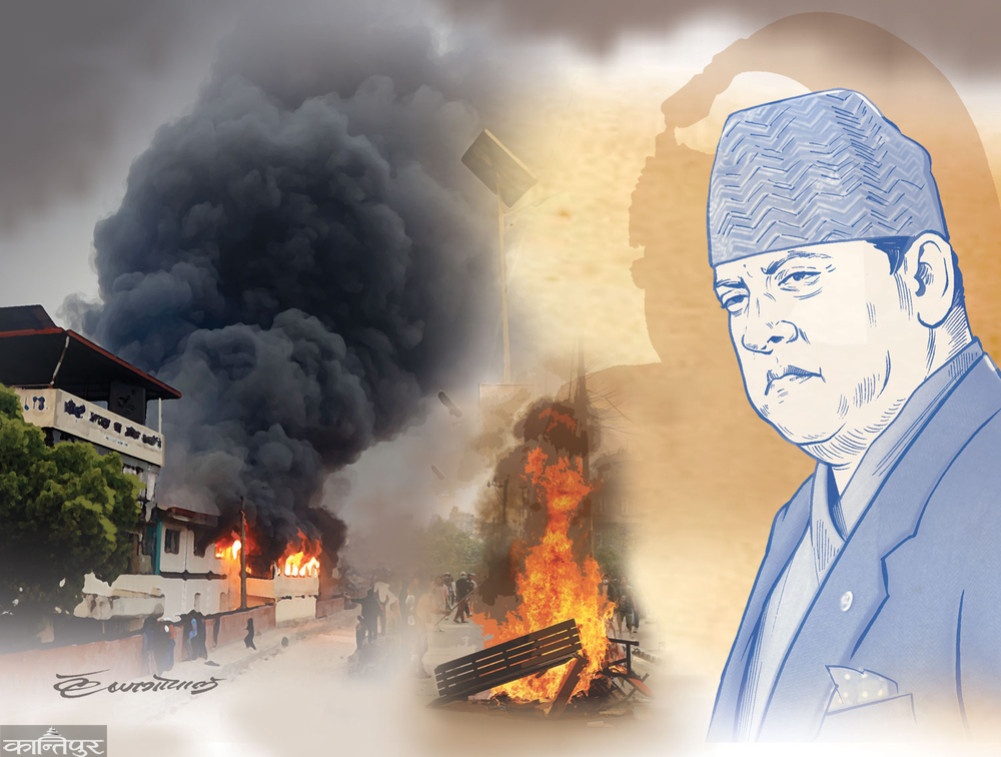
It is right that he gave up all the facilities of the state and came to do politics within the constitution, otherwise, Gyanendra, who broke the agreement with the people, must be punished.
We use Google Cloud Translation Services. Google requires we provide the following disclaimer relating to use of this service:
This service may contain translations powered by Google. Google disclaims all warranties related to the translations, expressed or implied, including any warranties of accuracy, reliability, and any implied warranties of merchantability, fitness for a particular purpose, and noninfringement.
Commenting on and analyzing events becomes risky as new events unfold at a rapid pace. When you wake up in the morning, the previous day's information is stale. In the morning, the information fades into the shadows of the evening. Such intensity of events wakes people up.
Things that could not be learned for years in a peaceful and stable situation are learned in a single day at a time like this. This year, Gyanendra Shah's tumultuous attempt to regain the throne has taught the Nepalese a dynamic lesson of history. The 'left-liberal' line, which is unable to remind the new generation why the monarchy was bad, has made it easier.
In opposition to the undemocratic actions of the current ruling group, the pressure campaign to make the republic more people-oriented and results-oriented is underway. Once again, attention has to be paid to the remaining aspects to complete the revolution of 2063.
are those aspects Making the former king Gyanendra responsible for his crimes, punishing him like other citizens according to prevailing laws, depriving him of the privileges that Khaipai received as a former king on the charge of taking an unconstitutional path to fulfill his aspirations to become a king.
Criminal prosecution of the leaders responsible for the violent incidents in Tinkunye and all those involved in looting and arson. By forming a special court for this case, giving the opportunity of legal defense to those involved in robbery, arson and murder, punish them with severe punishment within two months.
This is what the state should do now, and this is what the civil society should put pressure on the state. Only by doing this, it is possible to peacefully suppress the current counter-revolutionary movement through constitutional and legal measures. Only by doing this can the ghost of this monarchy be reduced to ashes forever. And, extremist efforts and forces to push the country back into turmoil and instability can be prohibited. In Marxian commentary, this is called dictatorship imposed by revolutionary forces on counter-revolutionary forces.
The character of counter-revolutionary defiance
Now there are many faces in the royalist category. Pashupatishamsher is a representative character of the feudal system, born as Jarnel in Khalaka of Rana Chandrashamsher and brought up by King Mahendra and Virendra. Kamal Thapa is the descendant of Thapa Khalak of Tharpu who joined the military service of King. Who grew up doing politics from the Mandle group since his student days. Rayamazhi, who has played a continuous role in parliamentary politics since 2051 and as the Home Minister who suppressed the 2063 movement, is a person recommended for action by the commission.
Navraj Subedi is now Panch who has been brought forward by Gyanendra as a hero and has risen in the umbrella of the palace. And, Durga Prasain is a disgraced person as a crook and middleman by posing as Maoist, CPN and UML. Ravindra Mishra, who is at the forefront of stimulating the movement, is a representative character who advocates a regressive and authoritarian right-wing regime from an ideological point of view. RPP President Rajendra Lingden is the person sent by UML after winning elections twice from Jhapa. Dhavalshamsher Rana became the mayor of Nepalgunj for the first time in 2054 as a UML candidate.
In terms of class base, Gyanendra Shah, Pashupatishamsher, Dhavalshamsher, Kamal Thapa are representatives of the big bourgeoisie. The rest belong to the petty bourgeoisie. Those who are seen on the streets looting a mobile, two/four bottles of liquor or beer, some old clothes or other ordinary food items, those involved in arson and stone pelting, are members of the urban lower bourgeoisie and the lustful proletariat.
Acharya Srinivasa and others are semi-educated hypocrites raised as religious gurus by the bourgeoisie and the middle class. Those who are lured by the hifi of the Panda Lafangas who were able to gain power by the politics of Indian Hindu extremism and want to raise Hindu extremism and gain power in Nepal (we have no problem with Hindu fundamentalists, we have objections to politics in the name of any religion). The poison of Rashtriya Swayamsevak Sangh (RSS) has dissolved in them.
A line including Dhawalshamsher and Jagman Gurung seems inspired by the encouragement given by right-wingers like Yogi Adityanath and the RSS and the Indian establishment. Raja Gyanendra himself is seeking blessings of RSS, ruling BJP and Modi through Yogi Adityanath. Atleast got the covert blessings of RSS and Yogi. The 'RSS', which is investing billions to make Nepal a Hindu state with the flag of Hindu extremism and unbroken India, is institutionally the player behind this arrogance.
Therefore, the current counter-revolutionary movement is inextricably linked with the long-term plan of not allowing Nepal to be stable and prosperous forever. That is why it is important to press its head as soon as it comes out of the nest. This is the primary task that needs to be done to advance Nepali society today.
New 'power elite'
After 2047 Congress-UML and after 2063 Maoists, Madhesi and other identitarians and their aspiring new political elite gradually developed. During these years the same line of rotation is constantly in power and power. The main part of the leadership has been promoted. Those in the
leadership used their positions in the service of the bourgeoisie and capitalists who had traditionally occupied business and industry, protecting a limited number of aspirants from the lower bourgeoisie through the abuse of policy and state power to uplift them into the new bourgeoisie and bourgeoisie. They raised their status by exploiting the resources of the state against the law while they were in elected and statutory bodies, and under their protection, the bosses of the bureaucratic system were also elevated. This can be called the Nepali avatar of the 'new class' in the definition of Milovan Zilas.
A middle class of those who changed the political equation was formed, combining the alliance of the bourgeoisie with those in the decisive positions of the political administrative apparatus. With that, a 'Deepstate' was created with a nexus between cronies, middlemen, political party leaders and the state apparatus. It is this class that is in power and in power in Nepal today.
Within this there is still a line loyal to the old palace. This is where the fervor of the Hindus in the Congress comes in, from which Gyanendra Shah and his followers are getting excited. It also includes a line of modern bourgeois converts from successors of Gorkha court brothers and pandit priests who had previously received baxis or birtas from the court.
A line of these Gorkhali elites has now transformed into the modern bourgeoisie. This class had previously opposed republicanism, land reform, inclusiveness and proportional representation after 2063, seeking the continuation of limited traditional elite control over resources, preventing the development of free capitalism. It also prevented the democratic movement from expanding to a 'full bourgeois revolution' and gave place to traditional elites.
A corrupt and immoral power is run by players from this 'Deepstate' with the ruling neo-elite. Therefore, it has hindered the development of all productive forces to make the country's economy dynamic. The development of progressive capitalism has stopped due to the protection of the interests of the crony bourgeoisie of the upper ladder, who have found a way to continue earning by staying in contact with the 'deep state' without working, without taking risks, without joining the competition, by evading taxes, by creating policy compatibility.
This 'Deep State' has now succeeded in capturing the key policy making and regulatory bodies. The 'Energy Minister' who shows the character of the current government is a clear example of this. It is eating away at the basic structure, institutions and systems of democracy from within. Institutions providing education and health services have been paralyzed. It has hindered the path of national industrial development. It is because of this power, which represents the character of crony capitalism, that the economy is unable to accelerate, leading to mass unemployment, labor migration and emigration. This has created a situation where there is a lack of employment in the city and no livelihood in the rural areas due to the disruption of the 'backward and forward linkages' of the economy.
Transition
Nepal is a part of world capitalism. The beans of Humla or the apple of Jumla, the ambrosia of Elam or the ginger of Palpa all do not fetch a price without competing with the world market. Therefore, every farmer in Nepal is a producer and consumer of the world market. The state has not provided the level of capital, technology and managerial efficiency needed to compete after joining the global market. This has pushed the economy and society into a deep crisis.
In the competition with the world market, Nepali productive forces, i.e. capitalists, managers, workers and even natural resources, need a state that is ready for laws, policies and implementation against broker capitalism to make them competitive. What the political parties and those in government have not done, do not want to do or are unable to do is to free the national capital from the shackles of broker capital. The crux of the current crisis is here.
It is not sharply expressed on the street because of the transitional vague picture of society and class. As the main point of the working class is towards immigration, its presence and intervention in the decision-making process of politics is weak. The lower bourgeoisie is floundering. The idea of building public opinion and pressuring the rulers to be accountable has degenerated into an opportunist idea of serving the elite and making a living. Its presence in the lively debate is minimal. The new classes and the traditional elites have been favored.
The spectacle that is seen on the streets at the moment is behind the struggle of new and old power elites. There is a reluctance to struggle between different interest groups within the 'Deepstate'. A large section of the lower bourgeoisie or petty bourgeoisie (which includes a failed businessman who immolated himself in front of the parliament building in Baneshwar) who were frustrated with the continued power of the faces who failed to instill hope in the people, the undemocratic style of governance and the lack of rule of law, sometimes created an image like Ravi Lamichhane, sometimes Balen Shah, and went to take away the monopoly of the 'Deepstate' and cronies.
A part of this line has now become 'royalists' and has come out on the streets to see if they can make themselves powerful by carrying Gyanendra Shah, who has more potential than them in terms of institutional and cultural values.
Thus, the current battle has also emerged as a power struggle between the traditional power elite and the two opposite factions of the bourgeoisie and the 'deep state' of the neo-elite. Working in the unorganized sector in the city, sitting at the bottom of the social ladder, suffering from poverty and having no class consciousness, the unorganized tapkas sit in the forefront of the processions and throw stones, set fire to big houses and offices, attack the police because they are the image of the state, and are involved in looting small items.
which was also involved in Lhotse Mall incident and Tinkune-Koteshwar incident. After the disappointment given by the Republic to the Tapka, known as the chappal class that participated in the 2062/063 movement, it has lost all hope.
Gyanendra Shah, who previously had control and sole possession of the 'Deep State', would know its meaning. Shah was more pained by being separated from the 'Deep State' than by the loss of Sripech Khosie. The frenzy that was unleashed by the 'royalists' in Kathmandu on Friday is a failed attempt to bring back the same old power.
Indian media, RSS and even the religious pandas of India try to make noise no matter what they try to do, it is not likely to make the counter-revolution successful. Instead it will lose power forever. It is right that he gave up all the facilities of the state and came to do politics within the constitution, otherwise Gyanendra must be punished after breaking the agreement with the people.
There are contradictions and conflicts in society. There is also a struggle between the two sides whether to move towards progressive capitalism or maintain the status quo in alliance with crony and crony capitalism. But the counter-revolutionary act of taking advantage of the confusion of this conflict and pushing the country back decades is not acceptable. Can't happen.
More democratization of power, democratic power and institutions is the only option now. Our destination is the effective implementation of the current constitution as a document of agreement to advance Nepali society with secularism, inclusive and proportional representation, effective federalism and democracy. The rest are all nonsense.