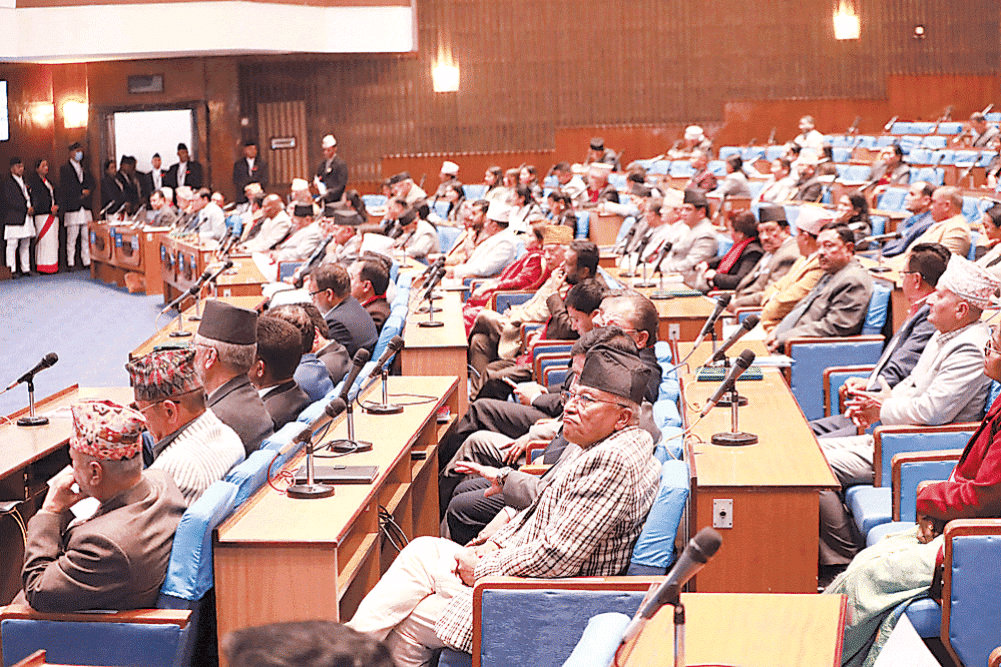
Do workers have to die more to get the agenda of migrant workers in parliament? Should domestic workers who have been sold be raped? Should the youth drowning in debt and being suffocated by exploitation, harassment, fraud and fraud have to decide to commit suicide?
We use Google Cloud Translation Services. Google requires we provide the following disclaimer relating to use of this service:
This service may contain translations powered by Google. Google disclaims all warranties related to the translations, expressed or implied, including any warranties of accuracy, reliability, and any implied warranties of merchantability, fitness for a particular purpose, and noninfringement.
Federal Labor Minister Sharadsingh Bhandari was giving a list of the works done by him in a dialogue program of Kantipur Television a few days ago and said that since he returned to the Ministry of Labor last time, he has done a lot of good work in favor of young workers going for foreign employment.
While he was making this claim, the news of a worker committing suicide somewhere in the labor market of a labor destination country was making headlines. The news that his body was buried in a box for four months while waiting to be returned to the country was disturbing the family of the laborer. This news shocked not only the Nepali laborers in the Gulf but also the South Asian migrant workers.
By the way, this is not the first statement of Bhandari, who has become a minister for the 18th time in the last four decades. And this statement is not only his. The tendency to claim that someone else has done something that they have always done best has become entrenched in the political culture. However, whether this competitive chanting has a positive effect on public opinion is a matter of debate.
There is a need for a separate debate to talk about the status, leadership and actions of the ministry that is in charge of the young human resources that occupy a large part of the country's population and a large part of them are foreign workers. But the possibility of that initiative is not seen at least in the case of the current leadership. This article is not an attempt to evaluate the work of the Minister of Labour. Because, I don't have the basis for evaluation, but the association, research and collaboration with migrant workers and their support networks have raised many questions for the minister and his team.
Now that the parliament is in session, the federal parliamentarians also have a question - Why can't a timely unified legal framework be on the agenda of the parliament to address the many challenges they are facing, including fraud, exploitation, fraud, deception, dishonesty, etc., which are the mainstay of the country's economy?
Foreign employment traders and their broker networks commit fraud step by step. Such fraud has been a mandatory culture of our foreign employment for decades and has been institutionalized not only in the ministry, but also in all state agencies that are attracted to the process of foreign employment. It is not to be believed that federal parliamentarians are unaware of this reality.
Because, foreign employment professionals are the grassroots organization of the party of MPs. He is a party worker. There was no such thing as not being aware of the activities of their workers. And the brokers who reach the village houses are also the agents who coordinate the work with this or that network of employment professionals. They also belong to this or that party.
Human trafficking and human trafficking, which flourished in the name of foreign employment, show no sign of abating. Rather, the patterns of fraud and exploitation are changing due to the increasingly toxic nature of global labor markets. Networks of fraudsters are increasing self-interested intervention at the very heart of state-run agencies. Anyone who is interested in labor migration will understand that human trafficking and human trafficking in the name of foreign employment is increasingly flourishing. How can we assume that the people's representatives who represent the Nepali villages, which are run by the capital of immigration, do not know this?
There is a committee on labor in the federal parliament, but why is there no systematic discussion of the problems and challenges of foreign employment? Compared to other topics, how can those migrant workers, their families and the general public who are interested in this dimension understand this silence?
In terms of foreign employment, the most important question now is why the previous agreements are not being revised and renewed in a timely manner? is to say Since the labor agreement has not been renewed for years, it has been converted into a general agreement and has reached work. And how many new destinations have forced laborers to go to Hachuwa.
s that have made workers more vulnerable in the immigration process and in the workplace. Because as it happens on the ground of this agreement, when more and more workers are sent to businessmen who specialize in fraud and bring them to agents and employers who are experts in exploitation, the rights of workers tend to be secondary.
This situation signals a message that our political and administrative leadership cares more about sending more remittances to unemployed youth than protecting workers and accessing justice. It is an aspect linked to the political and economic interests of the parties. Access to protection and justice is seen and understood only in relation to the laborer and his family. Let's say that a young man or a young woman is too lazy to work in the country and goes abroad, or going abroad is a part of his entertainment.
is a moment of excitement and celebration. Minister Bhandari's discriminatory comments such as saying that young people who own two buffaloes in his region Madhes province go abroad to make three buffaloes, doesn't this also show his attitude towards migrant workers? What does he know, Madhes province is one such province, where the human development index is among the weakest. Most of the unskilled youth migrate abroad and are more exposed to exploitation, fraud and injustice.
Similarly, another important question is why the reforms that should be done to open up the restrictions imposed on women domestic workers have not been done for decades? Why is the minister talking about raising the risk of women domestic workers by sending them to the destination country as a trial force instead of holding meaningful talks through labor diplomacy and making fundamental reforms to protect the rights and interests of workers?
In spite of the many examples of exploitation, fraud and violence that have been experienced for three decades, why is it still a test game instead of making the labor migration safe and dignified by improving them in principle? Who is making this decision for whose benefit? Can the general public and the families of workers question the Ministry of Talukdar or not? Regarding female domestic workers, where are the suggestions given by the migrant workers who are interested and have come back to go to G to G modality through the policy research institute of the government?
The possibility that the labor market, the destination of workers who have just woken up after the corona virus, will become more unstable and complicated due to the fluidity of the recent world politics, cannot be denied. Which will not only weaken the social justice of migrant workers, but it is certain that the diversification of differences based on apartheid and national identity will become more complicated.
In this situation, countries like ours, which are affected by remittances, should be more careful and focus on securing employment opportunities that are not available in the domestic labor market by lobbying in favor of their workers through labor diplomacy and making a balanced labor agreement.
India, Bangladesh, Sri Lanka, Thailand, Philippines, Vietnam, Cambodia and other countries are doing the same. But unfortunately, we have not even been able to renew the past labor agreements. We are pushing our citizens on the risky path of testing. Is this situation a sign that we are not able to understand and manage our labor migration process?
When studying the documents of the Ministry of Labor, it is also clear how naive we are in terms of immigration management. Labor migration cannot be managed by calling the ambassador of the destination country and begging them to send Nepali workers to your market. For that, there is no alternative to decide the latest legal blueprint of integrated immigration based on the time and political system by covering the various dimensions of immigration that are attracted to the ground conditions of Nepal. Why are our MPs not interested in this?
This situation indicates two sides. On the one hand, the extremism against migrant workers seems to be normalized by a large section of Nepali society, including political ones, who consider themselves employers. Because
, this episode is classy. He is confident in terms of political connections and interests. In this category of confidence are the businessmen who have grown up as the class organization of the party. And his brokers happened to be the workers of the respective parties. Taking into account the remittances, the state's policy loopholes in political influence are sought to attract as many workers as possible, and flourish the farming of profits in the name of foreign employment. It is to fulfill political interests by saying that we have the magic wand to solve the problem of unemployment.
On the other hand, parties and parliamentarians who are ready to have a complex debate by bringing their own legal blueprints in the parliament in many ways seem to be adept at stretching the debate with convenience. But these do not speak clearly about the necessity of a timely legal framework in relation to migrant workers. Should migrant workers die more in order to get the agenda of migrant workers in the parliament, should domestic workers who have been sold be raped? Should the youth drowning in debt and being suffocated by exploitation, harassment, fraud and fraud have to decide to commit suicide?
However, in the previous televised debate, the incumbent labor minister, who came into politics with the 'luck of Rajyoga since the Panchayat period' to be a minister for 18 times, was saying that 'domestic workers are very interesting' - about 3,000 women will be sent to Saudi Arabia as a test. Yes, that's it, it's a matter of class.
There are more women and sexual minority workers who are not given a place in the family due to various gender violence, rift in family relations, deprived of the necessary education, skills and technical skills opportunities due to being women and marginalized communities, socio-cultural narrowness and being rejected by the domestic labor market and not given a place by the domestic labor market due to various reasons including political syndicates.
This group is forced to go into forced labor. His life is more important to him than the state and its restrictions. The departmental minister who came with the 'Rajyoga fortune' has to celebrate this group by passing it off as a fraudulent businessmen in a private house of a narrower society than their home society. What can be a more interesting irony when analyzing the gender aspect of foreign employment? Is this fun only for departmental ministers or MPs as a whole?
The questions raised/raised here are unanswered. There are many more such questions related to the Ministry of Labour. The real question is, is the current structure, leadership, direction and capacity of our Ministry of Labor up to the time to manage the increasingly complex labor migration? What challenges and opportunities have surfaced in today's changing global labor market? Where do we stand in the global and regional labor market? Is there an objective analysis of the political and administrative leadership of the ministry and the syndicate influencing it? Federal parliamentarians who are in the role of making policy should be held accountable or not?
In the end, it has been more than a year since the ministry started the process with the investment of its international partner to bring the Foreign Employment Act 2064, which has lost its context and significance, into a new version. But there were reports that the process has been revised within a limited circle. Where did that process go? Although the Ministry's scope is limited, the government's policy research institute has submitted a draft of a comprehensive/integrated labor migration policy blueprint to the ministry, with the participation of labor migrants' networks and researchers in a wider scope, although it is centered on Kathmandu.
What is the opinion of the leadership of the ministry? Where that legal process has reached has also been a matter of interest and doubt. The issue of doubt is also in the sense that, when it is called an integrated blueprint, there is a possibility of general manipulation of the old one without including the various dimensions of migration, such as human trafficking, smuggling, labor diplomacy, illegal immigration, labor migration between India and Nepal, and internal migration. There is a possibility that foreign employment will be easier for businessmen, but the protection of workers and social justice will be overshadowed. Which was also reflected in the minister's televised speech.
The federal parliamentarians should ask the leadership of the ministry to answer these questions. Let's have a thorough debate on labor immigration like any other issue. Let the common tax payers and the workers who are defrauding the country's economy by sending remittances be informed. Whether this expectation is fulfilled or not will be clear in the coming days. But let's all start asking questions from our own place.