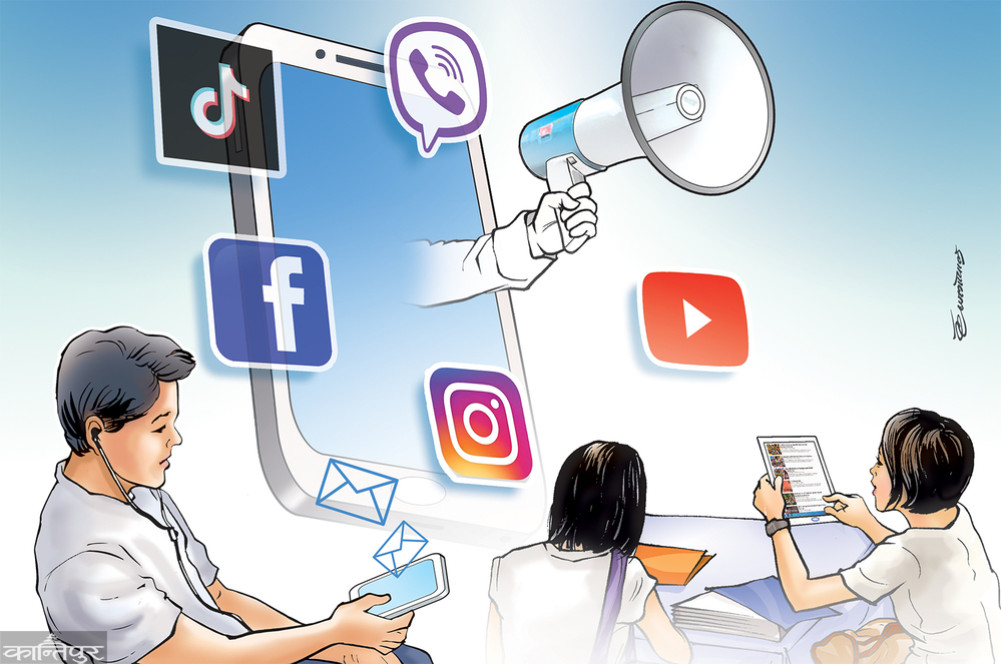
Social media users are being misused by some individuals or groups for their hunger for fame, their political and financial goals
We use Google Cloud Translation Services. Google requires we provide the following disclaimer relating to use of this service:
This service may contain translations powered by Google. Google disclaims all warranties related to the translations, expressed or implied, including any warranties of accuracy, reliability, and any implied warranties of merchantability, fitness for a particular purpose, and noninfringement.
Probably because there is no discussion in the Nepali intellectual world, even on the Internet, information about information terrorism, viral capitalism and digital workers are not found in Nepali language. The concept relates to the phenomenon of how digital workers dependent on social media algorithms weaponize misinformation to gain financial advantage. This helps us to some extent to understand the reasons behind the spread of misinformation.
The government's recent bill to operate, use and regulate social media is also unaware of these concepts. This article tries to discuss about these trends that help to understand the changes in the form of information, capital and labor in the digital society and the deep impact and impact it has on our daily life.
Social media expert Sinan Arel and communication experts Dev Roy and Soares Vosoghi analyzed 126,000 information shared more than 45 million times from 2006 to 2017 and published in the journal Science, a study says - false information spreads 6 times faster than true news. Even true news rarely reaches a thousand people, while political false information reaches about 10,000. After studying the spread of false information in depth, their conclusion is that political false information spreads very quickly.
false information is often new and unexpected, which creates feelings of surprise, fear or disgust in people and makes them more likely to share that 'information'. For example, during the Covid epidemic, the false information that '5G network spreads corona' was viewed more than 100 million times on Facebook. There are two main reasons for the rapid spread of false information - the 'algorithmic recommendation system' plays a key role in the spread of content on platforms like Facebook, YouTube, Twitter and Tiktok, and on the other hand, the lack of 'digital literacy', the ability to recognize false information, also plays a role.
Social media companies are not transparent about why, how and what content they promote. Algorithms tend to promote more stimulating content. Social media laws could clarify the public's right to know 'how it decides'. Laws introduced by the European Union and France on algorithm transparency can be an example. In addition to this, targeted digital advertising by various groups, click weight techniques and troll factories are also used to spread false information.
The interrelationship between 'information terrorism' and 'viral capitalism' in digital society helps to understand the causes of the spread of misinformation. The tendency to use information as a weapon to spread false information and propaganda is called information terrorism. Lately it has been associated with 'viral capitalism'. Viral capitalism is a new concept of the digital economy. 'Viral Capitalism' is the trend of rapidly spreading content on digital platforms and reaping financial benefits from it. Such trends have given rise to a new form of capitalism, where individuals gain wealth and fame through social media. Information terrorism supports viral capitalism. Where rapid dissemination of content and user attention transforms into 'profit'. Content creators make money by creating viral content on social media platforms.
Social media misinformation promotes viral capitalism. Most of the content that goes viral on social media platforms is based on offensive or controversial topics. To understand how viral capitalism exploits a sensitive event for financial gain, the alleged 'Amala Scandal' which was discussed in Nepal some time ago can be an example. There are many examples of how far 'digital workers' can go for financial profit.
The digital age has given rise to different types of communication workers. Some people are not able to differentiate between 'journalists' and 'digital workers'. Those who earn by creating content on social media, video streaming platforms and other digital media are called 'digital workers'.
Constant changes in social media algorithms, advertising policies and technology have led to digital workers relying on volatile incomes to resort to 'viral capitalism'. Digital workers depend on algorithms. Their content earns ad revenue only if the views, likes, shares and engagement rates are high. If a product, service or character goes viral in digital media, it creates instant branding opportunities and financial returns.
According to Tarlton Gillespie, a scholar of digital labor, 90 percent of digital workers depend on variable income. Most content creators' income is not fixed, because their income is influenced by algorithms. On platforms like YouTube, Facebook, Tik Tok and Instagram, content creators' incomes are greatly affected by policy changes made by platforms.
On the other hand, the competition in the digital content market is also high and in the absence of traditional employment benefits, insurance, pension or stable salary, such content producers are engaged in making quick financial gains by making false information viral. Empowering digital workers with rights such as minimum employment and social security through a connected platform can reduce the tendency to resort to 'virals' and encourage them to be accountable. Digital workers should see themselves as part of a responsible and democratic digital society. Platforms that are benefiting from the information and data of 'digital workers' in return only pay them from ad revenue, whose income is not fixed.
There are also those who earn from digital platforms by creating content in entertainment, education, technology, lifestyle or other diverse genres. According to Forbes magazine, Jimmy Donaldson earned $54 million in 2023 from YouTube videos alone. He did not resort to any 'information terrorism'. Many such content creators provide creative and informative content. There are also content creators who have made a lot of money from brand endorsements and sponsorships focused on beauty, fashion, fitness and lifestyle. Kylie Jenner, for example, charges $1.2 million per Instagram post.
Many YouTubers and digital media in Nepal are attracting the attention of viewers by producing negative content. Criticism and satirical content on old leaders is spreading rapidly in digital media. YouTube videos with titles such as 'Yo Neta Ab Sakio!', have gone viral. There is a trend of trolling targeting old leaders, trending hashtags and spreading false information. Such controversial content generates interest for social media users and, in turn, generates controversy for digital platforms. As negative content gets more comments, shares and engagement, these content automatically become viral. Rival parties also use this to attack the opposition party or leader.
As false information spreads rapidly, individuals and groups are misusing it to mislead society. Social media users are being misused by some individuals or groups for their hunger for fame, their political and financial goals. Social media users should think that they are not being misused in disseminating false information and controversial content for the vested interests of someone's financial gain and social power. In a country like ours where digital literacy is low, the risk of misleading people and unfairly influencing their decisions is high. Therefore, 'false information' is also an enemy of democracy and freedom of expression.
According to a 2021 study of viral content by Andrew Jones, 40 percent of the content that goes viral on social media is based on offensive or controversial topics. Controversial content gets more likes, comments and shares than others. Such content is based on unverified or false information, which creates misconceptions and confusion.
Information terrorism and viral capitalism are interdependent. When media consumers promote content through their views, likes, comments, and shares, the physical and economic impact of that content translates into 'viral capitalism'. The profit-driven model of viral capitalism promotes information terrorism. Because they are making huge financial gains from the process of spreading false information, but information terrorism spread uncontrollably has created a serious threat to the democratic process, social stability and reliable journalism.
– Wagle is studying at Communication University of China.