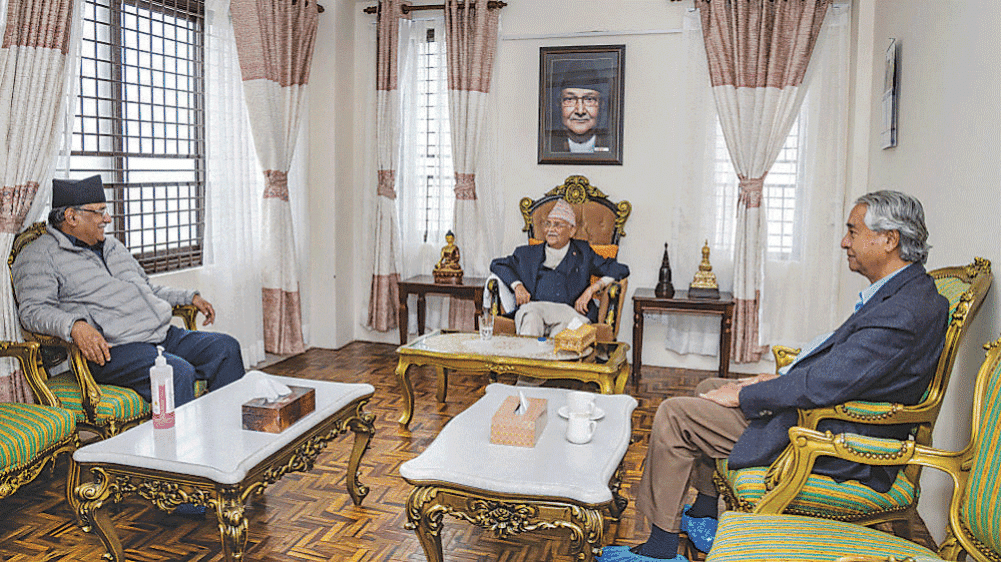
An interdependent relationship between politics and crime has been established and institutionalized. In the struggle to achieve leadership by running factions and maintain unity in the party only after being established, internal democracy and pluralism of society will be suppressed within the party.
We use Google Cloud Translation Services. Google requires we provide the following disclaimer relating to use of this service:
This service may contain translations powered by Google. Google disclaims all warranties related to the translations, expressed or implied, including any warranties of accuracy, reliability, and any implied warranties of merchantability, fitness for a particular purpose, and noninfringement.
Actress and Rashtriya Prajatantra Party leader Rekha Thapa's statement is now widely discussed on social media. She says - 'As soon as any child is born, he is born with the right to become the ruler and executive of the country, everyone has a way to become independent and master - the Republic. I will speak the language of the people, I will speak as a Rekha Thapa (individual) (rather than RPP). Not everyone likes the principles of the party. The party she belongs to is known as the monarchist party.
Kamal Thapa was its party president for almost 18 years. He was replaced by Gyanendra Shah from Rajendra Lingden as he left the issue of restoration of the monarchy in the republic. And, it is not difficult to understand that a different porter was sought in the new environment after the old celebrities such as Pashupatishamsher Rana, Lokendra Bahadur Chand, Prakash Chandra Lohani and Keshar Bahadur Bista were not chosen by the Shah. Rekha's statement comes in the wake of rumors of royalist restoration of Gyanendra Shah and Shah's appeal to help him, which is very timely.
Monarchy is not just about a king and queen, it is about a system. Being a king deprives the citizens of the right to choose their guardians or rulers. Irrespective of any qualities or virtues, only the king's children will be rulers. When the king is at the center of power, the influence and distribution of power revolves around him i.e. in the 'core'. It doesn't even reach the 'periphery'. It is a common character to have a relationship with the king, according to the level of closeness and trust and racial or class status, to be surrounded by the king, to form groups of people of such status, to compete with each other to please the king, and to use and abuse the king's power.
In a monarchy, only the elite of a small class have the advantage of power. People are deprived of all rights. Therefore, after the small group established by Hukum Pramangi, who benefited from being around the king, who enjoyed all the rights alone, after being displaced in the republic, it is no other way to have that dominance, dignity, and arrogance and try to bring the Shah forward again.
In principle, democracy is exactly the opposite. In a democracy, every level of executive and managerial responsibility has people's representatives. They go to regular referendums and gain legitimacy. Opportunities are distributed through methods and competition. Governance is governed by laws and regulations. All are equal in the eyes of the state and the law and the people remain at the center of all these processes. People who have similar ideas and principles organize themselves, choose party leadership through internal elections, compete between and through parties, and take responsibility.
Since the end of the monarchy, there is no need to go into that debate, but are political parties different from the character of the monarchy and developing and following the character of democracy? The main characteristics of democracy are transparency, accountability and rule of law. But has the country progressed like that? The people who brought the republic by throwing the monarchy have been able to feel it within the party and through it? Have the changers explained and made them realize the value, importance and value of being a people? These are today's Yaksha questions. This is the republic chosen by the Rekha Thapa generation and sought by the new ones. Contradictions in
systems and trends The
system is not automated, it is operated by a person or leadership. When the leadership uses the new system as political opportunism and utilitarianism and does not accept and assimilate the change, it is difficult to confirm the fundamental meaning and justification of the system change.
Political parties are the backbone of democracy. At all three levels, the executive (Council of Ministers), legislature (Parliament) and their leadership are elected from the party. So how much internal democracy does the party itself practice? How many policies, principles and methods have the party followed? How much have the responsible leaders within the party adopted and assimilated the results of the change and moved forward? How transparent and democratic leadership is selected in the party? How democratic is the leadership? How visionary, committed, humble and ethical, disciplined and pro-people are they? A standard like
is a measure of how advanced democracy is. But even when analyzing the Nepali political parties, leaders and activists from both vertical and horizontal angles, it seems that they talk big about social and political change in the country, everything else should change but they don't want to be themselves. He has a tendency to listen and understand them, but he does not listen to others.
The trend and practice of having to obey everyone but not anyone else has developed as a common character of Nepali politics. Parties are often driven by leadership directives rather than policies, rules and collective decisions. This practice is from central to local leader/activist level. As long as such hypocritical tendencies remain in the party and politics, it is not possible to address people's expectations and feelings in any system.
In addition, there is a Nepali practice of assuming the top or leadership in the party according to the hierarchy and classification, as in the generation of joint families like 'Ba' and 'Dai' based on age, maturity, and the period of involvement in the party. Even the remnants of such rituals are not systematic. This culture and tradition develops the party's decision-making and management practices through the leadership's attachment, intentions, intentions, orders and blessings, instead of reasonable, rational, factual and objective debates in a party that is supposed to be alive.
Thoughts, integrity, plans, programs, policies, images and ideals, integrity, sacrifice and contribution or dedication become secondary for leaders and workers. There is no atmosphere of fair competition and new leadership formation is not possible. As long as the senior is alive, his mioma team will go round the circle according to the level and role order through 'Ba', 'Dai' like musical chairs.
Even after the state provides old age allowance, all the young leaders who do not get opportunities within the party and organization will remain. Such tradition, culture and mechanism seem to be politically, structurally and psychologically hindering even for someone new to join politics or who intends to become a leader. The practice of having to take the leadership of the party by oneself, considering it unsafe to give birth and raise a successor in a competitive manner, within one's possession if forced, to move forward from the legacy as much as possible, to find out the competitors who have struggled on their own or who have developed capabilities has been established as a political culture of 'Nepali flavor'. The psychology of Hindi street literature like 'Buri Nazarwale, Tera Muh Kaala' dominates the leadership of every party. They do not lag behind in planning the journey of ascension with the leadership.
Manmohan Adhikari, Girija Prasad Koirala, Sushil Koirala, Surya Bahadur Thapa, Gajendra Narayan Singh party chiefs have died in history. Oli, Deuba, Dahal, Nepal, Hun of the old big parties or Yadav, Chaudhary, Rawat, Lamichhane or the small party Bijukche, KC, Vaidya, Mainali, Chand, Singh, etc., all the leaders of the parties are thinking of killing and staying in leadership after life. It is clear that all the energy, time, power and network are being spent on its implementation. On the one hand, this culture did not allow an 'agency' to be born and a 'ground' environment for politicians to become national leaders or politicians according to the needs of the country.
Everyone stripped each other and stripped one by one, now there is no way to bring back the lost faith and trust. At the cadre level, rather than working hard and developing leadership, it has become a culture to ensure opportunities by reprimanding the current leadership. Now in the Congress, except to a certain extent, there is a tendency not only to not question the leadership of any other party, but to get close to the leadership by reaching home and cheering even on the internet. The courage and status to question, hold the leadership responsible and accountable, and give creative support and advice was not developed.
It does not make political parties creative and timely. Makes workers ghosts and embezzlers. Nor does the government allow it to be effective. As a result, even if they are in the government of their own party, the status of the parties is limited to the character and role of the student organization and the opposition, which cannot do, manage and implement according to the law, cannot suggest and help from outside, but can only protest and protest. Its impact was seen not only at the level of citizens and society, but also at the system and system.
political socialization and mobilization
politics, to make civilized, cultured, abstract and to institutionalize and strengthen the change, the main need and role of a refined and modified responsible person who rose from the ancient practices, thoughts and traditions. Most of the first generation politicians who did the politics of ideas, integrity, ideals, struggle and sacrifice for change have passed away. Most of the second generation leaders are ideologically vague, divided, insincere, aimless, directionless, motionless and extremely utilitarian and opportunistic in behavior.
The current situation is that the latter and the third generation are dependent on this second generation, trained, influenced and socialized by them, and are following politics as a profession rather than a service. The fourth or new generation is mostly non-political in terms of political principles and culture, but looks like raw clay. Those who have the company of cultured and well-thought-out leadership, may turn into a chaotic group or a challenger in the clutches of national power and opportunists.
The rhythm and future of politics depends on the political education given to this generation. But the current party's structure, election, membership distribution, participation process and practice are within the syndicate of the elders, which was built by the leaders themselves to choose the leadership from the workers who have chosen their livelihood.
The parties have not developed new leadership for decades. The second generation seems to be waiting for their turn to give and receive. A single person born by the movement does not get an opportunity to lead the party and it is not possible for anyone from outside to enter the party as a leader and make a place. An alternative force that can upset this root is not yet visible inside and outside the party. This vicious circle developed within the country and the party has made the established leadership of any party unchallenged and arbitrary like a king.
In such a syndicate, the workers are unlikely to get a place and opportunity in a party that does not hold the tail of a leader. That is why factions have flourished. Rather than on the basis of diversity in opinion and loyalty, it has become the compulsion of the worker to join or move to the faction that can be more secure and profitable. Therefore, no matter what can be done or not, the faction that can protect the workers and 'keep' those who are unemployed seems to be the biggest. Also, among the workers who can carry, develop and use the true character of the leader, he is said to be close to the leader. Based on the depth and level of the relationship with the
leader, his position in the group and on behalf of the group is formed and established. This status has become a terrible vicious cycle of getting a role within his party, participating in decision-making and implementation, getting a ticket and winning the election, securing an executive role after winning, again working according to the leader's orders and intentions and further strengthening the future. Instead, dedication and reliability towards the leadership is expected, from whom further opportunities are determined by examining and evaluating the impact and results.
Therefore, instead of developing political consciousness and leadership capacity, many leaders/activists have to resort to brokering and swindling within the party. The party is also responsible and accountable for both its rewards and counterproductive results. This is the result of leaders publicly defending cases against 'big fish' who are considered to be involved in corruption and cannot even be touched by the authorities.
In another sense, the interdependent relationship between politics and crime has been established and institutionalized. When the internal democracy and the pluralism of the society are suppressed within the party in the struggle to reach the leadership through factions and to maintain unity in the party only after establishing itself, then the semblance of monarchy comes again.
conclusion
The political and civil culture should be developed by praising and encouraging the good work done by the leader and criticizing and giving suggestions for the bad work. But instead of that, setting up a mechanism culture that produces blind devotees and youths are more involved in it is leaving the path of future leadership development, democratization of the party-country, development and strengthening of political culture and setting a journey towards chaos and destruction. A nation cannot be built, nor can development, prosperity or advancement be possible unless the citizens themselves are aware, alert and active. On the contrary, there is growing opposition and anger that the country is moving towards the establishment of Netaraj instead of the rule of law, with leaders becoming kings, officials burdened and all other subjects.
It seems that the ancient power can take advantage of this murky water inside and outside the country. The key point to be understood here is not that the leaders of such public outrage parties did not have the ability to be like a king, but that they dominated everywhere like a king and paralyzed the republic. Therefore, in order to make politics system-oriented and dynamic, the pressure is intensifying that the senior leaders should become guardians and transfer the leadership to those who are unbroken, unbroken and able to face new challenges even within the party.
is largely determined, constructed and defined by politics. This system and the mentioned situation, as the facilitators of both are political parties, it is necessary to establish and develop a republic within it. In order to institutionalize democracy and republic, the roots of political culture and heritage politics should be uprooted. It seems that the initiation and initiation of this process should be done from within the parties. Then every newly born citizen has equal and secure rights and chances to become an executive.