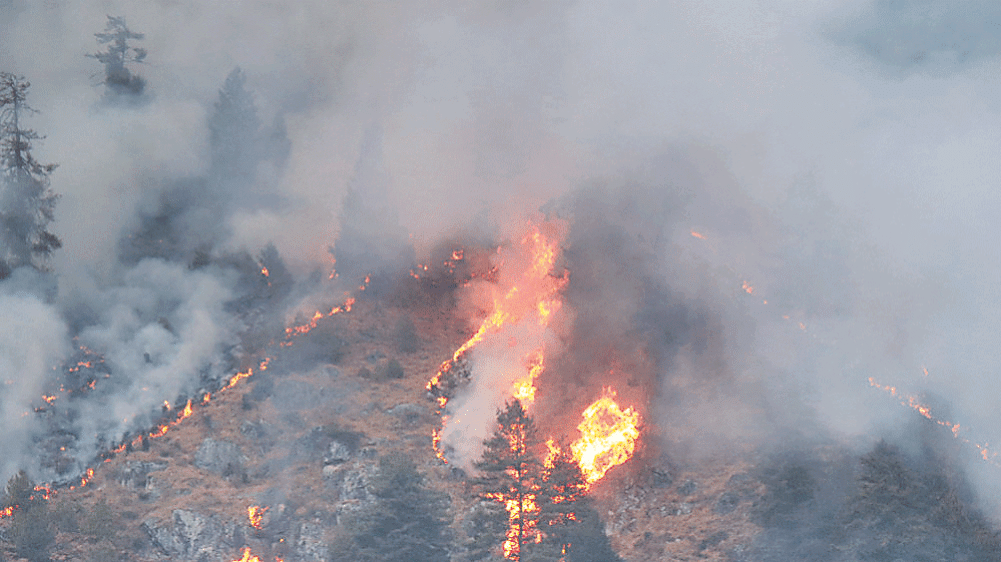
It is possible to celebrate a forest fire zero decade if policies, awareness, funds and penalties can be arranged along with strict punishment for those who set forest fires.
We use Google Cloud Translation Services. Google requires we provide the following disclaimer relating to use of this service:
This service may contain translations powered by Google. Google disclaims all warranties related to the translations, expressed or implied, including any warranties of accuracy, reliability, and any implied warranties of merchantability, fitness for a particular purpose, and noninfringement.
Forest fires not only affect forests, wildlife and the environment, but also cause great damage to people, water, water bodies, forests, animals, herbs and biodiversity. It also affects climate change due to toxic air emitted from it. Every year in Nepal, during the five months from January to May, forest fires occur in hundreds of places every day.
Based on the data since 2057 in Nepal, more than 42 thousand forest areas have been destroyed by fire. Due to the spread of fire from forest to settlement and from settlement to forest, crores of wealth has been destroyed and dozens of forest workers, community, protection workers and security personnel have died while fighting the fire and the same number have been injured and disabled.
Forest fires occur on natural and man-made basis. A fire can also be ignited by lightning, wind-dried bamboos, friction of trees, landslides and large rocks. Human-caused fires are caused by ignorance or mistake, while forest fires that are set deliberately and for their vested interests have proven to be even more deadly. It is relevant to say that ``Prevention is better than treatment'' and that ``prevention is better than control'' is also relevant in the case of forest fires.
In Nepal, more attention has been paid to forest fire control than prevention. It can be understood from many past incidents in Nepal and the difficulty of controlling forest fires in the United States that it is expensive and risky to control forest fires. If we can prevent forest fires, we can reduce the impact of climate change and human health by reducing air pollution.
Protecting the watershed area increases the water storage capacity and helps in supplying the necessary water in winter. When forest fires are prevented, it will be possible to maintain human-wildlife coexistence by reducing the number of wild animals entering the settlements. Scientific research has proved that once a forest is burnt, it takes 18-19 years to restore that place to its original condition. So, is it really possible to reduce deadly forest fires in Nepal from every point of view?
In Chitwan National Park in 2058/59, when I saw the line of rhinoceros killed by poachers and put on their noses to get their horns, it seemed that all the rhinoceros from Chitwan were hunted and killed. It was a time of conflict, even zero poaching of rhinoceros, which seemed impossible, with determination, confidence, patience and learning from mistakes, in 2058 at least 37 rhinoceros were killed by poaching in one year, and that number gradually decreased and we succeeded in bringing it to zero in 2064.
In 2066 and 2067, when rhino poaching increased again, it is a matter of pride for Nepal that we have succeeded in reducing rhino poaching to almost zero since 2068, with the cooperation of the government, security agencies, communities and conservation partners.
Even though it seems impossible to prevent forest fires in Nepal, it is not impossible if the government and the community cooperate together by setting the goal of a zero forest fire decade. Effective strategies and plans should be formulated for forest fire prevention and control.
In addition to the necessary budget, implementable programs, dedicated manpower, community and government employees and security personnel should be provided with services, facilities, incentives, insurance arrangements and strict punishment for forest fires. In addition to this, if policy, awareness, fund and punishment can be arranged, it is equally possible to celebrate the zero forest fire decade in Nepal, like the year of zero rhino poaching.
Forest fires are caused by the combination of heat and oxygen, especially flammable materials such as leaves and dried twigs. Two elements are under our control to prevent this. The most important issue for forest fire prevention is to pay attention to combustible materials and measures to reduce heat. The best way to prevent forest fires is to remove flammable materials from the forest by working together with foresters, communities, and security personnel, like the Gorkha and other divisional forest offices. It is very easy to suggest to others but what have we done ourselves? It is a matter of introspection.
In Chitwan National Park, I used to be shocked to see the forest fires that started in the name of grassland management and the park itself was destroyed. Deforestation in the catchment area of Bagmati river and drinking fountains in Kathmandu valley is like the death of rhinoceros in Chitwan.
Based on the experience of allowing the local community to collect scraps in Chitwan for the removal of inflammable substances, in coordination with the Central Zone Committee, an arrangement was made to allow the local consumers to collect Jhinjhamizha, Patpatingar, Salla Salleri and Simta for certain days in Shivpuri Nagarjuna National Park. After the
, efforts are being made to prevent and control forest fires by arranging it in Rule 20 of Shivpuri Nagarjuna National Park Regulations, 2076. By doing this, on the one hand, flammable substances were removed, and on the other hand, by being able to use the forest resources within the park, a sense of belonging to the park was awakened in the local community. Therefore, giving the community the opportunity to remove all flammable materials from forest areas across the country without consumption is a smart way to prevent forest fires.
Forest fires in steep areas like Chure, Madhya Pahad and Mahabharat Pahad are challenging for us. Public awareness should be raised by mobilizing community forest user groups and intermediate zone user groups, which can reach every household on the edge of the forest. The park-reserve office should use controlled fire for grassland management. Ranchers did not set fire to the forest so that new grass would grow, farmers had to be careful when burning leaves for fertilizer in the fields.
Those who enter the park and forest area are not allowed to carry cigarettes, bindi, marijuana, hookah, firecrackers, candles, explosives, matches, lighters, swings, hydrogen-filled balloons, gas, heat-generating electrical equipment. Based on the experience of the forest fire near Tarakeshwar temple in Shivpuri, it is necessary to monitor the youth who go to the forest to eat marijuana and discourage it during the dry season. Arrangements should be made to keep the ganjajs who attract young people to consume ganja by making huts in the forest outside the forest during this season.
Goal burning should be completely prohibited. Beehives, forest camping and campfires should be completely controlled. The act of walking in the night, burning firewood should be discouraged and the alternative should be used. Farmers, shepherds, porters should be warned to be careful while cooking in the forest. The trend of culling should be strictly curbed. Forest encroachers must stop burning national property worth crores to remove trees.
Burning of trees to dry them to collect forest produce should be discouraged. Criminals who set forest fires to hunt wildlife poachers should be prosecuted. Organizers should be careful that the fire does not go to the forest while worshiping Vanadevi, Vanjankri, and the monastery inside the forest area. The security agencies should also stop the practice of moon mari within the forest area during this period. Dry trees, bamboo, babio, simta, salleri should be removed from the forest as far as possible. If the branches of the tree touch the electric wire and the branches of the tree are washed on the roof of the house, it should be covered in coordination with the owner, community and related agencies. Although the name
is a forest feast, earlier forest feasts used to be held in nearby fields and near empty fields near water sources. However, at present, the forest office, park office, community forest user groups have built forest picnic areas within the forest and park areas in the name of source of income.
One of the causes of forest fires in Nepal is forest food. As it is said, ``Halo Kater Mungro'' due to the system of eating forest food in the forest area for the greed of some money, when forest fires occur, the forest worth millions is destroyed. Lately, a forest picnic site has been constructed within Shivpuri Nagarjuna National Park.
On the one hand, tourists should not be disturbed when entering the park because it will affect the wildlife, on the other hand, it is wrong to encourage them by creating forest food places inside the park. Chickens, goats, goats and ducks are slaughtered in the forest feast inside the park, and when they are washed, the water springs and drinking water sources of Kathmandu valley are contaminated with waste material and the smell of meat and blood attracts carnivorous animals such as leopards. There is a situation where the forest can be burnt due to the fire lit to cook the forest feast, and the park itself is disfigured by the garbage such as alcohol bottles and plastic. Such forest banquet places should be closed unconditionally.
The unstoppable dangerous factor in forest fires is wind direction and speed. This makes the fire more widespread and powerful. To control forest fires, the fire is extinguished after reducing the 21 percent oxygen on the surface to less than 15 percent by sprinkling water, adding soil, sand, apple pulp, pitter or swatter. This year, due to the dry drought, the combustible material has dried up badly.
Therefore, in order to control forest fires as a preliminary, an implementation plan must be created that includes the available manpower, resources and means in the government and community based on the steepness of the land, wide-leaved, angular, evergreen, deciduous and forest types. After analyzing the fires in the past, the low, sensitive and highly sensitive areas should be separated, fire lines should be constructed, shallow chakla pits near the forest areas should be covered with plastic and filled with water.
The practice of investigating and prosecuting forest arsonists is extremely rare. Forest fire control is possible if a mechanism can be built to prevent forest fires and reward and salary facilities can be provided to those who inform about them.
Forest fires strip the land and loosen the soil. This creates a favorable condition for the water droplets to break up and wash away the soil, leading to excessive soil erosion and landslides. By making zero forest fires, we can protect the drinking water, irrigation and hydroelectric power that people need, and prevent the polluted air that affects climate change. If we can prevent forest fires, not only the watershed area will be protected from biological diversity, forest, animals, herbs, we will also avoid the terrible destructive floods, landslides, inundation and erosion that come in the rains and the physical infrastructure will be protected.