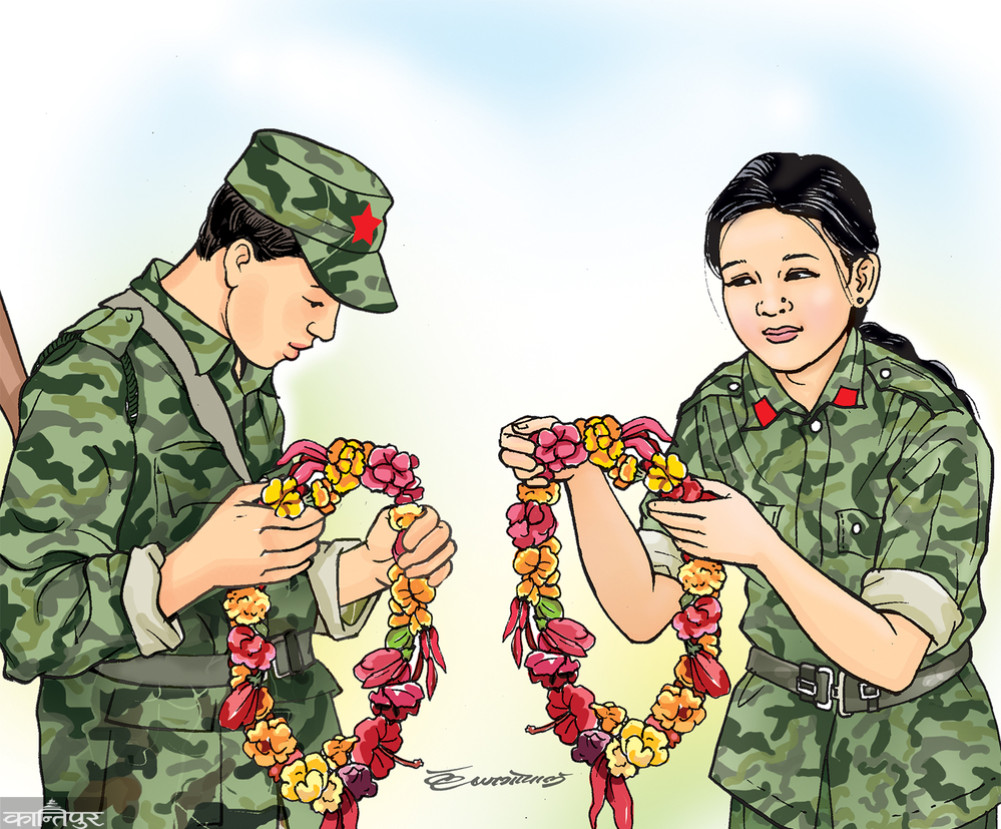
The three main causes of relationship breakdown are caste, class and patriarchy. The Maoist insurgency wanted to drastically change all these three things. But after the fighters return home, the return of casteism and a huge gap in the class of husband and wife seem to be the main reasons for 'divorce'.
We use Google Cloud Translation Services. Google requires we provide the following disclaimer relating to use of this service:
This service may contain translations powered by Google. Google disclaims all warranties related to the translations, expressed or implied, including any warranties of accuracy, reliability, and any implied warranties of merchantability, fitness for a particular purpose, and noninfringement.
In the second week of February, after completing the defense of the thesis, I put the title of the thesis on social media - "Marriage and Divorce of Nepal's Maoist Ex-Combatant". Many congratulated at once. Slowly trolls also started. Most of the trolls were foreigners and some Nepalese too. The trolls were mostly 'masked'. Who didn't have his photo on his profile. Their point was that social science cannot produce 'workable' research.
Is social science dead or not dead for many years around the world? There is a wide debate going on about that, this is the result of that. Especially in western rich countries, only subjects such as science and technology, not social science, accelerate social progress, so the voice is being raised that social science should be discarded. This voice has become stronger as the influence of fundamentalists has grown from developing to developed countries. Jawaharlal University in India is a nearby example. There has been widespread interference by fundamentalists in the department of social science, where voices of different opinions are echoed. There is an example of those who interpret nationality differently. Also, to reduce such noise, the government has intensified its recruitment of its own cadres who bow down to power. Sociology that questions and cautions power and society has been made almost dull. Not only JNU, but all over India, the voice of intense hatred towards social science is being voiced by the government itself. In the US context, a recent study says that 'hate speech' has become more prevalent on Twitter since Elon Musk bought Twitter. The common man's understanding of how anything is shown is what fanatics are doing. Therefore, what is shown in the western media and epistemology, the same thing is being expressed through common people.
Is social science dead?
Sociology has an important role in understanding the complexities within the existing social, cultural and economic perspective, society and human relations. Unlike the research and exploration of science and technology, social science studies the complex aspects of human behavior. At the center of which are common man and society. Its research on public policy, education, health and the integral social forces of human society can have an impact on the daily life of the common man and society as a whole. In Western society, there may be several reasons why the argument that social science should be discarded has been voiced. They doubt the direct utility of social science. They doubt the methods used during the study and also question the conclusions drawn by the study. They also understand that conclusions are biased due to the cultural and perspective limitations of social science. Social science can draw a roadmap for the distant future, even if it does not have immediate benefits or immediate results. However, they ignore this issue.
Sociology's Roots: Family, Society and Relationships
The original meaning of the trolls explained above was, 'What difference does your study make?' The troll's answer to this question comes from a faceless account named James, “…but this is an official sociological study. The basic pillars of society are family building and relationships. This is the main point, this is the character of sociology. The main focus of my study is what happens when revolutionary ideologies and social forces collide. That is, the Maoist fighters, guided by the revolutionary communist ideology, interacted with the social forces such as love, caste, marriage, society, family, divorce, and what was the result? An attempt is made to discuss this.
Maoist rebellion and public discussion
Let's look back a little later, they claimed that the Maoist rebellion itself started with the aim of 'destroying' the mainstream social and political corruption. Its success and failure are also based on the content, and the debate is still ongoing. There has been an insignificant debate about inter-caste marriage (especially between Dalits and non-Dalits). The mainstream media seems to have been talking about the divorce of those who got involved in the Maoist rebellion for many years. That is not the truth What was sold was that the (interracial) marriages during the war were destroyed.... That is, the marital status of the fighters was disturbed according to the reports seen in the media. Those articles and thoughts were the sensation of the time. Which man read with interest. game However, those contents that were shared among the common people did not have a comprehensive analysis of how revolutionary ideologies and social forces (such as caste, marriage, family, society, etc.) work together or collide. Sociological analyzes of the return of Maoist fighters in the scholarly circles were also of a one-sided nature, either full of eulogies or only negative comments, or rather lacking in sociological thinking.
revolutionary ideology and social power
The Maoist insurgency had a strong ideological influence among its cadres during the war, but after the peace process, that ideological influence weakened. How does the interaction between ideology and social power work in Nepal? What are the strengths and limits of the revolutionary Maoist ideology that aims to draw the boundaries of social and cultural change? The essence of the study with such a purpose was, if the revolutionary ideology is mixed with the social forces, these two can realize the direction of advancing the society by showing a relationship of coexistence. Sometimes the revolutionary ideology is powerful in this sense and sometimes it can be weak because it has to blend into the society. This conclusion came after direct interviews with the fighters.
An important aspect of the Maoist insurgency in Nepal was the very liberal concept of love relationships that led fighters to marry. Such leniency towards love (which leads to marriage) between fighters was not seen in insurgencies such as the LTTE in Sri Lanka and Naxalism in India. The then senior leader of the Maoists said during the interview, "Maoist fighters were not miraculous or talismanic powers, they also needed love and support." The party policy determined on monogamous relationships encouraged the fighters to marry inter-caste. When there were some problems, it was solved by forming a bridge between the couple. However, the lower level (bahun-kshetri) leaders also tried to stop the ready fighters for inter-caste marriages. Although this was contrary to party policy, it meant that revolutionary ideology did not work equally well in Maoist circles. Maoist fighters, whether during or after the war, have been seen to advance in relationships only by introducing their loved ones to family or relatives (women were at the fore). This means, the fighter wanted to get his relationship approved by the family. The squeeze can be extracted, on the one hand, the Maoist fighters want to maintain their revolutionary image by inter-caste marriage, on the other hand, they also want to be obedient children of their parents and family.
While progressing towards marriage through inter-caste relationships, especially women fighters used to move their mothers and families forward. In this way, it is understood that society and family had a strong presence in the revolutionary ideology of making a decision at the same time so that there will be no trouble in the family in the future when marrying before the mother and the family. Therefore, home, family and society have always dominated the marriage relationship of Maoist fighters in Nepal. What will the society say about non-Dalit high caste families who have accepted marriage? The feeling of that was very much fabricated. It seems that non-Dalit mothers are not even able to despise their children's choices and are also worried about what objections will come from the society. In order to get out safely from this mentality, they had prepared a strategic narrative that, I did not believe, the customs of the society should not be broken, but the children were also stubborn. Such successful marital status shows the equal role of revolutionary ideology and social value and recognition in social integration. In addition, it is seen that these social forces play a significant role in the success of inter-caste married life of fighters at the time of research, and in some cases, it is also seen that the revolutionary ideology itself led. For example, it was seen that such inter-caste relations were easily accepted from the perspective of family members also being involved in the rebellion, while it was also seen that there were problems in such relations in rural areas where high caste demographics such as Brahmin-Kshetri were more. Intercaste couples who joined the Maoist rebellion and married revolutionaries and lived in urban areas did not see any problem.
According to the media, were most of the marriages between Dalits and non-Dalits broken by Maoist fighters? Straight answer – no, not all were broken. So what happened? In this context, the media has over-sold sensation among the people without doing the overall situation. It is true that there have been problems in some marriages that took place during the conflict. In this too, the dominance of social power is seen. For example, caste, class and patriarchy are among the three main causes of relationship breakdown. All these three things the Maoist insurgency wanted to change drastically. But after the rebellion was over, these social forces emerged before him. The return of casteism after the fighters return home and the wide gap between the classes of husband and wife seem to be the main reasons for divorce. Similarly, the creation of equal relationship between men and women, which was proclaimed by Maoists, also became very weak after the end of the war. Patriarchy or a poor view of women are also reasons for the deterioration of inter-caste marital relations of fighters.
Overall, unlike any other perspective, the end of the Maoist insurgency has seen widespread social integration of combatants. Such social integration seems to have benefited them overall. Therefore, if the leaders during the insurgency had also educated the fighters about these different levels of social integration, such inter-ethnic relations would have gained stronger support.