The development of a democratic state system should promote equality and justice, but due to the influence of neoliberalism, it has led to the creation of extreme economic inequality and discrimination all over the world.
We use Google Cloud Translation Services. Google requires we provide the following disclaimer relating to use of this service:
This service may contain translations powered by Google. Google disclaims all warranties related to the translations, expressed or implied, including any warranties of accuracy, reliability, and any implied warranties of merchantability, fitness for a particular purpose, and noninfringement.
Art is shared by all. Common resources should also be used fairly by all. But, the world is not like this. A limited number of people have become rich by occupying the maximum resources of the world, while the number of poor people is increasing exponentially. The "World Inequality Report, 2022" revealed the fact that the richest 10 percent of the world owns 76 percent of the world's wealth and 50 percent of citizens own only 2 percent of the wealth.
Similarly, according to a report published by Oxfam in 2024, the richest 1 percent of the world has more wealth than the 95 percent of people with poor financial conditions. The report states that the 1 percent hold 43 percent of the world's financial assets. It shows the reality that the world is controlled by certain individuals and corporations and that the majority of people are deprived of wealth and financial resources or live in poverty.
Even in America, the world's economic power, 11.5 percent of people are below the poverty line. In India such population is about 22 percent. According to a 2021 report, the richest 1 percent of neighboring India owns 40.5 percent of wealth. Thus, among the groups forced to remain below the poverty line in America, African Americans are the most, while Hispanics are in second place.
In India, the majority of Dalits, tribals and Muslims are below the poverty line. In the case of Nepal, the Multidimensional Poverty Index showed that 17.4 Nepalis are in multidimensional poverty. Similarly, the National Living Standards Survey has shown that 20.27 percent of Nepalis are below the poverty line. Thus Dalits and marginalized communities are the most below the poverty line.
Around 1950, on the one hand, the world politically advanced in the process of democratization, while on the other hand, world capitalism, which developed rapidly, was developing. Theoretically speaking, the development of a democratic state system should promote equality and justice, but due to the dominance of neoliberal capitalism, it has led to the creation of extreme economic inequality and discrimination all over the world.
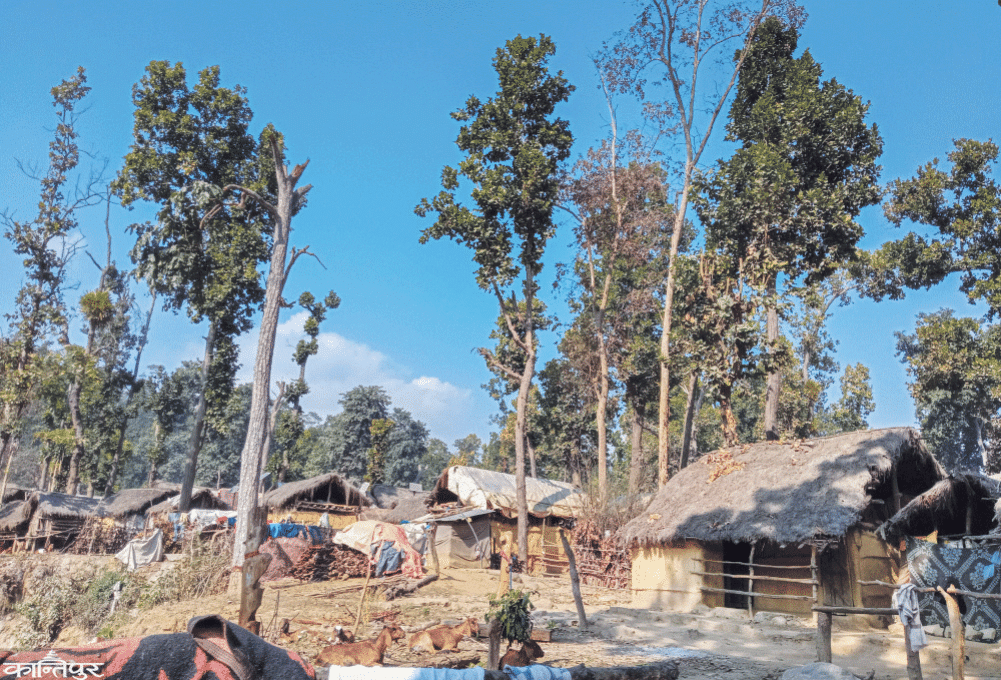
In the feudal economic-political system in Nepal, all the natural and financial resources of the state were in the possession of the feudal lords. Even in the capitalist system that is developing after 2046, they have been transformed into feudal capitalists. In other words, the cycle of financial exploitation and oppression of the laborers, workers and farmers of Nepalese society is continuing. Thus, the number of Dalits, Muslims and marginalized communities is the highest among those who live in a state of economic poverty or are forced to live below the poverty line.
financial vicious circle marginalized communities
It has been almost 6 decades since the poverty alleviation debate started in Nepal. But when there is a debate about poverty, which is the rich class of Nepal? Which community? Why did certain castes and communities end up in extreme poverty? There is not much debate and discussion about the historical context of monopoly and hegemony over the country's natural resources and assets.
How the majority of marginalized communities in Nepal were trapped in a vicious cycle of poverty and how certain families and communities captured the state's resources and assets should be looked at historically. Until we see it that way, neither the debate on poverty will be complete, nor the journey of economic development and prosperity will be meaningful. For example, Dalits, who use labor, skills and art to fulfill the needs of the society throughout their lives, were not only exploited from generation to generation because of their caste, they were forced to live the life of a slave.
If there was a condition to get capital through labor, naturally the economic life of Dalits would be very high. If the Dalits, who put in a lot of labor and sweat in the agricultural sector, got the right over the land, they would not only be freed from slavery, but there would be a great transformation in economic and social life. Likewise, the Tharu's economic life would have been different if the hill rulers had not looted the Tharu's land and turned it into a profit.
Some of the tribals have been displaced from their traditional land due to the seizure of tribal lands in the name of land reform. In this way, the discussion of development, which is done by forgetting the history of oppression by the class and community holding the reins of state power on the marginalized community, cannot give justice to the oppressed community.
Even in the democratic system based on the open market economy after 2046, the marginalized communities are the most subject to economic exploitation and financial oppression. For example, the traditional occupations and businesses of the Dalit community have been transformed into capitalist profits with modernity. Due to the lack of necessary capital for the modernization and commercialization of skills and businesses, most of the Dalit communities have not only been displaced from their traditional occupations, but have also fallen into the trap of unemployment.
The middlemen around the power are making enormous profits from the agricultural products produced by farmers. The state that needs to end the tyranny of the middleman is always involved in protecting the interest of the middleman. This has finally created a situation where the working class, farmers and laborers cannot escape from the vicious cycle of poverty. Basically, the oppressed community has become more oppressed due to such problems. Therefore, such issues have not been given much place in the discussion of poverty or economic transformation in Nepal.
By the end of the last fiscal year, the government's debt was 24 trillion 34 billion 90 million. As of last January, such debt has reached 26 trillion 11 billion 60 million. Of that, internal 12 trillion 82 billion 81 billion and external 13 trillion 28 billion 25 billion. Even after the formation of the government under the leadership of KP Oli, it seems that the amount of loans is increasing rapidly. On the one hand, the state is imposing taxes on the people and on the other hand, it is imposing heavy debts day by day.
It is destroying the economic life of the communities who have been forced to suffer economic exploitation and financial oppression for generations. However, the capitalists, contractors and professional brokers and middlemen are taking huge benefits from this system. The state is engrossed in protecting the interests of the middlemen by burdening the poor and marginalized communities with debt. Such an economic system has increased the danger of the poor and marginalized communities getting trapped in the cycle of poverty.
From the year 2026, Nepal is transforming from an underdeveloped to a developing country. Overall, Nepal seems to have made a leap in development. However, the transformation of Nepal into a developing country does not make any sense until the economic life of the marginalized communities, which have historically been affected by deprivation, poverty and inequality, is improved.
Therefore, the discussion of economic transformation, poverty alleviation or prosperity of Nepal must necessarily include the historical financial exploitation of marginalized communities, the current situation and the issue of liberation from it. End of poverty and equitable economic development in Nepal is impossible without reviewing the extreme economic inequality created by world capitalism as well as analyzing the crisis caused by Nepal's neoliberal capitalism in the economic life of marginalized communities. Socialism limited to the
slogan
Theoretically, all the political parties in Nepal seem to have assimilated the socialist socio-political system. Political parties have also been formed in the name of socialism. Most of the political parties formed in this way have representation in the parliament. Be it CPN (UML) or Nepali Congress, which leads the ruling coalition, sometimes they discuss socialism. However, no parliamentary political party has a socialist economic idea or approach to solve the problems created by historical exploitation, oppression and atrocities on the marginalized communities of Nepal.
If there was a commitment to building a socialist economy, at least he would have discussed the socialist economic system within the party. Socialistic economy was discussed when the government's policies and programs were being formulated or the budget was being allocated. Most parties do not want to make socialism anything more than a rhetorical slogan, because they have the most to gain from the present anarchic capitalist system.
The party leadership and workers have benefited from capitalists and middlemen who have more control over the economy. There has been an economic transformation in the lives of millions of unemployed workers. This party has no interest in the debt forced by the state on the poor, nor the lives of citizens who are forced to commit suicide due to lack of finances.
Remittances have been contributing 23 to 30 percent to Nepal's gross domestic product. The poor, laborers and laborers have contributed so much to the economic sector of the country by going abroad for employment. Remittances have proved to be the backbone of the state's economy. On the other hand, due to foreign employment, the poverty of marginalized communities has also decreased to some extent. Thus, foreign employment has contributed to poverty reduction of marginalized communities, but the state does not play a significant role. The poor have tried to reduce poverty on their own.
The long practice of the past has shown that an economic system controlled by brokers and middlemen cannot transform the economic life of marginalized communities. Therefore, only a socialistic economic system of the nature of having a fair access, ownership and control over the natural resources of the marginalized community deprived of financial resources, means and access by the state, ownership and control of the community in production, market, exchange and consumption and building a self-sufficient national economy can bring transformation in the economic life of the poor and marginalized community. Therefore, it is necessary to rapidly advance the necessary debate and discussion for the construction of an economic system for the benefit of marginalized communities, so that the country can move forward towards real socialism, not slogans.