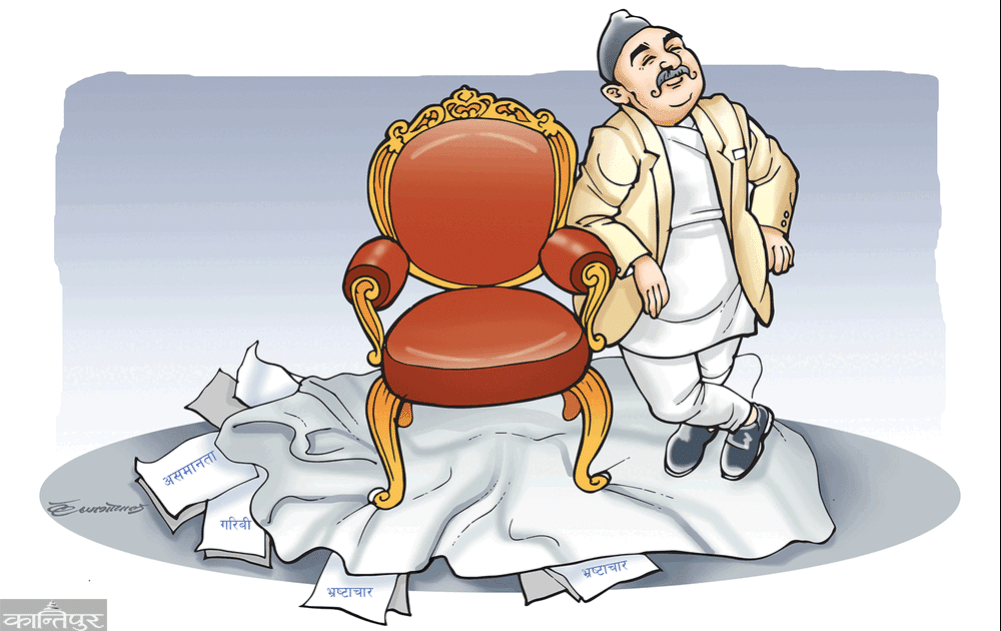
It is easy to give long and preachy lectures about the harmful effects and consequences of corruption, but is society as a whole ready for morality?
We use Google Cloud Translation Services. Google requires we provide the following disclaimer relating to use of this service:
This service may contain translations powered by Google. Google disclaims all warranties related to the translations, expressed or implied, including any warranties of accuracy, reliability, and any implied warranties of merchantability, fitness for a particular purpose, and noninfringement.
Among the high-class, upper-caste 'Janaijati' and the middle-class Nepalis, two categories of people are eloquent. Although the changes after 2006 have been significantly reduced after 2015, the gathering and learning community is allergic to the expressions like republic, federalism, plurality, diversity, proportional inclusion, positive discrimination and social justice.
First his face turns red. Then the tongue starts to itch. And they start giving fluent sermons. They deny their structural advantage and start pointing out hypothetical facts that prove they are/are not natural products of authoritarianism.
He has no doubt that Nepal's ruling elite are qualified and skilled as they were selected through a competitive process. She is firm and confident that the future of the country can be secured only in the hands of 'people like us' i.e. the 'Hajma' category. He has not yet been able to "digest" the political power of outsiders and businessmen like Madhesi and Maoists, who are not connected to any palace, nor Gorkhali Tharghar, nor the legacy of thirty-two Kothi moneylenders, nor marriage to any military or civil family, but they have succeeded in gaining influence in national politics after 2008.
At Haj, the class sometimes praises Suryanath Upadhyaya, sometimes cheers Sushila Karki, sometimes carries Balen Shah and sometimes tramples behind Ravi Lamichhane. But despite taking the most advantage of mainstream politicians, nothing positive is said about them.
Various types of consultants who fell into the comfortable category due to the 'globalization, privatization and openness' economic policy after 1990, professionals who succeeded in making name and money by engaging in consulting business, managers who joined the "elite civil society" by connecting with bilateral and multilateral donors through the gas enterprise, "social workers" who eat the rent of ancestral property due to the expanded market, and financial enterprises related to the remittance economy, including cooperatives, restaurants, furnaces. The Fursdilo Group (FUS), a group of shops, cafes and land traders, are also Jamaat activists who are unhappy with the post-2008 changes.
He doesn't like politics, he really likes to insult politicians. They ask in a loud voice - 'Youth has left, foreign interference has increased, the country is sinking, where is the civil society?' Then one or two other pegs cheat and go to sleep. In one thing, the public spokesmen of the Hajma and the Fus category agree—perhaps because they are happy to change their tunics according to the season, their interests and concerns are very contemporary in nature. No one can cultivate the stimulating gossip that suits air, water and soil.
After the presentation of the budget, everyone is ready to expand their market, so August and September are the seasons to discuss the various dimensions of development. After Sohrashradh, religion, tradition and culture and the so-called distortions seen in them, are extended from September-October till the end of 'national festivals' like Dasain and Tihar till November. Mahendra Memorial Day to commemorate the 1960 royal military coup, Prithvi Jayanti celebrated in honor of the Gorkhali victor, the birth anniversary of King Birendra, who was pushed into oblivion after the Narayanhiti massacre, New Year's International New Year's Day renamed Hat Day and February 1, 2005 royal-military coup, the frenzy of nationalism in the liberals increases in December-January. February and March are the time for scandals about governance and power imbalances. From April-May to June, the health condition of democracy is observed. After that, after July-August, the new cycle starts again, returning to the development debate. It may be that the concerns of the public circle have also become somewhat mixed, just as the weather has changed due to climate change.
The recently published Transparency International's Corruption Perceptions Index (CPI or Corruption Perceptions Index) report, 2024, which presents visual evidence of being a socially conscious and aware citizen by expressing deep concern and concern about corruption, has been reconciled. Nepal is ranked 107th out of 180 countries with a score of 34 according to Taza Bhadhasu, which measures the perception of corruption in the public sector.
Bhadhasu index refers to the state of transactions prevalent in the public sector which is maintained for the investment and operations of the profit sector. The report, which is based on a purely Western concept, does not take into account any of the local factors of corruption, such as the deterioration of democracy in weak countries, the inadequacy of public education and health services, conditions that cannot ensure social justice, lack of employment or economic inequality. For example, the authors of the Bhadhasu Report probably either do not know enough about the Chakri, Chukli and Chaplusi (Chachucha) rituals prevalent in Nepal or they have completely ignored such binding and trending elements.
Kajal's closet
Economists James Robinson and Daron Acemoglu, who are co-winners of the 2024 Nobel Memorial Prize in Economics, wrote about why some nations prosper and others fail, and the book first published in 2012
The essence of 'Why Nations Fail' has been known to most of the Nepali people since then based on empirical knowledge - in an exploitative state, the ruler is overthrown, in an inclusive state, the welfare of the common people is ensured by improving the lives of the common people. Achieving economic progress through social change, cultural upgradation and state transformation is a painful, slow and long process. Hence ambitious people of any caste and class readily agree to accept the role of doyam or even lower to join the 'ruling group'. The
problem is that the permanent establishment does not readily accept the new elite. Attempts to kill him with various accusations are always going on. The easiest accusation that can be leveled against those who are trying to make a place in the ruling group is that of financial embezzlement. The practice of 'eating from the bottom and feeding from the top' in Nepal's public sector is also benefiting some people from the subordinate community, due to the fact that those who do not receive elite patronage or are not proficient in the art of chachucha can not remain free from accusations regardless of whether they eat or not. Therefore, 'anti-corruption' has been only a slogan produced for public consumption to make enemies of those connected to power or to prove themselves clean.
In April-May, showing the state of democracy, democracy and republicanism, federalism in name only, inclusivity made as canceled by the corruption of ruling elites, and the so-called secularism of the traditional nature will start again. This is not Nepal, here the Khas-Arya permanent power is re-established with more and more influence with the support of two or four symbolic outsiders from the political struggle after every change. There is no possibility of breaking this vicious cycle.
Since it is an apocryphal story heard from the elders, the authenticity of the context cannot be confirmed, but the story of Subba Taraprasad Pant of Chandrashamamsher can be thought-provoking to show the symbolic attitude of the rulers. It was said about the prosperity of Taraprasad, who connected vast lands from Palpa, Madhesh's Kapilvastu, Ruppandehi and Nawalparasi to Bara district, ``Bara in the district and Tara in Subba''. Seeing his grand mansion and comfort, some people spoke in the Nepal Darbar - "Taraprasad's churifuri bhattai bho maharaj" says, then because it would be easy for corruption to confiscate asphalt and evacuate the country, the zamindar of the scholarly family was made subba. Being from the famous Bahun family of the West, Tara Prasad's relatives or well-wishers may have been inside the Nepal Darbar. He warned her in time. In order to avoid the possible outcome, Subba of the Pandit Khandan resigned and saved his wealth by offering sacrifices for the sins that may have been committed knowingly or unknowingly while in office, expressing gratitude to Maharaj Chandra for his appointment. Incidentally, the influential economist, diplomat and politician of the Panchayat period, Yadav Prasad Pant was the grandson of Subba Tara Prasad.
No one calls Chandrashamsher 'corrupt' because he acquired the 'right' to abuse state machinery and exploit the people by joining conspiracies like clan murders for coup d'état. King Prithvi Narayan's alleged divination about 'taking bribes and taking bribes' is widely discussed, but even those who only cite the fact that he took away the conquered lands from the villagers and distributed them to his fighters are considered anti-national.
Transparency International has also defined corruption as the misuse of public office or position of power for personal gain. The assumptions that corruption undermines public trust, undermines democracy, hinders economic development and thereby exacerbates inequality, poverty, social divisions and environmental crises are realistic. But unless we address the interrelationship between self-sustaining courtesy growing from the bottom up and the wave of parasitic corruption spreading from the top down, the ongoing decline in public moral values and beliefs cannot be addressed.
It is easy to give long and preachy lectures about the harmful effects and consequences of corruption, but is society as a whole ready for morality? The questions are difficult, there is no happiness without finding answers. The number of civil and military salarymen, privileged elected officials and transaction facilitators will be at most one million. Among them, the Jamaat who can benefit from the transaction will be around 3 lakh at most? That is only 1 percent of the total population. Unless the remaining 99 percent want it, there is no chance that corruption reduction will take off.
Some lessons from neighboring India seem thoughtful. Prime Minister Narendra Modi's slogan 'Na khaunga na khane donga' has been misconceived - when he came to power, India's position on Bhadhasu was 85, within 10 years it has dropped 11 places to 96, but big donors and majority of voters still believe in him. The perpetrators of Indian Hindutva politics started the 'India Against Corruption' movement centered in the capital New Delhi in 2011 against Prime Minister Manmohan Singh, who had a relatively mild, gentle and clean image, by bringing forward the social workers of his era such as Anna Hazare, Arvind Kejriwal and Kiran Bedi. India's demonetisation of 2016 is regarded as the biggest attack on personal property in human history, except during wartime. No one has said anything about such corrupt political behavior so far, that is because the idea that others may have suffered a bigger shock than themselves will reassure even the common people. There is an oft-quoted statement by Japanese Prime Minister Tanaka Kakui in the Lockheed aircraft procurement case of the 1970s about the inevitable public acceptance of corruption—if there is a government transaction, then there is a transaction.
transparent wall
Kautilya's statement, "Just as it is impossible to detect the swimming fish that has consumed water, the manipulation of public officials cannot be detected". The intention of those who share the assurance that corruption reduction is a political agenda of social awakening, that it can be addressed through the strengthening of institutions such as the Commission for Investigation of Abuse of Authority, should be doubted. Kabir has a couplet - 'Kajar ki kothari mein keto hi sayano jai, ek lik kajar ki lagi hai tai lagi hai' meaning no matter how vigilant a person enters Kajal's closet, he cannot come out unscathed. After all, the officials of the Commission on Abuse of Authority cannot be summoned to prevent possible abuse of authority. Efforts can be made to create ideals by creating pressure to improve the behavior of political leaders.
episode This is also probably apocryphal, but a dillagi Ekta was very popular to make fun of the luxurious leaders of the Soviet Union at the time. It is said that during the 1970s, Leonid Ilyich Brezhnev, the then Soviet surveyor, proudly showed his mother his lavish office and his holiday dacha, furnished with chandeliers. His mother was pleased to see her son's lavish lifestyle but asked very worriedly - 'But Leonid, what will you do if Bolshi comes back as a Communist?' The story may be fabricated but the relevance of the metaphor cannot be doubted.
BP Koirala's soul is crying after seeing the lifestyle of the socialists of his party. Madan Bhandari remembers his bicycle ride when he sees Nepalese communists being as luxurious as in Soviet Union, China or North Korea. Times have certainly changed, but republican politicians would not have rushed to follow the interests of Shah-Rana elites. The mismatch between a legitimate source of income and a publicly visible lifestyle is perhaps the main factor in giving corruption public acceptance. Common people do not even get access to public services without paying service charges through facilitators. At one time, people with political ambitions used to do such work as volunteers.
Without the consent of their patrons, Sahabegar volunteers are not transformed from facilitators to intermediaries. It is said that once a tiger has tasted human blood and becomes a cannibal, it is impossible to change its habit. It is not enough to blame the free market for political activities that are not only free of ideology, but also violate the values and norms of public morality.
Hindi poet Avtar Singh Pash points out people who are deviated from ideals and socially aimless and warns - 'Sabse dangerous hota hai hamare sapnon ka mar jana'. Such people have no courage left to fight. Poet Rajesh Joshi elaborates on it further -
'Khatranak hai
sapno ka mar jaana
dangerous