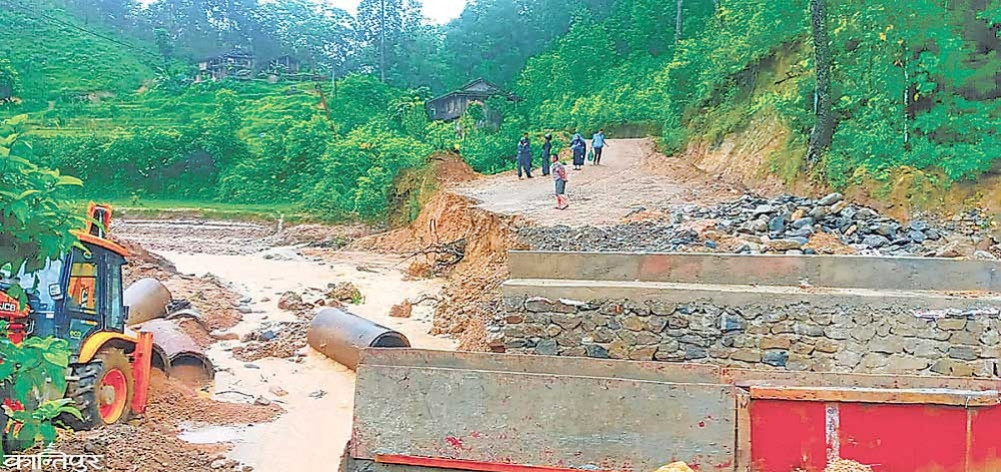
The provincial government should encourage the people who were born in the village and are working in the city to go to their native village and start agricultural and tourism companies to increase agriculture, forest products production and tourism services.
We use Google Cloud Translation Services. Google requires we provide the following disclaimer relating to use of this service:
This service may contain translations powered by Google. Google disclaims all warranties related to the translations, expressed or implied, including any warranties of accuracy, reliability, and any implied warranties of merchantability, fitness for a particular purpose, and noninfringement.
Prosperity is fundamentally derived from a combination of natural resources and human resources. As powerful as these two important aspects are alone, it is only when they work closely together that life-giving products can be made from natural resources. Prosperity leads the way with increased production.
Nepal is currently trying to push itself out of this mix. As skilled manpower is concentrated in natural resources and small towns, the natural resources of villages are becoming unused. The drive to return the skilled manpower of the city to the villages rich in natural resources is bound to increase the country's productivity and prosperity over time. Despite being a prosperous province itself, there is a possibility that prosperity can be achieved through 'Gaon Fark Abhiyan' in Bagmati Province, where both population and prosperity are highly unequal.
According to the 2078 census, the population of Bagmati province is 61 lakh 16 thousand 866. Which is 20.97 percent of the national population while its area is only 13.79 percent of the total area of the country. While the population density of Nepal is 207.29 per square kilometer, it is 301.32 in Bagmati province, the highest in Madhesh province is 633 and the lowest in Karnali is 60.
The disparity in population density across provinces is even greater in the districts and municipalities of Bagmati Province. In Bagmati province, 77.3 percent of the population lives in the urban areas, which cover a small geographical area, while only 22.7 percent of the people live in the rural settlements, which cover a large geographical area.
According to the National Census 2078, the population of the 3 districts of the valley is 3 million 25 thousand 386, which is 49.46 percent of Bagmati Province, but its area is only 899 square kilometers, which is only 4.42 percent of the entire Bagmati Province. Moreover, Kathmandu district with an area of 395 square kilometers (1.9 percent of Bagmati province) has a population of 2 million 41 thousand 587, that is, one third of the population of Bagmati province (33.37 percent).
The population of Kathmandu Metropolitan City with a total area of 50.67 square kilometers is 862 thousand 400 (population density 17,019.93 per square kilometer). Thus, when more population lives in a very small area, it becomes difficult for those people to get enough water, clean air, fresh vegetables, and public services.
On the other hand, the area of Shivpuri Rural Municipality of Nuwakot, which is connected to Kathmandu District, is twice that of Kathmandu Metropolitan City, 101.5 square kilometers, but the population is about 50 times less, totaling 17,203 (population density 169.49 per square kilometer).
While the population density of Kathmandu district is 5,169 per square kilometer, the population density of Dhading, which is connected to the western border, is only 169.10 per square kilometer, while the population density of Nuwakot and Sindhupalchok, which is connected to the north, is only 235 and 103.3 per square kilometer, respectively. In this way, when the population is concentrated in one place, there is a severe lack of resources for production in Kathmandu, and on the other hand, the natural resources in the districts connected together have become useless due to the lack of manpower.
When there is a shortage of drinking water in Kathmandu, natural pure drinking water is being wasted in the neighboring districts. When fresh vegetables are insufficient (or high prices) in Kathmandu, they are wasted in neighboring districts. The productive power of clay soil is unutilized.
According to the 2078 census, out of 61 lakh 16 thousand 866 people living in Bagmati province, only 33 lakh 96 thousand 954 people were born there. The rest are recent born and residing at the present address. Out of the 20 lakh 41 thousand 587 population of Kathmandu district, 7 lakh 24 thousand 34 people who were born there have recently come to the district.
To overcome this situation, the Bagmati state government should bring a policy of 'reverse migration' through 'Jaon Village Campaign'. That is a policy to encourage citizens who were born in a district of Bagmati Province and migrated to Kathmandu Valley (especially in the city) to return to their villages and start production work.
The role of Bagmati province
The government of Bagmati province should encourage the people who are born in the village and work in the city to go to their native village and open agricultural and tourism companies to increase agriculture, forest production and tourism services.
In such companies, the people living in the same village or born and working in the city should be added as employees/workers and they should also be made owners of the company by making a certain percentage of share investors. which will be adopted by the village and community. Also, the barren land of the people who left the country and went abroad from that village should be used and the owner of that land should also be given a fixed share based on the land. This will ensure that not only the utilization of the barren land, but also that there will be no possible obstacles in the future by the land owner after the investment.
The state government should arrange project-based unsecured loans (and interest concessions), free seed distribution and market facilitation (guarantee) or provide subsidies based on production to the companies formed in this way. If this is done, it will be ensured that the companies that focus on production will benefit and it will be encouraged to open such companies.
The metropolitan city and municipalities of Kathmandu Valley are providing services like education, health, drinking water, roads, electricity and lights to the people as far as they can, but that service is not enough for the citizens. Even though the municipalities provide these services with all their capacity and resources, the service is becoming thin when it reaches the yard and hands of the citizens.
The main reason for this is the overpopulation of the service here. It is not likely that the municipalities of the valley will immediately increase the geometrical resources and increase the service provided to the people at the same rate. Therefore, the metropolises and municipalities of the valley should encourage their residents who have migrated from other municipalities to invest in the production sector in their native land.
The profit he earned by investing in the village will eventually come to Savika Municipality in the valley, so the metropolis and municipality helping in this is a kind of investment to increase their revenue.
The village councils of Bagmati province should make a plan to bring back those who have left their native land and migrated to the city due to opportunity and compulsion with the investment, technology, management skills earned in the city and more than that, love for the village. Municipalities should make a list of such people and increase institutional access to every person and make every possible request and encouragement to return to the village. Living with modern facilities is possible only by working in the village, everyone should work towards this. - Shrestha is a member of Policy and Planning Commission of Bagmati Province.