Citizens are not preferring the trend of making alliances before the election and sharing power with another party as soon as the results are announced.
We use Google Cloud Translation Services. Google requires we provide the following disclaimer relating to use of this service:
This service may contain translations powered by Google. Google disclaims all warranties related to the translations, expressed or implied, including any warranties of accuracy, reliability, and any implied warranties of merchantability, fitness for a particular purpose, and noninfringement.
When the two largest parties in the House of Representatives, the UML and the Congress formed a power alliance last June, the main objectives were political stability, good governance, economic acceleration of the country and amendment of the constitution. Six months have passed since the formation of the government. Criticism has started saying that the government has not been able to move forward according to the purpose for which it was formed.
Such voices have started to be heard within the ruling party. The pressure of which has fallen on the core leadership of the party currently in government. 6 months is not enough to complete the objective, but this period is not short to prepare the foundation.
In the current situation, what is the opinion of the citizens of Nepal about the political, economic and contemporary social situation? Is Nepal taking the right direction? What are citizens thinking about political and economic direction? The national citizen opinion survey conducted by 'Sharecast Initiative Nepal' has shown its factual picture.
in which it seems that the politics of the country has not yet taken the right direction, the economic situation has not improved and the satisfaction of the citizens has not improved significantly. While corruption and unemployment remain a major problem, the survey shows that there is no improvement in the level of trust in government institutions that are responsible for governance.
From December 16 to December 27, the data was collected through interviews with 3,000 citizens living in 214 wards of 196 municipalities in seven provinces and 52 districts. According to Madhu Acharya, President of Sharecast Initiative Nepal, the respondents were selected based on the ratio of the population by separating groups such as education, economic status, age, caste, religion, and gender. Sharecast, which is conducting many surveys in the fields of
media, used to conduct polls on political and social issues in the past as well. "We have tried to understand the opinion of the citizens not only related to the issues that have been dealt with in the past but also on contemporary issues," he told Kantipur. We have not analyzed it. It can be understood by analyzing as needed.'
How has the opinion of the citizens been reflected in some important questions asked about the services provided by the municipalities and social and political issues? Let's look at the facts.
Where is the political and economic direction?
Finding another government without forming one government, internal disharmony between the parties without the government moving forward and its impact on the entire system has become a regular practice of Nepalese politics in recent times. Citizens are not satisfied when the activities are contrary to what they expect to be improved. Which is also confirmed by the answers to some of the questions asked in this survey. Of the 3,000 respondents who participated in the
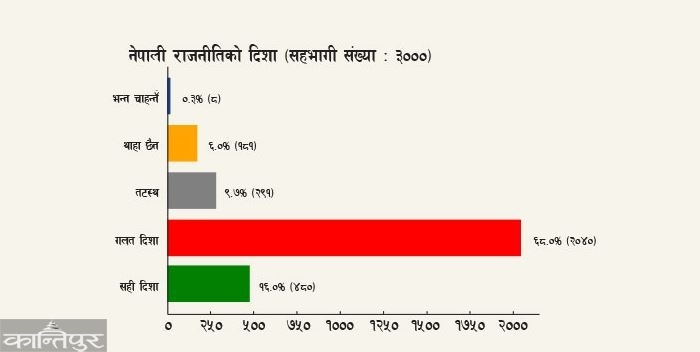
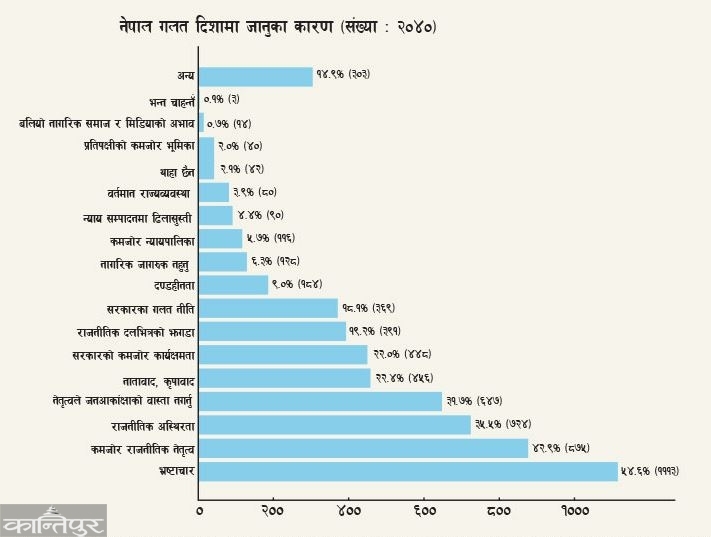
survey, 98.5 percent were somehow interested in politics. 68 percent i.e. 2,040 people answered that the politics of Nepal is going in the right or wrong direction. Only 16 percent i.e. 480 people said that Nepal's politics is in the right direction. Corruption, weak political leadership, instability, nepotism, nepotism etc. are the main reasons leading the politics of Nepal in the wrong direction.
54 and a half percent answered that the country is going in the wrong direction due to corruption and 42 percent due to weak political leadership. 35 percent said they are going in the wrong direction due to political instability. Gandaki province is the most concerned that politics is in the wrong direction. More than 55 percent of those who gave such answers are middle and lower middle income earners aged 45 to 59 years who are graduates and above. This means that the citizens who are aware and academically adept are dissatisfied with the fact that the path of politics is not progressing properly.
Politics is going in the right direction and what is considered positive by 16 percent? 40 percent said that the
is in the right direction, infrastructure development is good, 15 and a half percent said that there is an increase in service facilities and 10 percent said that progress is being made socially. Majority of the respondents who said that politics is going in the wrong direction did not see any improvement in the economic situation either.
53.8 percent said that the economic situation is getting worse. Only 24 percent answered that the economic situation is getting better. Even among those who answered that the economic situation is bad, the number of middle and lower middle income people with higher education in the age group of 45 to 59 years is more than 60 percent.
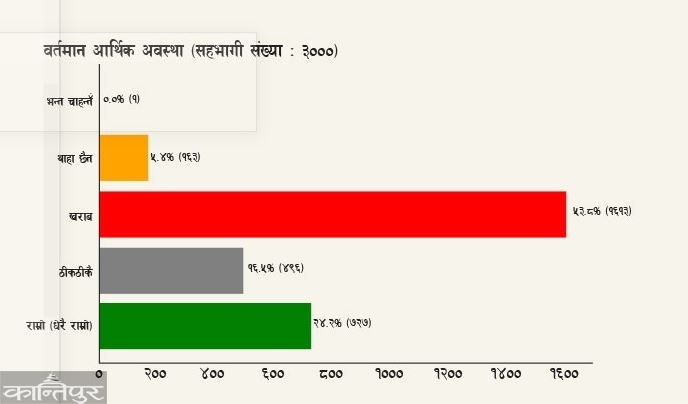
With this data, it is not difficult to understand the impact of the wrong direction of politics on the economy. Similarly, looking at the cluster of respondents, the Jamaat who is more educated is saying this.
Even though the current political and economic situation is in a wrong and bad direction, there are some positive signs in the question of what is the overall situation of Nepal now compared to five years ago. 50.5 percent answered that there was some improvement compared to five years ago.
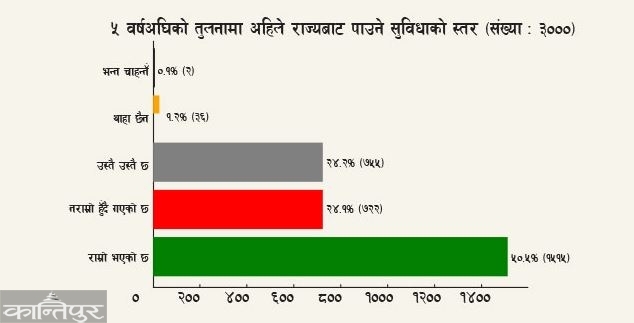
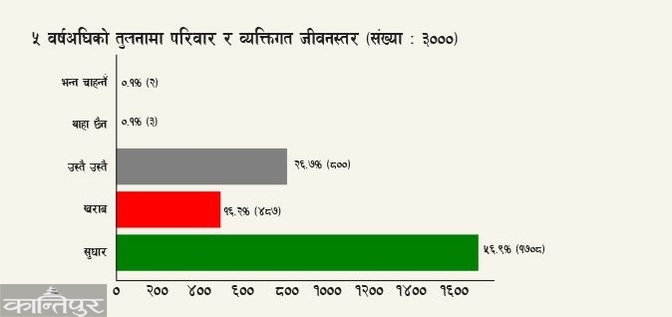
Although the indicators of the country's overall situation are bad, the survey has shown that the personal life and family conditions of the citizens have improved now compared to five years ago. About 57 percent said it was improving to some extent compared to five years ago. In the past five years, due to the covid epidemic, huge human and economic losses had to be suffered. The good response now can be understood as a sign that the damage caused by the Covid-19 has been remedied and it is moving forward.
How necessary is the amendment of the constitution and electoral system?
After the formation of the latest power coalition, the most discussed and debated political issue is the amendment of the constitution and the electoral system. The current ruling coalition is formed with the agenda of amending the constitution. For future political stability, preparations are underway to improve the current electoral system and raise the proportional threshold. Commenting that small parties have become the cause of political instability, the two major parties leading the power are going to change the law on political parties to increase the threshold. The survey has revealed facts that serve as a background for these developments.
About 47 percent have voted in favor of the need to amend the constitution written by the Constituent Assembly in 2072. About 16 percent said minor revisions were necessary. This means that about 62 percent have indicated the need for constitutional amendment in one way or another.
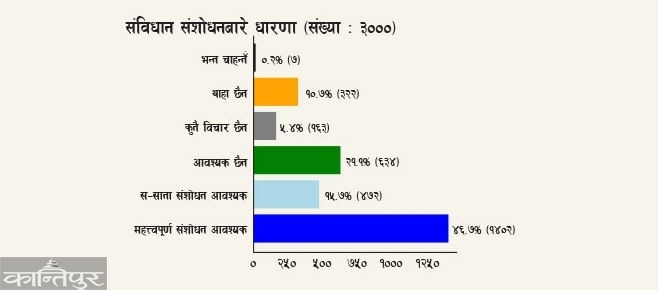
This strengthens the argument that the needs pointed out by the political parties about the amendment of the constitution are in accordance with the expectations of the citizens. Looking at the respondents who said there is a need to amend the constitution from the provincial cluster, the respondents from Karnali and Madhesh pointed out the need for more amendments. About 69 percent of the respondents from Karnali and about 68 percent from Madhesh mentioned that some kind of amendment is necessary in the constitution.
75 percent of the Dalits of Terai have pointed out the need for constitutional amendment under the caste cluster. About 70 percent of the hill Brahmin cluster and about 83 percent of the Madhesi Brahmin cluster pointed out the need for revision in one way or another. This fact has disproved the understanding that only the Madhesi and tribal communities are more dissatisfied with the current provisions of the constitution. It can be understood that the citizens of all clusters have realized the need to amend the constitution. In connection with
elections, the survey questioned the culture of why the same person is repeatedly elected to power and position or remains seated and forms alliances to win elections. It also has interesting answers. The main reason why the same person stays in office and gets elected is because of the fact that the style of buying votes or financial inducement works. 52 percent of the participants in the survey answered that they are being elected by buying votes or financial incentives.
24 percent answered that they were elected because of the candidate's past actions, while only 21 percent said that they were elected because of the candidate's or party's loyalty. More than 54 percent of Madhesh, Bagmati and Sudurpaschim are responsible for winning by buying votes or financial inducements. This means that when elected in three provinces, there is a basis to assume that economic matters are effective.
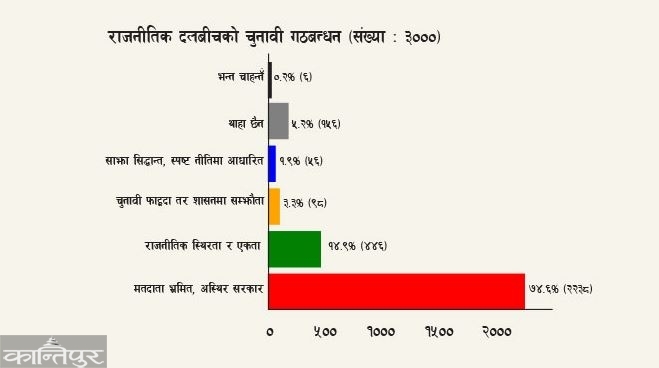
The survey also revealed a lot of negative facts about the coalition culture in the election. About 75 percent of the survey participants responded that coalitions are often opportunistic and weaken the party's identity. Only 14 percent of respondents said that electoral alliances bring unity and stability among parties. 90 percent of respondents who studied above graduation level said the alliance was wrong. 62 percent of uneducated respondents also said that the alliance is not good. Likewise, 80 percent of the 40-59 age group did not prefer the coalition.
It can be understood from this that the citizens are not preferring the trend of forming alliances before the election and sharing power with another party as soon as the results are announced. It seems that there is a need for improvement on the tendency of the party and the leader rather than the electoral system.
Governance, problems and reform issues The
survey also revealed some facts about the country's burning problems and priorities for reform. When asked what is the current problem, 61 percent said unemployment. 30 percent said poverty and lack and about 27 percent said the repair of roads . About 25 percent consider corruption as the main problem. In the question of which profession Nepalis are more attracted to in the country now, 72 percent said foreign employment and immigration. Similarly, in the supplementary question of what is the root cause of Nepalese emigration, 82 percent said lack of employment opportunities. It depicts the dire situation of immigration trend and employment problem.
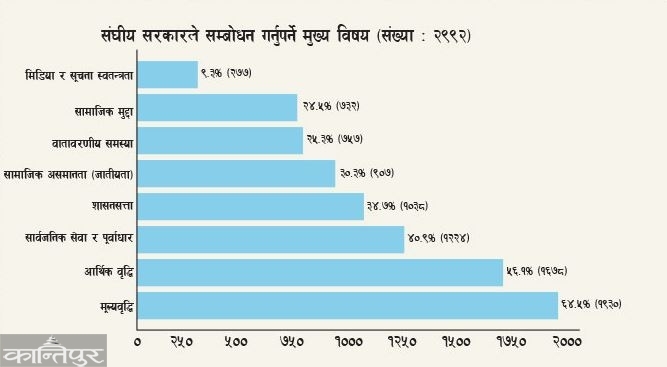
The number one issue that the federal government should prioritize for immediate reform is price increase. 64 and a half percent answered that the main priority should be to control the price increase of food, housing, transportation, education, electricity, mobile, internet, healthcare and drinking water. About 40 percent said that the improvement of public services and physical infrastructure should be considered. It seems that the government should start the reforms from the questions directly connected to the citizens' lives.
For all these reasons, citizens' trust towards government institutions may be seen to be stable or reduced. The survey asked whether trust in government institutions has increased, decreased or remained stable. It had a list of the President, Prime Minister, State Government, Parliament, Judiciary, Municipal Mayor, Deputy Mayor, Nepal Army, Nepal Police, Media, Civil Organizations. About 30 percent of them said that their trust in the federal government has decreased, while 45 percent said that their level of trust has remained stable. Under the provincial government, 20 percent said that trust has decreased and 42 percent said that it is stable. The survey showed that the level of trust towards
media and civic organizations has increased. 57 percent said that the trust in the media has increased, while about 48 percent have trust in civil organizations. When asked about the state of freedom of expression, about 80 percent answered that they can speak or write what they feel with confidence.
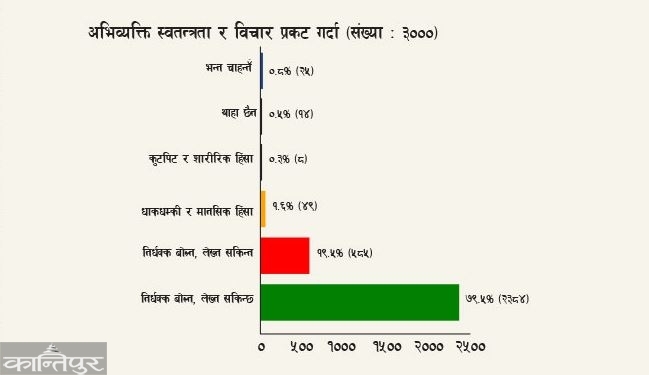
This fact shows that the level of freedom has increased. Looking at the gender cluster, 74 percent of the 1,512 women who participated in the survey said they can speak openly. About 85 percent of the 1,448 men who participated in the survey said they speak confidently. This shows that women have not yet reached the level of men in the freedom to speak their mind.