In order to end corruption, local level elections should be made partyless, when adopting a system where only independent people compete in elections, political parties themselves become the opposition and monitor the local level effectively.
We use Google Cloud Translation Services. Google requires we provide the following disclaimer relating to use of this service:
This service may contain translations powered by Google. Google disclaims all warranties related to the translations, expressed or implied, including any warranties of accuracy, reliability, and any implied warranties of merchantability, fitness for a particular purpose, and noninfringement.
The Abuse of Authority Investigation Commission filed a case against Mohan Bahadur Basnet, the mayor of Nagarjuna municipality in Kathmandu, on 15th December 2081 in a special court for corruption and money laundering offences. The Commission has made a demand of 92.2 million bigo against Basnet, who was elected in both the local elections of 2074 and 2079, in the case of bribery and 130 million 12 million in asset laundering.
Basnet is not the only public representative who has been charged with corruption. According to the authority's data, cases have been filed in the special court against 531 people's representatives at the local level in the last five financial years. Cases have been filed against 70 people in the financial year 2076/77, 22 in 2077/78, 151 in 2078/79, 226 in 2079/80 and 62 in 2080/81.
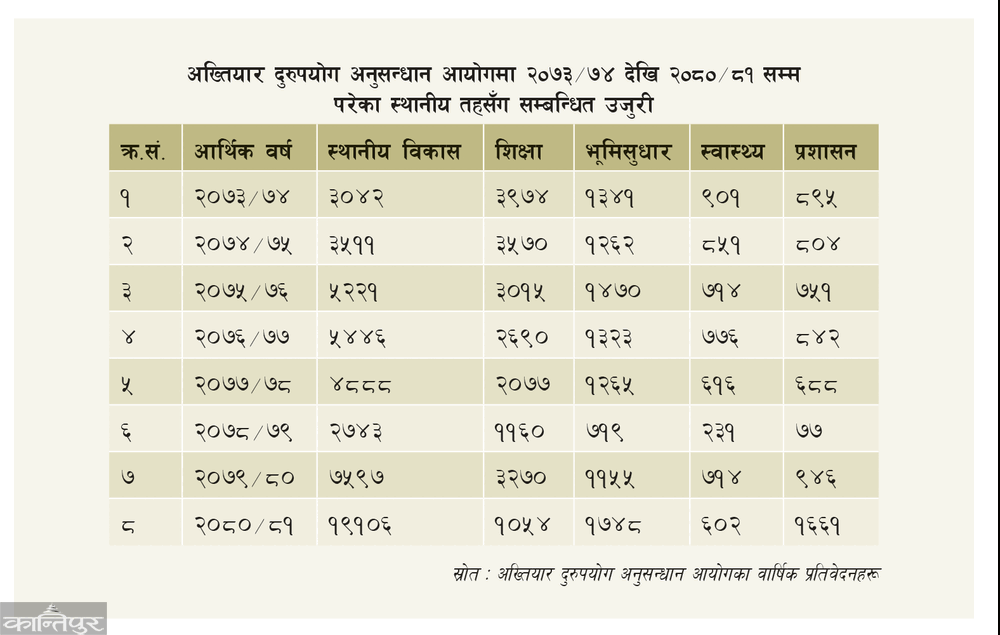
With the implementation of the federal governance system, there has been a significant increase in authority and resources at the local level. It seems that corruption activities have also increased. According to the annual report of Akhtiyar, the number of complaints about corruption at the local level has increased.
In 2080/81, more than half of the 26 thousand 918 complaints registered with the Commission and its subordinate offices, i.e. 52.80 percent, are related to the local level. Similarly, 34.88 percent of the complaints against the federal government agencies and 12.32 percent of the complaints against the provincial government are mentioned in the report of the commission.
Article 4 of the Constitution of Nepal 2072 stipulates that Nepal will be a federal democratic republic state. According to which, there are a total of 761 governments in Nepal including one federal government, seven provincial governments and 753 local governments. The constitution of Nepal has provided single and common rights to all three levels of government.
This type of federal government system is considered as a highly decentralized system of government. Federalism and decentralization are presented as synonymous concepts in this article. Looking at the data presented on this basis, it helps to make the impression that there is a positive causal relationship between decentralization and corruption.
The relationship between decentralization and corruption
Decentralization means the transfer of authority, responsibility and resources from the center to government agencies that are close to citizens. WE Oates, in his book 'Fiscal Federalism' published in 1972, asserted that decentralization contributes significantly to increasing accountability and reducing corruption by bringing the government closer to the citizens. But many scholars do not agree with this.
In the article "Decentralization and Corruption: Evidence Across Countries" published in the Journal of Public Economics in 2000 by R. Fishman and R. Gatti, they presented the conclusion that decentralization increases the opportunities for corruption due to the lack of necessary and sufficient monitoring and accountability at the local level.
Looking at it this way, there is a sharp difference of opinion among experts on whether decentralization increases or decreases corruption. In Bertone's book 'Comparative Governments: An Economic Theory of Politics and Public Finance', published in 1996, it is argued that decentralization will reduce corruption in public service delivery and development work.
During his studies, he found that decentralization will reduce corruption as the competitive environment and system will reach the local level, financial transparency and accountability will increase, and citizens will be able to monitor the resources and development in their villages and their quality.
Some donor agencies have also conducted in-depth studies on the relationship between decentralization and corruption. The "Corruption in Slovakia: Results of Diagnostic Survey" report conducted by the USAID and the World Bank in Slovakia in 2000 showed that countries with a decentralized government system are less corrupt than a unitary centralized government system.
However, some experts and researchers claim that there is a positive causal relationship between decentralization and corruption. Their conclusion seems to be that decentralization will also increase corruption. One of these is, EC Banfield.
In his 1979 article entitled 'Bureaucratic Corruption in Sub-Saharan Africa: Towards a Search for Causes and Consequences', he argued that decentralization would create more power centers, involve more officials in the decision-making process, and could not even regulate and monitor them, leading to illegal activities and corruption. have presented the conclusion that it increases.
Another scholar Remi Prudhomme has argued that decentralization will increase corruption in an article titled "The Dangers of Decentralization" published in 1995. According to him, officials working in local government agencies are given more discretionary powers than central officials, who are more likely to abuse their power to fulfill private interests.
Similarly, he argues that decentralization increases corruption because there is a possibility that responsible officials at the local level will be influenced by various interest groups. Similarly, Sebastian Freele and other scholars have mentioned in the article titled "Federalism, Decentralization and Corruption" that whether decentralization will increase corruption or not will be determined by the degree to which the competitive environment has been decentralized in the market, economic activities, public procurement, etc. They conclude that if a highly competitive system is also decentralized, it will reduce corruption and if not, it will increase corruption.
Looking at it this way, whether decentralization increases or decreases corruption is not the same experience around the world. It seems to be determined by time, place, existing laws, economic policy, competitive environment, state of rule of law, involvement of citizens in the governance system, accountability etc. in the respective countries.
Has decentralization increased corruption?
If the annual report of the Abuse of Authority Investigation Commission or the news published in newspapers is taken as a base, decentralization helps to create the impression that corruption has increased in Nepal. When studying the news published in the newspaper and the annual report of the Commission in an improper manner, there is corruption in the areas of public service and procurement at the local level, selection of plans, implementation and management, social security allowance, fake educational certificates, encroachment on public property and land.
Local people's representatives exploiting public resources and means in collaboration with contractors, giving financial aid or contracts to themselves or their close associates, choosing plans based on access, making workers or close people officers of the consumer committee and disbursing the budget, involving workers who are not actual consumers in the consumer committee. Irregular activities such as providing a large budget in the form of peski are done at the local level. In some cases, it is seen that fake or fake bills are taken for payment, and the payment is made saying that the work that has not been done has been completed.
is to analyze such facts in a way that decentralization has increased the number of retail financial irregularities and the actors involved in them. In the last financial year 2080/81, the Commission filed 201 cases of corruption at the federal, provincial and local levels in the special court. Among them, there were 102 corruption cases related to the local level, 79 against the federal government agencies and 20 against the state government.
In the cases filed in this way, the largest amount of bad demand is 8 billion 40 million 649 thousand 407 rupees and 98 rupees against federal agencies. Although there are many cases at the local level, the bad demand amount is very low. Out of the 102 local level cases filed in the special court, 18 are related to fake educational certificates. Similarly, in the same fiscal year, 1,545 people were made defendants in 201 cases, only 62 people are local people's representatives.
In this way, the number of corruption complaints at the local level is high, but the amount of corruption is low. Let's look at another example, in the 61st annual report of the Auditor General in 2081, the amount pointed out by the audit to federal government offices, state government offices, local levels, committees and other organizations is 95 billion 600 million 21 million.
in which the amount to be recovered is 15.51 billion 45 million rupiah from the federal government government office and 4.15 billion 84 million rupiah from the local level. There is corruption in one department or agency under one ministry of the federal government, more than the amount to be recovered from 753 local levels across the country. A
can be taken as an example of irregularities in the procurement of widebody aircraft. The sub-committee formed by the Public Accounts Committee of the Parliament concluded that there was an irregularity of 4.35 billion 56 lakh rupees in the purchase of wide-body aircraft and asked the Commission for Investigation of Abuse of Authority to conduct further investigation. In which the commission investigated and filed a case in a special court. The special court decided that 1 billion 47 million rupees was corruption.
If we consider only this incident as the basis, the amount of corruption within one division of a ministry of the federal government is much greater than the corruption at the local level across the country. Therefore, decentralization has increased the incidence of corruption and the characters involved in it. Even if we do a comparative study of the allocated budget, there is more corruption at the federal level. Decentralization has increased the habit of citizens to complain against even the smallest irregularities in government close to them. Which can be taken positively from the point of view of corruption control.
What to do to reduce the number and character of corruption?
Grand corruption is more widespread in centralized governance than in decentralized governance. Having said that, the corruption that is becoming decentralized cannot be ignored. This makes corruption a 'culture'. Therefore, it is necessary to take some policy actions to control corruption at the local level. First, competitive markets should also be decentralized. Without intense and systematic competition, local level budgets, resources and means are captured by local factions and interest groups.
Therefore, policies, laws and a clear economic system should be developed to further decentralize the competitive market. Secondly, the method and system of citizen involvement in the governance process should be developed and implemented systematically. In other words, if the citizen monitoring system can be systematically implemented in the matter of local development, construction and service delivery, virtue can be promoted without allowing corrupt activities to occur at the local level. For this, emphasis should be placed on promotional and preventive actions.
Third, effective implementation of mechanisms to increase social accountability and transparency is necessary. The Local Government Operation Act 2074 provides for the implementation of mechanisms to enhance social accountability, including public hearings, social testing, and public audit. But the local level has either not implemented such mechanisms or is only doing it for show.
Many problems can be solved if such mechanisms are managed by a third party and implemented effectively. Fourth, there is no effective and strong presence of civil society and media at the local level of Nepal. Neither is there a system of opposition. At the local level, there is still a culture of 'political consensus' developed in the unrepresentative era, which promotes collusion and sharing. Such sharing increases corruption.
To end corruption, local level elections should be made non-partisan. By adopting a system where only independents contest the elections, the political parties themselves become the opposition at the local level. Political parties closely monitor the local level. People's representatives are freed from the pressure of keeping their party's workers, giving contracts, keeping them in the consumer committee.
It develops a situation where no corrupt or criminal background person gets the patronage of the party. Through the amendment of the constitution which is going to be done now, the local level elections should be made partyless and a system should be implemented where any person can participate in the elections independently. This contributes to reducing the number and character of the growing corruption at the local level.
– Ghimire, an associate professor at Tribhuvan University, has studied corruption and underdevelopment.

