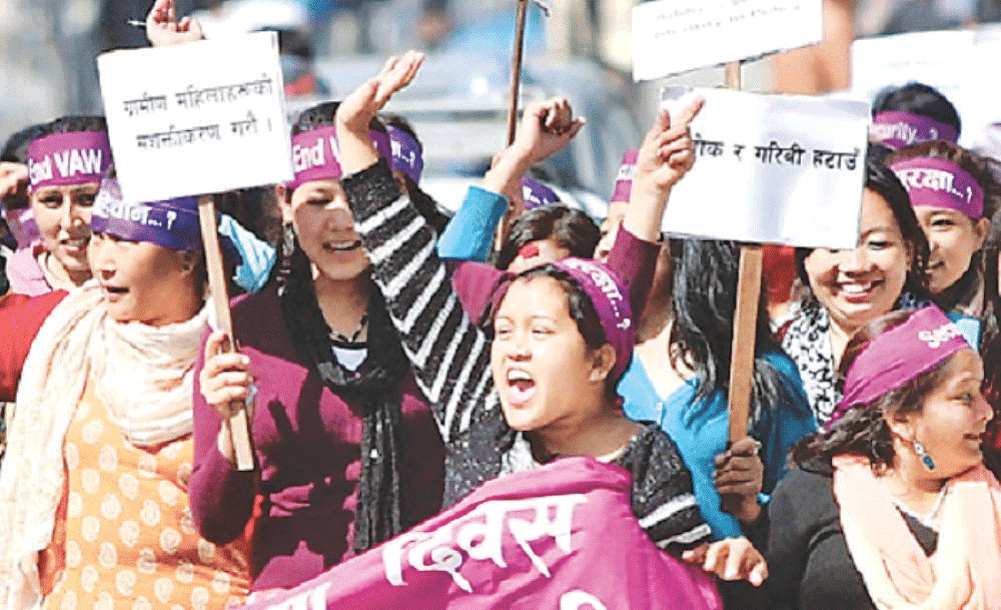
Although the government has made various policies, plans and programs for women's empowerment and gender development, the institutional system is weak
We use Google Cloud Translation Services. Google requires we provide the following disclaimer relating to use of this service:
This service may contain translations powered by Google. Google disclaims all warranties related to the translations, expressed or implied, including any warranties of accuracy, reliability, and any implied warranties of merchantability, fitness for a particular purpose, and noninfringement.
In the last two decades, Nepal has achieved significant progress in gender equality and women's empowerment. Women's participation in politics at all three levels of government is commendable and encouraging.
Vidyadevi Bhandari as the President of the country, Onsari Gharti as the Speaker of the Parliament and Chief Justice Sushila Karki in the Supreme Court, Chief Secretary Leeladevi Gadtaula and other women have led in the private industry, establishment and banking sector. This has inspired even the common woman to move forward psychologically. has built confidence.
It is found that women's participation in public service and private sector has progressed qualitatively and numerically with the provision of inclusive governance system. The Constitution of Nepal has given equal rights to men and women. In Article 38 of the Constitution, women's fundamental rights and duties have not only been declared, but also in practical implementation. Every woman has equal rights to descent, safe motherhood and reproductive health without gender discrimination.
It is mentioned that no physical, mental, sexual, psychological or any violent act or exploitation should be done against women on the basis of religious, social, cultural tradition, custom or any other basis. Women have the right to participate in all state agencies based on the principle of equal inclusion, and to have equal opportunities in education, health, employment and social security.
Nepal's federal parliament, state assembly and local municipal assembly have played an important role in policy formulation and implementation according to the model of inclusion. In two decades, the number and position of women in Nepali security forces is also increasing. Women entrepreneurs, industrialists and bankers are emerging in the private sector. Before 2063, the presence of women in the public service was about 8 percent. The Civil Services Act 2049 has given reservation to 6 different groups for civil services. In order to make the
service inclusive, there is a provision to separate 45 percent of the posts filled by open competition and consider it as 100 percent and fill the posts by competing separately among the candidates of different groups. Under this, 33 percent reservation has been set for women, 27 percent for tribals/tribals, 22 percent for Madhesi, 9 percent for Dalits, 5 percent for people with disabilities and 4 percent for backward areas. On the same basis, the presence of women in the civil service has reached around 29 percent.
Similarly, there are 37.98 percent female teachers. About 11 percent of the Nepal Police, 10 percent of the Armed Police and 10 percent of the Nepal Army have access to the security agencies. Which points to more women in top leadership positions in the future. Also, there are 114 women in the federal parliament, 193 in the provincial assembly and 14,465 women in the local level. Based on these figures, it seems that the presence of women in the last 18 years has raised significant hopes for inclusive governance.
Although the government has made various policies, plans and programs for women's empowerment and gender development, the institutional system for gender development is weak. Women development programs are being implemented in a piecemeal manner. The monetization of women's domestic work and the invisibility of its contribution to the economy still persist.
ing gender policies often come as tokenism and window dressing without considering the underlying causes of existing discrimination and bias against women. Investing in women's talents and education properly analyzed and gender responsive budgeting is limited in practice and not results oriented.
Women's access to social, economic, educational, political, administrative and other fields is very low compared to men. Women, who constitute more than half (51,505) of the total population in Nepal, are backward in every aspect of the state. Traditionally, caste discrimination, early marriage, and the importance of having a son, are still relatively undeveloped. A question mark has been raised on the policy and destiny of Nepal's zero tolerance and egalitarian society building. Its improvement requires joint efforts of individuals, society and the entire state system in terms of policy, method, destiny, structure, social value framework.
Various legal and institutional arrangements for reducing violence against women have been practiced, modified and refined since the past. For example, the first written law of the Civil Code of 1910, which deals with the sale of live flesh and blood, sexual intercourse, sexual intercourse with the intention of sexual intercourse, coercion, coercion, and the castle of servants and bondsmen, should also be considered as a progressive system of that time.
We have reached various subject laws and the Civil Criminal Code 2074 through the amended Civil Act 2020 that was released after that. Continuous monitoring and monitoring of the implementation of such policies, rules and laws should be done by the constitutional commission and the three-level state system. Another reform initiative could be the partnership of the government at the level of women's entrepreneurship and innovation.
It is necessary to bring awareness and transformation campaign to end the thinking and behavior that does not allow women to be included in the inclusive governance process. It is necessary to create a real information system for women who have reached the policy-making level and who are eligible to be reached, and also to measure the performance level. Another aspect of the reform is to formulate awareness campaigns to increase the qualitative and numerical presence of women so that there is no hindrance in the participation of women in public administration.