It is not easy for the UML to fulfill its dictatorial aspirations in the current balance of power. However, he wants to go there, from where democracy and its foundations can be found.
We use Google Cloud Translation Services. Google requires we provide the following disclaimer relating to use of this service:
This service may contain translations powered by Google. Google disclaims all warranties related to the translations, expressed or implied, including any warranties of accuracy, reliability, and any implied warranties of merchantability, fitness for a particular purpose, and noninfringement.
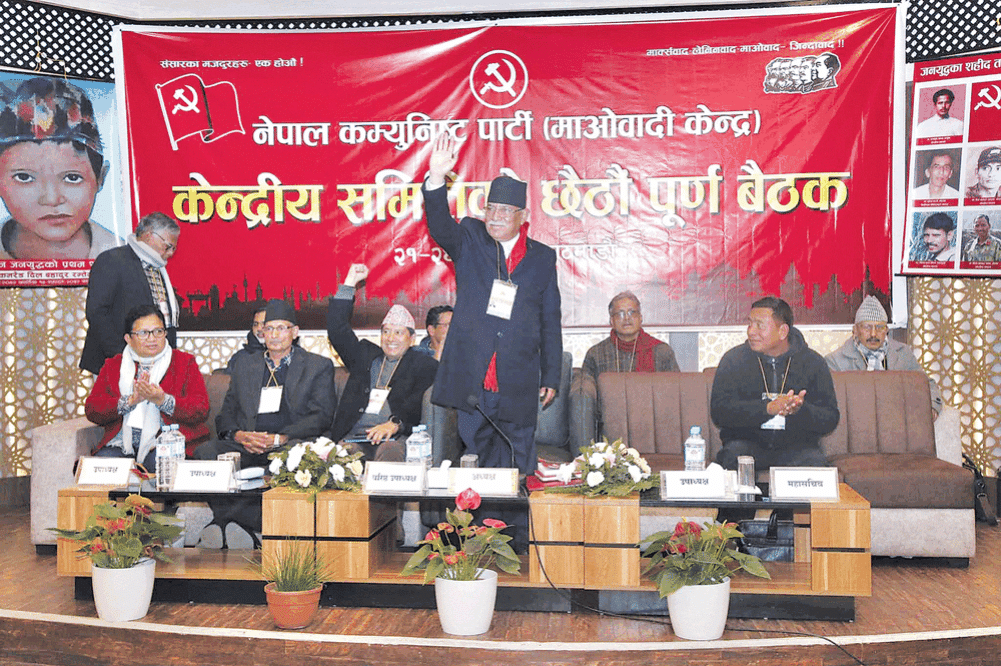
Sometimes politics proceeds through interesting coincidences. Like, last week in Kathmandu, one such interesting combination happened. In other words, on the same day, the meeting of the central committee of UML and Maoist was held. And it was over in one day. Interestingly, in the meeting of both the parties, they talked a lot about each other. It is also natural to talk, because the relationship between these parties has its own historical course and ups and downs.
which, at times, proceeds from the stage of intense conflict. Sometimes a wall of exhilarating unity climbs. And again comes a new series of contradictions. The meeting of both the leaders of the ruling party and the main opposition party, which started on the same day and ended on the same day, attracted the attention of many. In this meeting, some people discussed the differences and originality in the policies, principles, questions, working styles and methods of these two communist parties. This article summarizes those discussions.
What was seen, the shrinking of internal democracy within the Communist Party UML, which was democratized by Madan Bhandari through Jabaj, and moving towards Maoist democratization from the military organization was an interesting phenomenon in itself. Why is it said that, in the meeting of UML, the party president Khadga Prasad Oli himself showed his intention to restrict criticism and questions in the name of discipline, it was seen that the Maoists are becoming liberal. As a
, Chairman of the Maoist Center Pushpa Kamal Dahal 'Prachanda' said during his speech - 'It can be called a very strange coincidence. On the day we started the central committee meeting, another party UML also started meeting. People are surely comparing these two parties, two meetings and two directions of action. People must have noticed the difference between the two trends.'
Prachanda went on to say - 'In a party, the bureaucratic centralism and Dictatorship management was attempted. In our party, we have tried to respect the votes, to take the votes received for consultation throughout the country, to create an open environment for discussion, and to create consensus and understanding. The working class is comparing these two today.'
In reality, Prachanda's statement was meaningful and it showed how internal democracy is viewed between the two parties. The narrowness of the UML leadership in this meeting was surprising in itself. Not only did he seem to have planned the questions within the party, on the contrary he had issued an order not to speak too much. Even in national politics, UML seemed to be favoring two-party democracy and for that he proposed to amend the constitution. If the UML was becoming an example of how a democratic communist party can become a tool of dictatorship, it was seen that the Maoist dared to stand as a true supporter of 'multi-party democracy' in this meeting.
That is why it was said in the report of the Maoist Center - "The purpose of the constitutional amendment of the UML-Congress coalition government is to weaken federalism, move the multi-party competitive democracy to a two-party dictatorship, inclusive And to weaken the proportional representation, the electoral system is seen to favor brokers, capitalists and middlemen. Instead of that, it is necessary to emphasize on the amendment of the constitution with the aim of 'making the people more empowered, strengthening democracy and preparing the basis of socialism'.
The important thing to remember here is that because of the number of seats and the role of Maoists in the National Assembly, the attempt to amend the constitution to make it 'suitable for the two-party system and the convenience of Congress-UML' will fail. And UML President KP Sharma Oli has been forced to accept this reality. That is why he said while concluding the meeting of the party central committee, the constitution cannot be amended before 2087. What this means is that it is not easy for the UML to fulfill its dictatorial aspirations in the current balance of power. But, he wants to go there, from where democracy and its foundations can be discovered.
The Maoist party discussed in this meeting how to make its role effective in national politics. It has been concluded that we must move forward to build the foundations of democracy and socialism. In the meantime, the mood of the meeting to accept the weaknesses, self-criticize and move forward is seen. The
should be that way, the Maoist meeting has captured the bitter and sour moments of the coalition period. The Maoist came out of this meeting confident that it could stand on its own two feet. With such confidence of the party and leaders, enthusiasm has been communicated to the entire cadre. But it is clear that UML leadership wants to move forward by establishing its own ego rather than learning and improving. Looking at the discussions and conclusions of these meetings, it seems that the UML wants to establish the supremacy of the leadership and promote Maoist collectivism.
Maoist is the largest party in the country after contesting the first Constituent Assembly election in 2064 alone and has won about 30 percent of the popular vote. Reminded. Why did the Maoists, which emerged as the first big party alone, shrink in the days that followed? What weaknesses did the party do? And now how can those mistakes be corrected? How can it be compensated or compensated? The meeting also reviewed the issue.
Maoists have made a clear effort to restore the spirit, issues, originality and image of the party during the people's war, if they were blurred or faded from this meeting. It has looked back at issues such as the form of government, the electoral system, the format of federalism, addressing the movement of marginalized communities for identity and rights.
In addition, the party's core class, proletariat, working class, laborers, farmers, lower and middle class, women, Dalit, Madhesi, tribes and other oppressed communities have tried to unify the party with the spirit, feelings and voices. In the report presented at the meeting, it is stated that - 'based on the party policy related to the right of self-determination and autonomy, to activate various oppressed ethnic and regional fronts, to promote identity and rights to the oppressed communities including tribals and tribals'. Must do.
But UML did not discuss any issues of basic level citizens in this meeting. Neither the crisis of democracy was discussed nor the issues of people's rights were discussed. Power and power became the central theme of the UML meeting. The fact that there was no discussion about the problems faced by farmers and workers in the meeting of UML, which calls itself a communist party, was a surprising situation in itself in terms of agenda. It seemed that the Maoist promised to fight for the rights of workers, farmers, tribals, Madheshi, Muslims, Dalits, Tharu and women, while the UML narrowed their rights through constitutional amendment. is dreaming of doing.
Another important strength of the Maoist meeting is to emerge as a party that stands firmly in favor of good governance and works to end corruption and misrule. The fact that the last government under the leadership of Prachanda has done everything possible to end corruption and misrule, fearing that they too may fall in the process, the Congress-UMA was forced to form a new alliance, the top leader of that party himself is now twisting the reality. have begun to accept the language.
President Prachanda's political report has clearly illustrated this. Where it is said - "Our government's campaign against rampant corruption in the country, the action against land mafia and smugglers, the anti-nationalism of brokers and middlemen and Corrupt and broker forces, frightened by the initiative taken to destroy the anti-people settings, are moving in the direction of regression and counter-revolution.'
But there was no significant discussion on this issue in the UML meeting. On the other hand, while the meeting was going on, the main donor of UML came under the suspicion of the authorities. And only the Prime Minister's bare assurance of ending corruption came. Which no one seemed to believe.
From the point of view of leadership strengthening, the Maoist center has once again closed its doors around Prachanda. The elements who kept their mouths shut in the hope of different types of disputes arising within the Maoists and the hope of a khichdi ripening have been disappointed. The party has drawn a clear path to conduct a public campaign for 6 months and then to solve the question of internal democracy in a lawful manner through the convention.
But in UML, it seems that the protest against KP Oli is slowly starting. Many people feel that Oli's announcement to end factions is itself a sign of faction formation. It is clear that the Maoists have decided to review their past and move forward with strong unity and collectivity. UML leadership on the reverse journey of centralization
is out. It is sad to say that in the last meeting of the Central Committee, the UML has appeared directionless, while the Maoist Center has resolved to move forward with a clear mandate and a progressive direction. Which is an important opportunity not only for the Maoist movement but also for Nepali politics. The
author is a central member of the CPN-Maoist Center.