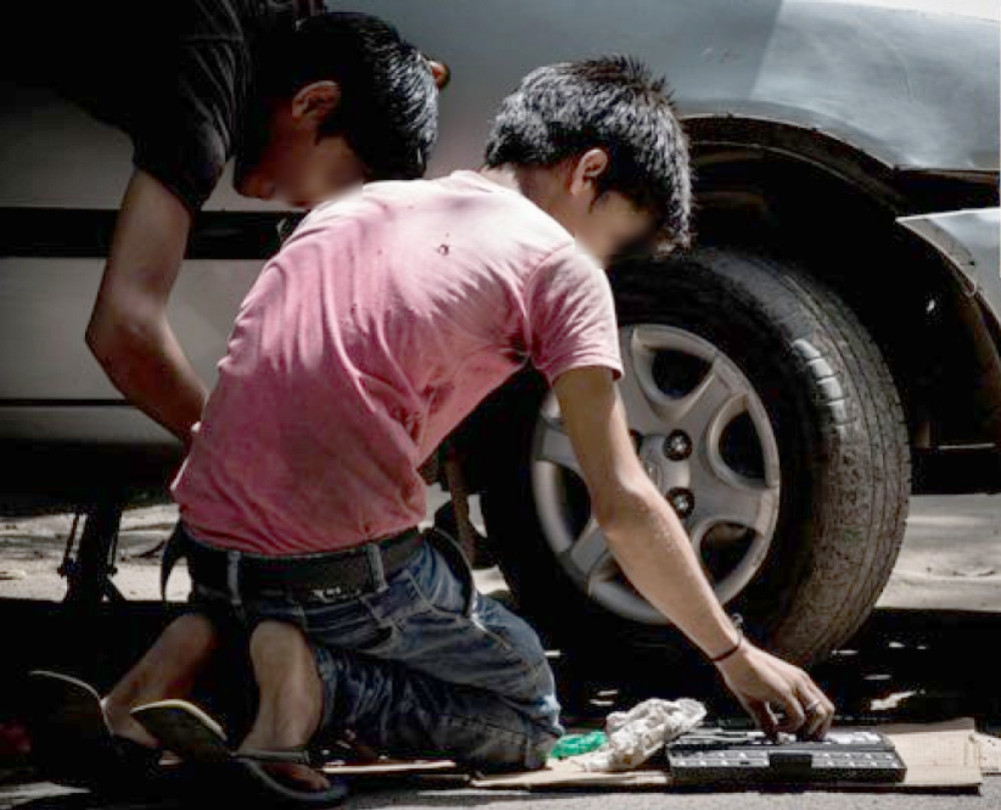
Emphasizing only the search, rescue and family rehabilitation of children involved in labor has not ended child labor. Why do children come to work? First of all, it is necessary to study it.
We use Google Cloud Translation Services. Google requires we provide the following disclaimer relating to use of this service:
This service may contain translations powered by Google. Google disclaims all warranties related to the translations, expressed or implied, including any warranties of accuracy, reliability, and any implied warranties of merchantability, fitness for a particular purpose, and noninfringement.
Whether by compulsion or desire, the all-round development of children involved in labor cannot be envisaged. Teaching children work or useful skills is not labor, but using them for gainful employment is child labor, a violation of children's rights.
Due to the lack of family and social protection, children are exposed to various risks including labor. How can tomorrow's society be civilized and prosperous if the growing Kalila Muna cannot be given a suitable environment, protection and correct guidance?
Article 32 of the Convention on the Rights of the Child, 1989 states that "States parties shall prescribe appropriate rules for the minimum age of entry into employment to ensure the right of children to be protected from economic exploitation and from any work that is hazardous or may interfere with their education or be harmful to their overall development." and provide for punishments and disciplinary measures' is mentioned.
Child Labor (Prohibition and Regulation) Act, 2056 has been issued to implement the Convention as a party state. It includes issues such as children not to be employed in hazardous work and punishments. In Article 39 of the Constitution, under the right of children, clause (4) provides that no child shall be employed in factories, mines or other such hazardous work.
Under Article 51 State Policy (i) 3, it is mentioned to end all forms of labor exploitation including child labor. The Ministry of Labor, Employment and Social Security has implemented the National Master Plan on Child Labor Prevention (2075-2085) with the aim of eliminating all forms of child labor from Nepal and making the country child labor free.
It aims to eliminate all forms of child labor by the year 2082 through a network and partnership campaign, providing social reintegration and economic alternatives. The bitter reality is that child labor has not been eradicated in spite of many such laws.
Focusing only on finding, rescuing and rehabilitating children involved in labor has not ended child labor. First of all, it is important to investigate why children come to work. The reason for labor can be different for everyone.
Children's first school and safety point is parents or family, so family protection, responsibility and role are considered very important. None of the children have come to labor from families that emphasize the necessary care, nurturing, nurturing and education for their children.
Not only the children but also the parents are not satisfied with Suga Ratai because of not being able to associate education with skills, skills with labor and labor with employment. Children who drop out of school end up joining the labor force because of the commentary that what happens after studying is to work and earn money.
In this way, being away from family care, there is a high possibility of getting involved in immoral activities such as falling into the family, theft, robbery, robbery, and violence. Therefore, it seems that programs such as earning while studying or learning while earning, which are sometimes implemented in our country, should be implemented in every school. Education would be the trust of all if we could build a skillful education system in which educated people can easily engage in self-earning.
Employers are not aware of child rights but are selfish and profit oriented. By showing the family's weaknesses, tempting them and limiting them to low wages or benevolence, even if it is hidden, the businessmen and businessmen who are longing to be employed have not been sensitized.
When some public representatives, politicians, employees, teachers, etc. are responsible for ruining the future of other children for their own children, it becomes clear what kind of journey we have set for the prevention of child labor. If there was no one to engage the children in work or labor, they would not have left home. It is the most ironic thing that such irresponsible characters of the society cannot be brought under the law.
According to Nepal Living Standards Survey 4th (2079/80), poverty in Nepal is 20.27 percent. However, the task of identifying poor households has not been completed. Let alone the federal and state governments, the local governments are also focusing on big physical infrastructure rather than small income generation programs to eradicate poverty, social issues are getting overshadowed.
The poor are forced to remain in the vicious cycle of poverty due to low income, low savings, and low investment. Therefore, by conducting an integrated poverty alleviation program in coordination with all governments, we should pay attention to building financially capable and responsible families and spread its effects to children who are underprivileged and in difficult situations.
Not only the government but also non-governmental organizations have an important role in solving children's problems. However, due to increasing duplication in government work, focusing more budget on conference, seminar, meeting allowances, working in accessible rather than remote areas, and due to lack of effective regulation of the government, the expected benefits have not reached the target group.
Non-governmental organizations should be active in making parents, communities, employers aware and aware of children. Rescue and rehabilitation, counseling, health and education for the affected children and support for livelihood of the family should also be provided.
The government aims to declare all local levels with child-friendly local governance by 2087. As the local level has not simultaneously implemented this concept, there is a tendency for employers or families to employ children in the municipality that does not implement the child-friendly concept. Therefore, if all the municipalities conduct the child-friendly campaign simultaneously and pay attention to continuity, significant success can be achieved in the prevention of child labor.