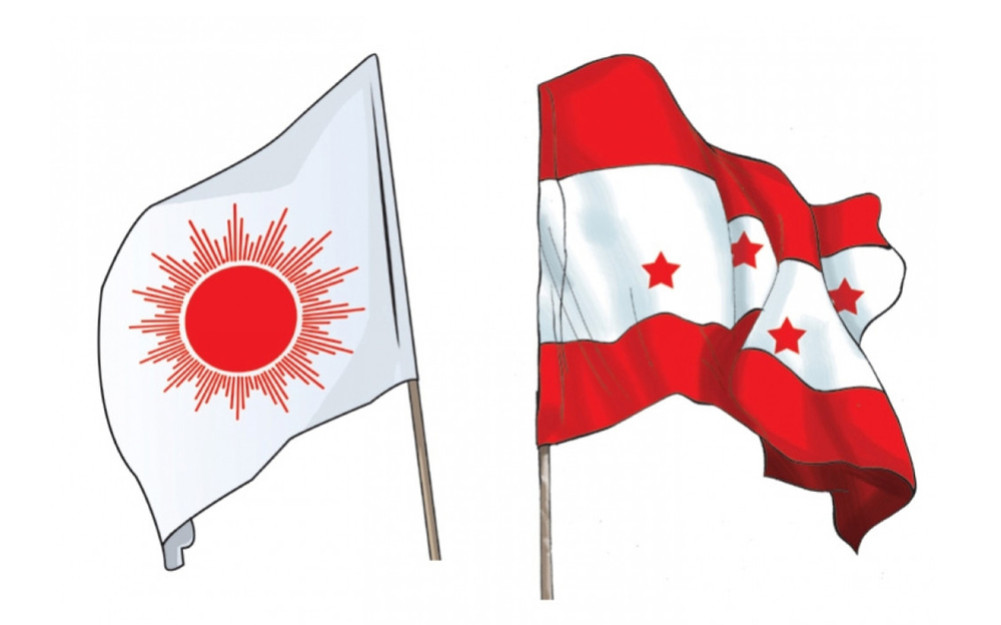
Saying that we are running a two-party rule by prohibiting it legally is like the panchayat running a one-party rule yesterday. Such thinking is unacceptable in a democracy.
We use Google Cloud Translation Services. Google requires we provide the following disclaimer relating to use of this service:
This service may contain translations powered by Google. Google disclaims all warranties related to the translations, expressed or implied, including any warranties of accuracy, reliability, and any implied warranties of merchantability, fitness for a particular purpose, and noninfringement.
The Congress and UML, the two largest parties in the House of Representatives, have started to renege on the promise they made to form a power alliance. While citizens are expressing interest in the agreement reached between the two parties for political stability, good governance and economic prosperity, instead of publicizing the progress details, the government itself is engaged in promoting instability.
On the one hand, there has been a delay in convening the winter session of the Parliament, that too because of the intention of passing the Ordinance, even the Ordinance is not for any emergency work, but with the plan to facilitate the division of parties.
If the government itself prefers to divide a certain party by keeping all the problems of the country at bay, then it should be said that the ruling parties intend to increase instability and weaken democracy in this country. The journey to good governance and prosperity in this country is still difficult.
There are two different parts of the issue that the government is trying to push the parliament session and bring an ordinance to split the party. As the last session of the Parliament ended on August 31, the government will have time until February if the constitutional facility is used.
because Article 93 of the Constitution mentions that the period between one session and another session should not exceed 6 months. But in general practice, the winter session is called in December. February 21, 2074 (the first meeting after the election), January 11, 2075, January 4, 2076, January 17, 2077 (only the National Assembly since the House of Representatives was dissolved in February 5), November 28, 2078, January 25, 2079 (the first meeting after the election of the House of Representatives) and January 22, 2080 The winter session was called.
Looking at this overall background, the parliament session started late last year, but if we want to mention the background, the previous year's session lasted until November 16. This year, as the session ended on August 31, the session had to be convened in the first week of December. Generally, the winter session ends in the first week of October and the winter session is called in January. A one-two week time has been given for the date of the
meeting. This year's winter session may be extended till January as it has not yet been convened. The government is preparing an ordinance by ignoring the demands of the opposition parties to call the parliament session, which is unfortunate for democracy itself. On the one hand, the government's attempt to govern by ordinance is contrary to parliamentary norms.
On the other hand, doing so with the aim of dividing the opposition party is objectionable. It is not that such a trend did not exist in the past, but it is the attitude of treating the same practice as a privilege that is causing the loss of faith in our institutions. Yes, in the previous parliament, the then Prime Minister KP Sharma Oli brought an ordinance to divide the party led by Upendra Yadav, but the ordinance was made inactive after the purpose failed.
When Sher Bahadur Deuba, who opposed Oli's ordinance, was the prime minister, UML was divided by bringing an ordinance with the support of Maoists. Maoist Chairman Pushpa Kamal Dahal split the JSP after supporting Oli who was opposing the Ordinance to create a unified socialist.
This matter is still pending in court. The Congress, which opposed this decision, is currently in the government itself and is engaged in the discussion of bringing an ordinance targeting the integrated socialists.
On the one hand, the Congress-UML comments that the small parties have increased instability, on the other hand, they have made the plan to divide those parties their main agenda. It is the height of contradiction to raise the slogan of stability and create smaller and smaller parties by dividing the opposition parties. In a democracy, no party will be big and powerful and how many parties there will be cannot be guided by the laws brought by the government. In a multi-party democracy, there can be two or more parties, their size is determined by their principles, commitments, service delivery.
Everyone has the opportunity to become strong, big and powerful, that is by competing, not by systematically breaking and prohibiting others. Saying that we are running a two-party rule by prohibiting it legally is like the panchayat running a one-party rule yesterday. Such thinking is unacceptable in a democracy.
It seems that the ruling party is taking a short path of suppressing the opposition by force rather than delivering the results according to the promises made during the elections and government formation. This natural path is not a long-term strategy for the Congress-UML, it is sure to be only a temporary setback.
In democracy, not all parties are always in power, if the practice of breaking others by forgetting the democratic norms becomes institutionalized, this blow will be fatal to itself tomorrow. No scriptures are needed for this, the hard history experienced by the parties themselves is enough.
Therefore, leaving the comprehensive plan of good governance and prosperity, the parties should not get involved in the maze of momentary selfishness. Because as much as the parties have tried to increase their size through this dauphe, the size of the country's challenge is wider than that.