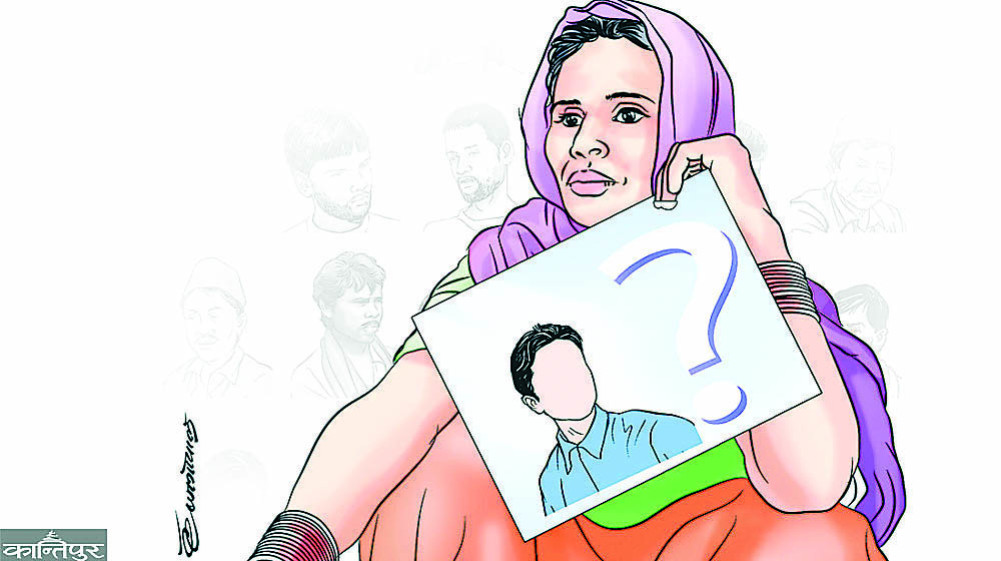
The matter of how the work of transitional justice will proceed has been overshadowed after the recommendation committee for appointing the office bearer has been subjected to serious political interference.
We use Google Cloud Translation Services. Google requires we provide the following disclaimer relating to use of this service:
This service may contain translations powered by Google. Google disclaims all warranties related to the translations, expressed or implied, including any warranties of accuracy, reliability, and any implied warranties of merchantability, fitness for a particular purpose, and noninfringement.
A peace process was launched to end the decade-long armed Maoist insurgency (Janyudh). The country entered the transitional phase after reaching the initial conclusion from the comprehensive peace agreement of 5th November 2063.
As part of the peace process, the people's war ended, the monarchy ended and a democratic republic was declared and the constitution was drafted by the Constituent Assembly. However, the verification and justice of human rights violations during the conflict and the investigation of the disappeared persons have not been completed yet.
is the failure of the transitional justice process, which has mainly delayed the truth-telling of the events of the conflict. There is no guarantee that the victims will get justice. No action has been taken against the guilty. The mental, social and economic rehabilitation aspects of the conflict victims are weakening due to political intervention, international pressure and the inability to project the expectations of stakeholders. Although two decades have passed since the conclusion of the peace agreement, the reconciliation and trust building in the post-conflict society has not even begun.
The Truth and Reconciliation Commission and the Disappearance Investigation Commission were found to be in conflict with the Constitution and international human rights. could not be achieved.
The Supreme Court decided that amnesty should not be granted without the consent of the victim, especially in cases of serious human rights violations. Even recently, the Supreme Court drew attention to the delay in amending the Act on Transitional Justice and ordered a deadline for the process of appointment of officials in the relevant commission.
Even with years of tireless efforts, almost a decade of time was wasted for urgent amendments to this law as the power-centered political transition could not be stopped. Amendments to the Act became possible after the recent political consensus. These amendments mainly cover aspects such as the definition of serious human rights violations and the conditions under which sentences can be reduced, the role of the Commission, the establishment of special courts, victim participation and reparations. However, they are not dissatisfied with the amendment of the Act.
Kantabijog happened because the recommendation committee formed under the chairmanship of former Justice Omprakash Mishra for the appointment of officials of the Commission on Transitional Justice showed its inability to make recommendations even though it was actively working. The members of that committee were people who had been accepted by all parties and parties to some extent. The Human Rights Commission had an institutional presence. Former Attorney General was its member. But the recommendation committee could not work and did not want an extension. Why not recommended
?
Although there was a recommendation committee consisting of people who were prominent in the society and trusted by all parties, the committee was dissolved mainly because it could not make a recommendation for some reason. As such, the influence of top leaders of political parties and the political culture of partisanship in the recommendation committee hindered free and fair decision-making. Some members of the committee did not seem capable of taking independent decisions and remained engrossed in fulfilling the wishes of the party leaders. The committee could not earn the trust of the conflict victims.
The committee could not make a recommendation due to the two-month time limit given to the committee, the appointment criteria set by the Act (eg, the qualifications of a Supreme Court judge) and the procedural complications adopted by the committee itself. Couldn't adequately search for a suitable person.
Since the recommendation committee to appoint officials could not work under the grip of gross political interference, the issue of Truth and Reconciliation Commission and Disappearance Investigation Commission can be formed in the near future and the work of transitional justice will go forward. International organizations have also expressed this concern recently.
Administratively, the work of the Commission and the preparatory work for its completion (eg, the establishment of a multi-donor trust fund) will also be relaxed. When will the government form a recommendation committee again, how much will the stakeholders believe in it, what will be the criteria for appointment, these issues are now under question. The matter of becoming a commission and determining transitional justice is sometimes!
The parties to the conflict may have thought that all the accusations and problems would have been resolved with time. However, the pain of the conflict victims will not only remain alive, but the very nature of the highly polarized and power-oriented political party will not allow this question to die. This problem will continue to arise to maintain terror as a political weapon.
Until the expectation of justice and dignified rehabilitation is met, the victim's resentment and pain will continue. Failure to build harmony and trust in society will lead to increased discontent and division. Nepal's image in the international community will be affected and the possibility of Nepal's conflict cases reaching international/foreign courts will increase as the legal system within the country does not provide justice. Transitional justice is more likely to become a weapon of power politics. which will hinder long-term peace and stability. These are also issues that seek to overshadow transitional justice.
What to do next?
The following steps can be taken to get the peace process back on track as soon as possible by reducing the risk of delays in transitional justice and reconciliation work.
(a) The President will hold a meeting of all major parties and key stakeholders, including the Maoists, as soon as possible. In that meeting, the contemporary situation of transitional justice and the inability to form a commission will be discussed and requested to reach a conclusion on the next roadmap. All parties will request the government for the necessary initiatives to form a commission within the next three months.
(b) To amend the provisions of the relevant Act by ordinance and make the provisions regarding the appointment of officials somewhat looser. Instead of appointing qualifications such as judges of the Supreme Court for the positions of presidents, preference should be given to appointing people with empathy, emotional understanding (empathy) and communication skills as well as legal qualifications.
(c) Reviewing the process of formation of the recommendation committee and appointing neutral and independent people but also appreciating the sentiments of the stakeholders and especially the victims of the conflict in the recommendation committee. The recommendation committee should reach out to a respected person who is trusted for this task in the society with a request to take responsibility.
(d) After nominating the chairman, consult with him and appoint the members inclusively.
(e) Emphasizing the testing of recommended persons.
(f) Political parties should not interfere in the work of the recommendation committee and the commission to be formed even for their own dignity.
(g) Some people are prosecuted for serious human rights violations. If some apologize, the victim will forgive. The reparation package will not only be financial, but will include honorable rehabilitation and psychological reconciliation in society. In such matters, it would be appropriate to advance the work by agreeing with political parties and conflict victims.
(h) Communicate with the court system about specific aspects of transitional justice while respecting the natural role of the court.
(j) Realizing the importance of international cooperation and understanding, immediately communicate with international human rights organizations about the next work and new schedule.
(j) Development of a compensation package, dialogue at the local level and continuation of resolving the issues of the conflict victims and deepening reconciliation efforts at the community level and establishing the recognition that this work will help after the formation of the commission.
(k) After the formation of the commissions, prepare the necessary resources, manpower, training and a roadmap for comprehensive dialogue at the local level now and try to create a positive public perception towards the rest of the work of transitional justice.