Climate justice is necessary for a country like ours to protect the fundamental rights of citizens and implement the obligations of countries that are emitting more carbon. For that, it is necessary to raise the diplomatic initiative.
We use Google Cloud Translation Services. Google requires we provide the following disclaimer relating to use of this service:
This service may contain translations powered by Google. Google disclaims all warranties related to the translations, expressed or implied, including any warranties of accuracy, reliability, and any implied warranties of merchantability, fitness for a particular purpose, and noninfringement.
Recently, the least developed countries of the world are facing more problems due to various reasons. These countries are trapped by the covid epidemic, Russia-Ukraine war, internal and international geopolitical tensions of various countries. The problems of internal conflict, armed rebellion and terrorism are still there, apart from these there is an unimaginable and overwhelming burden on the country, climate change.
The complexity and increasing challenge of climate change is more dangerous and deadly than the other reasons mentioned above.
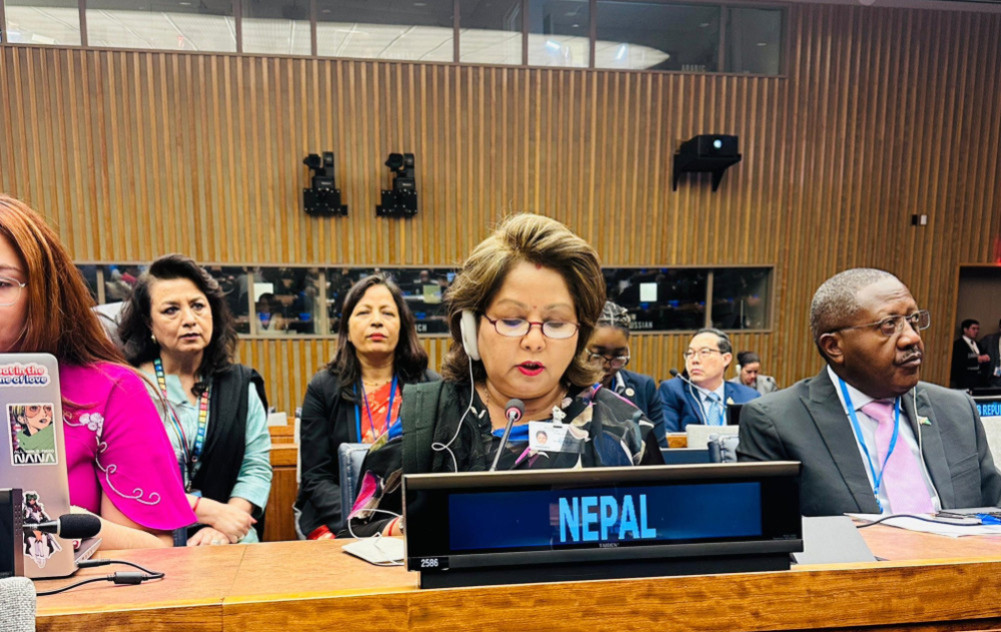
Foreign Minister Arju Rana Deuba, in his capacity as the president of LDCs, addressed the foreign minister level meeting of G-20, a group of 20 countries considered to be the world's most powerful countries, as part of the United Nations General Assembly held last October in New York.
He had said, 'Now we are only considering armed conflict, terrorism, insurgency etc. as a problem. But the problem of climate change is going to do more and more unimaginable harm to us and nations like us than to the outbreak of armed conflict or terrorism. Change is also becoming a factor. The third world leader of the meeting held the opinion that the cooperation of the countries belonging to the G-20 is important to reduce this type of multifaceted problem. For that, the solidarity of the LDCs is necessary.
Last October, this topic also got priority in the third conference of Asia Cooperation Dialogue (ACD) held in Doha, Qatar. On the one hand, due to the increasing conflicts and geopolitical situation in different regions of the world, on the one hand, the path to peace and prosperity is becoming complicated, and as a bigger challenge, the human community has started to suffer due to climate change.
There, including Nepal, the most affected countries, if they delay in looking for the solution to the problem of climate change, then it will make tomorrow's generation more insecure.
The least developed countries are still not able to meet the global sustainable development goals. Statistics show that Nepal and similar countries are still far from those goals. It has been observed that the impact of climate change can create obstacles to achieve the goal. This opinion has been held by the leaders of Asia from time to time. Therefore, the countries of this region have to cooperate in mitigating the effects of climate change to secure the future of tomorrow's generation.
It seems necessary for Nepal to intensify its climate diplomacy in the days to come. It needs to be pursued as a separate strand of diplomacy. A quick look at the world environment shows that diplomacy is measured based on the interests of one's country, national interests and returns.
This does not mean that we should remain confined within the confines of traditional diplomacy. Our geographical location and geopolitical environment is different and unique. Therefore, we should also continue to develop and expand the various dimensions of diplomacy according to the times. As if we have to rise above the traditional diplomatic circle to develop labor diplomacy, tourism diplomacy, energy diplomacy as a new dimension according to our needs.
UN Secretary General Antonio Guterres visited Nepal last year. He also visited the affected area here and gave a video message on social media that 'if the mountains of Nepal continue to melt like this, it is impossible to say what will be the condition of tomorrow's generation'. It can be assumed that the message reached the whole world. After that visit, the COP conference was held in the UAE.
Nepal was heard everywhere there. If so, how much compensation did we get as victims? How have we brought our voice to the world stage and have we been addressed accordingly? This is the climate diplomacy that needs to be done now. Climate diplomacy is the ability to raise our voice diplomatically for the issues and reasons that we are suffering from and create conditions in favor of the victims.
Nepal has sought justice in the International Court of Justice (ICJ) regarding the impact of climate change on Nepal and the compensation it should receive. Foreign Minister Arju Rana Deuba raised the matter in the court on behalf of Nepal last week. For the first time, Nepal has submitted its claim for climate justice to the International Court of Justice. Showing the current situation of climate change and its impact on Nepal, Nepal has demanded climate justice from the party countries and agencies.
Countries like Nepal are facing problems due to carbon emission by the rich and developed countries of the world. These countries actually have no contribution in terms of climate change ie the amount of carbon we emit is negligible. However, we are facing problems. Many researches have shown that not only adverse effects of climate change have been observed in Nepal, but Nepal is at high risk.
A recent study by ISIMOD showed that if the snow melt continues at the current rate, the glaciers of the Himalayan Hind Kush region will lose up to 80 percent of their current ice by the end of this century. Although it is seen here that the snow has only melted, behind it, it has caused a disaster with floods and landslides in the high mountain areas, and the danger of adding other infrastructure related problems has also increased.
Now it seems that due to climate change, the basic needs and rights of people such as food, health, housing, sanitation, and drinking water will gradually decrease and be taken away. Animals suffer more than us just because they cannot speak. Countries like ours need climate justice to protect these fundamental rights of citizens and implement the obligations of countries that are emitting more carbon. For that, it is necessary to raise our diplomatic initiatives.
– Pathak, the former editor-in-chief of Rasas, is the press adviser of Foreign Minister Arju Rana Deuba.