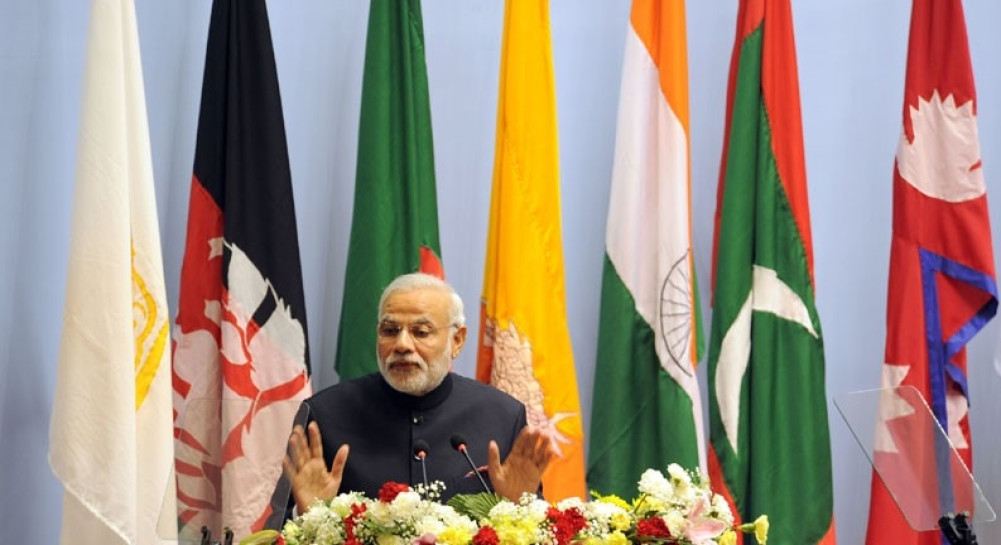
By putting the problem under the carpet and talking about strong and special relationship in the statement alone, the citizens cannot be reassured. Based on this understanding, it is possible to solve more than half of the problems immediately as soon as Nepal-India relations are promoted.
We use Google Cloud Translation Services. Google requires we provide the following disclaimer relating to use of this service:
This service may contain translations powered by Google. Google disclaims all warranties related to the translations, expressed or implied, including any warranties of accuracy, reliability, and any implied warranties of merchantability, fitness for a particular purpose, and noninfringement.
'India Today', an analytical weekly magazine published from India for half a century, published a sensational 'cover story' in its August 19, 2024 issue - 'Circle of Fire: Why India Should Worry'.
A 12-page analysis of the ups and downs of India's challenging neighborhood relations with a large photo of Indian Prime Minister Narendra Modi surrounded by portraits of heads of government from China, Pakistan, Sri Lanka, Myanmar, Nepal, Maldives and Bangladesh. It is mainly concluded that after the Bharatiya Janata Party leader Narendra Modi came to power in 2014, India is adopting the 'neighborhood first' i.e. neighborhood first policy, gradually losing its neighbors and increasing adversity in the neighborhood. Depicting these seven countries as a 'ring of fire' for India, arguments have been put forward that India should focus on improving relations with its neighbours.
In recent days, some completely unexpected developments in South Asia have led India to reconsider its neighborhood policy. Perhaps that is why there are signs that India has taken some new steps. For India, which is looking for a new role in the international arena with the ambition of becoming a world power, the lack of easy neighborhood relations has emerged as the biggest adversity. The ups and downs in India's relations with its neighbors other than the protected Bhutan are naturally not pleasant for India.
At about the same time, it seems that India has started trying not to be adversely affected by the political developments that have developed in the Maldives, Bangladesh, Sri Lanka and Nepal. The issue of China and Pakistan will be separated, it is difficult for India to move forward without somehow addressing the growing distance with its traditional friends in South Asia.
Maldives and India are in no way comparable. The Maldives is a small country of islands with a population of five million. However, what is a surprising sight is that India, with a population of 1.44 billion people, is not able to compete with the same small neighbor sometimes by working hard. After the election of the President of the Maldives in November 2023, the Indian Prime Minister Narendra Modi, Narendra Modi, went to Lakshadweep to suggest travel options to its citizens to dry up the tourism sector, which is the backbone of the country. India has kept 80 soldiers there for the maintenance and operation of rescue helicopters and a ship given to Maldives. India's relations with the Maldives cooled significantly after Muiju was elected president with the slogan 'India Out', announcing that he would be returned to India. Even after his election, eight months before his visit to China, the public tag of 'pro-China' was painted as proof. After his party won the majority in the parliamentary elections (October 6-10, 2024) and failed to replace President Muiju by promoting other parties in the Maldives, he was not only invited on a state visit to India, but a package was announced to solve the economic crisis. Reminding that India is the closest neighbor of the Maldives, efforts have been made to forget the past.
The results of the recently held presidential elections in Sri Lanka did not come as expected by India. The fact that India preferred/helped Sajith Premadasa, the son of former President Ranasinghe Premadasa, was not hidden, thinking that the 75-year-old Ranil Wickremesinghe, who took over the leadership in crisis after the Rajapakse family was ousted in 2022 through the general uprising named 'Aragalaya', could not win the presidential election. However, the election was won by Comrade Anura Kumara Deshanayake, the leader of Janata Vimukthi Peramuna (JVP), a communist party that occasionally raised a loud voice against 'Indian expansionism'.
Also, in Sri Lanka, which is being promoted as being close to China, there has been an unsuccessful armed struggle twice (1971 and 1987-89) and the leader of the JVP, who displayed a giant picture of Marx-Lenin in the foreground in the victory rally, has become an additional challenge for India. is With the expectation that leader Anura, who emerged unexpectedly amid the political opportunities caused by the extreme economic crisis, will adopt a pragmatic policy focusing on crisis resolution, the Indian Foreign Minister S. Jaishankar's visit to Colombo within 11 days of his assumption of power (October 4, 2024) and President Deshanayake's state visit to India (December 15–17, 2024) as his first foreign visit is India's quest for a new role.
India is caught in the biggest problem in Bangladesh. Sheikh Hasina's government, which India had been supporting and benefiting from for 15 years, was not only ousted on August 5, 2024 due to massive protests, she herself was forced to come to Delhi as an unwelcome guest. India has suffered a double blow from this. On the one hand, no other country is ready to give refuge to Hasina and she is obliged to keep her as a guest indefinitely, on the other hand, after she was driven away at the risk of her life, she had to restore relations with the interim government led by Mohammad Yunus, which includes the army, the opposition party that has strong ties with her, and non-political citizens. Ever since Professor Yunus's swearing-in, despite continuous deployment of its experienced High Commissioner in Dhaka, Santosh Jha, India has not yet gained a firm foothold in Bangladesh, instead disputes are escalating. Due to the unpopularity of Hasina, extreme suppression of the opposition, disregard for the voice of the citizens, swamp of familyism, she had to escape from the country within 45 minutes due to public anger, Delhi-based experts and media have created the comment that 'Pakistan and America are in the hands' behind it, India is desperate to tear it apart. is.
In 1971, after fighting a decisive battle on its own, and without being able to make a general assessment of what is happening in Bangladesh, with which it has a harmonious relationship, the trust and love given to Hasina alone has shocked India. Indian institutions, which are criticized for being interested in even the smallest matters in the neighborhood and being involved, cannot even have a general forewarning that such public opinion is manifesting against Hasina.
India-Pakistan relations could not be discussed. When the British colony ended in 1947, these two countries were born to fight. No one knows when the war that started after the creation of India and Pakistan on the basis of religion will be over so that the message that the people of this region cannot manage the state after the British leave will be sent out and the land can be used again. The bitter relationship between the two nuclear nations is not only limited to this region, but is evident all over the world. Although India's Foreign Minister Jaishankar's visit to Islamabad at the Shanghai Cooperation Organization (SCO) meeting did not make a concrete contribution to reducing further hostility that has appeared in recent days in relation to what seems like intermittent normalization, it should be considered an achievement even if it is only a small stone in the pond that has been frozen for 10 years.
A major concern for India in recent times has been its complicated relationship with its giant neighbor China. The relationship between the two countries, which has been limited to formalities after the incident in the border area, which has caused major human casualties in 2020 (official claims of 20 Indian and 4 Chinese soldiers dead) for the first time since the 1962 war, is slowly picking up the pace. After the war of 1962, the capitals of the two countries recalled their own ambassadors, but this time they did not drop to the level of not sending any ambassadors for 16 years, but both air and land transport services between the world's first and second populous countries have been closed for four years. Apart from limited diplomatic activities, some progress has been seen in recent days as the two sides have been spending time on military commander-level talks.
After the meeting between Chinese President Xi Jinping and Indian Prime Minister Modi at the BRICS summit held in Russia, the relationship has been eased hastily since then, and has been gradually eased by the foreign minister-national security advisor level talks in Beijing. It is difficult for India to face the challenges created by China, which is advancing with the ambition of becoming the world's first power soon. Despite the emerging complications in the political and military spheres, the continued trade between India and China and its continuous upward trend indicates the future of the relationship between these two countries.
It is discussed in the political-diplomatic circle that India does not like the recent change of power in Nepal. Regardless of the predictions of those who worry that the political stability and relative national self-empowerment that will be available when the country's two largest parties come together, India will not be able to push away and ignore its relationship with Nepal.
India has no choice but to deal with Nepal more cautiously and intelligently amid the unhealing wounds of the blockade imposed by Nepal in 2015 when it issued its own constitution. Amid many rumors and propaganda, the friendly meeting between Prime Minister KP Sharma Oli and Indian Prime Minister Narendra Modi in New York and before that, Foreign Minister Dr. The warm hospitality accorded to Arju Rana in Delhi indicates the traditional friendly relations between the two countries. After returning from the visit to China, Prime Minister Oli has certainly not given such an expression that he will visit India soon. Placing the problem under the carpet and talking about a strong and special relationship in the statement will not reassure the citizens in today's era. Based on this understanding, as soon as we are ready to advance the relationship between the two countries, it is possible to solve more than half of the problems immediately. Looking at the closeness of wavelength seen between Oli and Modi in the past, there is no problem in taking Nepal-India relations beyond the circle of bureaucracy and intelligence agencies when the two leaders are together.
Since Narendra Modi came to power in 2014, India has not failed to mention that 'neighborhood first' policy is its priority when talking about neighborhood relations, issuing statements or collaborating. Its success or failure may have its own angles, but one thing is certain – India cannot fulfill its global ambitions without facilitating neighborly relations. From the restructuring of the United Nations to the 'Global South', India's agenda cannot naturally attract global attention if its neighborhood is not seen as supportive. Therefore, the success India achieves in managing neighborhood relations will build its capacity and image globally.