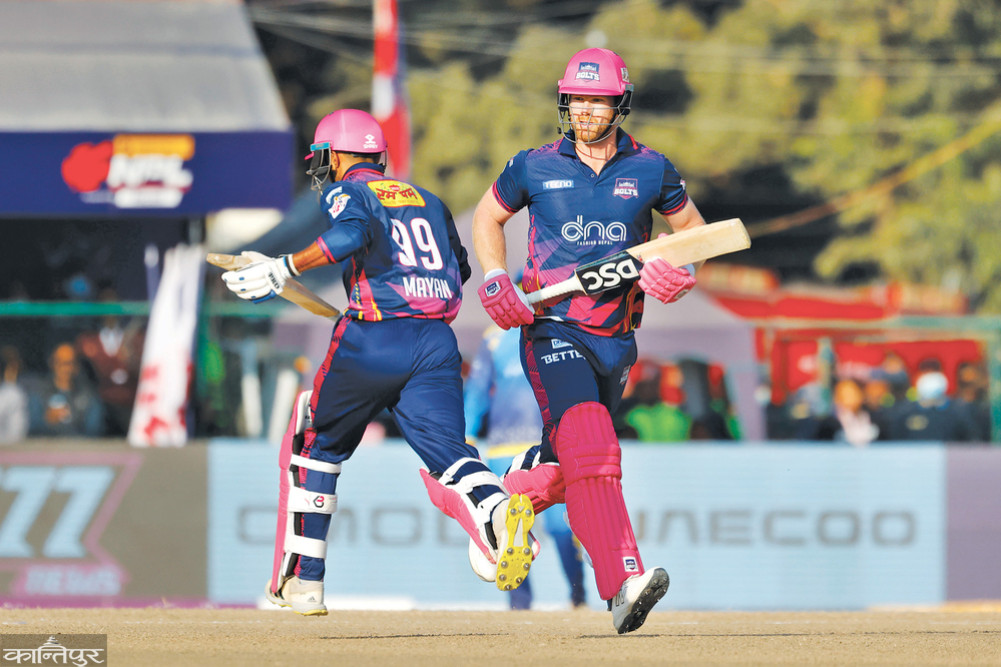
As the sport moves into the professional era, the potential for misuse of player and team names remains a challenge
We use Google Cloud Translation Services. Google requires we provide the following disclaimer relating to use of this service:
This service may contain translations powered by Google. Google disclaims all warranties related to the translations, expressed or implied, including any warranties of accuracy, reliability, and any implied warranties of merchantability, fitness for a particular purpose, and noninfringement.
Nepal Premier League (NPL) is about to end. Starting from November 15, most of the national level players and international players from the cricket powerhouse countries India, UK, Australia are also participating through the club.
Seeing the enthusiasm of cricket lovers and spectators, it can be considered that Nepali cricket has entered the stage of professional era. As the sport moves into the professional era, the potential for misuse of player and team names remains a challenge.
Unauthorized activities such as fake and low-quality materials used in the game, imitation or theft of game-related copyrights, production and imitation of caps, jerseys, shoes, socks, etc., production of sports materials, imitation of brands and designs.
As the intellectual property sector is emerging as a major source of income for various individuals, organizations and governments, the protection of intellectual property rights has become inevitable. In 2020, 40 percent of Switzerland and Singapore, 39 percent of the United States, 38 percent of the EU, 34 percent of South Korea, 30 percent of Japan and Canada, 27 percent of China and the United Kingdom, and 25 percent of Germany and India are the contribution of intellectual property to the economy.
To achieve such a result, Israel and South Korea have invested about 5 percent of the gross domestic product. The US, Sweden, Switzerland, Japan and Germany spent an average of 3.5%, China, Australia, France, Denmark, Finland an average of 2.5% and India about 1% of investment in research and development.
The investment in this sector promotes economic growth, competition, innovation, employment for the general public and revenue for the government for the development of the country. This article will briefly discuss various aspects of intellectual property rights related to cricket.
patent : A new technical solution discovered to solve a problem is called an invention, while the monopoly granted to its inventor by law is understood as a patent. The materials used in cricket such as balls, bats, pads, leg guards, socks, gloves, helmets and other equipment and materials are improved through continuous research and development to improve the quality and safety of the players. Through patent rights, the protection of the investment of inventors and investor organizations is guaranteed.
industrial design: Shape, configuration, pattern used to give an attractive appearance to an object is considered as a design. In order to provide an attractive appearance to the equipment and materials used in cricket, the rights over such motifs must be protected.
The design of the tools and materials of this game is very important. As there is a competition between manufacturers of equipment and materials to make them different and attractive from other manufacturers, manufacturers should pay special attention to protect the intellectual property (design) of such cricket materials.
trade mark (trademark): is a different name, logo, symbol, word, number, letter, sound, to distinguish the goods or services of one commercial establishment from the goods or services of another commercial establishment, to provide ease of identification of the goods or services to the consumer. A picture is used. In common parlance, a trademark is called a brand. In the context of
cricket, trademarks are used to distinguish teams, players, competitions and game materials from other teams, players, competitions and game materials. For example, jerseys, caps, tea or coffee mugs, stickers and covers used on laptops and mobiles, NPL, Biratnagar Kings, Janakpur Bolts, Chitwan Rhinos, Kathmandu Gurkhas, Pokhara Avengers, Lumbini Lions, Karnali Yaks, Sudurpaschim Royals names and logos. has been done It helps in determining brand value and establishing reputation among the public. It has also helped to increase the fame of the club and team through well-known players.
Commercial Confidentiality (Trade Secret): The above-mentioned tools and materials used in cricket, formula, commercial information, strategic game plan can be considered as commercial confidentiality. This will also help in the development and specialization of the game content manufacturing industry by stopping the unauthorized production of content in the current competitive times.
Geographical Indications (Geographical Indications): Geographical Indications are the names used to identify specific qualities, characteristics and popular goods in a particular geography. Materials with such characteristics are also used in cricket.
Light and strong cricket bats made from the wood of Salix alba, a type of tree found in the riverside and lowlands of South East England, are commercially produced as a geographical indication under the name 'English Willow'. It is protected by the UK as a GI tag. It cannot be said that such items that can be used in cricket are not available in Nepal. It seems that the interested party should conduct a study and research.
Copyright: Original creativity and artistic content prepared by organizers may be copyrighted. Sports-related copyrights include sports team anthems and theme songs, related music, sports audio visuals, advertisements, team or sports slogans, artwork, live broadcasting, rebroadcasting, distribution, games, players, publication of photos of sports events, sports competition reports, brochures, flyers, etc. And the written documentation of the game.
should be allowed to use, publish and broadcast from the relevant person, organizing body or authorized body for the above-mentioned work. Copyright protection is necessary for the investment of the organizers, the management of the game and the future development of the game. Based on the popularity of the IPL, the broadcaster has signed a contract with IPL for INR 48,390 crore for the rights to broadcast the match for the period 2023 to 2027.
Intellectual property and intellectual property rights: Intellectual property means the creation of the human brain, while intellectual property rights means the right to prevent unauthorized use of one's creation. If you have to use or use the intellectual property of other people or organizations, you have to do it through means like licensing, franchising agreement.
According to the Patent, Design and Trademark Act, 2022, the protection of intellectual property rights is being done through the Department of Industry and Copyright Act, 2059 through the office of the Nepal Copyright Registrar. While commercial confidentiality can be enforced through contract law, the protection of geographical indications has not yet been legislated. All types of intellectual property rights are covered by the National Intellectual Property Policy, 2073 and the Convention on Trade-Related Intellectual Property Rights, 1994, of which Nepal is a member and party.
Therefore, in the context that cricket is becoming more popular and professional day by day, awareness is also necessary regarding the related intellectual property rights. It is important to pay attention to sports equipment and material manufacturers, players, teams, Nepal Cricket Association and the government.
– Baral is an expert in intellectual property law. The views expressed here are the author's own.