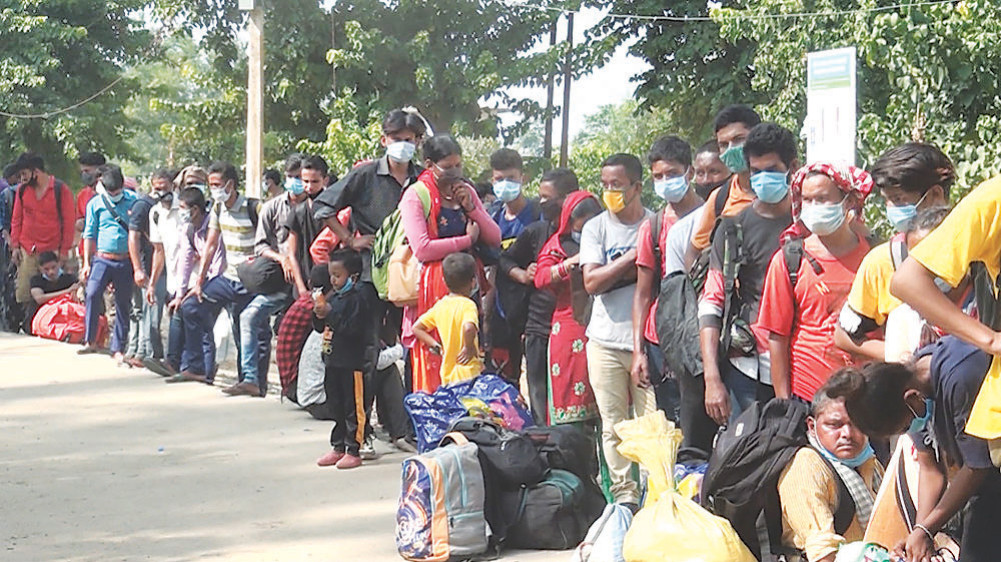
It is important to have a debate on the basis of data rather than myths about remittances, which are providing significant support to the economy. The negative commentary on the remittances created by the blood-sweat of Nepali workers and the use made by their families adds to the frustration. Now foreign employment should be a matter of choice rather than compulsion.
We use Google Cloud Translation Services. Google requires we provide the following disclaimer relating to use of this service:
This service may contain translations powered by Google. Google disclaims all warranties related to the translations, expressed or implied, including any warranties of accuracy, reliability, and any implied warranties of merchantability, fitness for a particular purpose, and noninfringement.
Remittances have played an important role in foreign exchange reserves for several decades. For some years now, it has been estimated that it will take 12 to 18 months to import goods or services. It is said in public circles that remittances prevented the country's economy from being deeply affected by the Covid-19 and subsequent economic recession.
Moreover, not only remittances came in, but according to the World Bank, 40 million US dollars went out of Nepal in 2022. $100 billion was spent on education alone in 2022/23.
According to the National Census 2078, 2.1 million Nepalis are abroad, of which 1.6 million have migrated for employment and more than 2 million for study and training. In the review year 2080/81, remittances reached Rs 15.71 billion 24 crores, which is double the foreign investment commitments (about Rs. 6 billion). According to the census, about 77 percent of households received remittances.
In 2010/11, the percentage of all households receiving remittances was 55.8%, and between 2010/11 and 2022/23, this percentage increased by 21%. Countries like India, China, Mexico, Philippines and South Asian countries like Pakistan and Bangladesh are in the forefront in receiving remittances. Continually contributing 20 to 30 percent to the GDP every year and looking at the dependence of remittances, Nepal is ahead of all these countries.
According to the census 2078, public data and remittances received by Nepalis have been debated in public circles. Major media outlets have also reported extensively on the deployment. Commentaries used in public by responsible media persons, government officials and policy makers are said to have positive and negative effects.
Fact-based debates play an important role in shaping sound ideas and policies. However, the opinions of some high-ranking people and the news communicated may create confusion about the message to many readers and listeners. This article attempts to clear such confusion.
First, when presenting data on the number or percentage of families receiving remittances or their growth, there is ambiguity when such remittances are said to have come from abroad. While that is both domestic and international remittance. Like
- According to the latest Nepal Living Standards Survey 2078, it is presented that the percentage of families receiving remittances in Nepal has increased from 23.4 percent in 1995/96 to 76.8 percent in 2022/23. However, it does not mention or does not mention that it also includes internal remittances which increased by 29 percent.
Secondly, in the case of remittances from abroad, there are presentations sent by Nepali workers who have taken work permits to work abroad. When Rashtra Bank or the media present the remittance amount, the remittance Along with the period entered, the number of labor approvals has been mentioned in the same period. While it includes migrant workers, students and remittances from various types of migrants.
Thirdly, dispatch to Nepal There is an incomplete explanation about the reason for the decreasing-increasing trend. Especially the increase in the number of people going to foreign employment is presented as a factor, which is not completely true. However, even in 2013/14, more than 740,000 Nepalis received work permits, while remittances were 30 percent less than at present. Even now, the number of people going abroad is around the same.
If so, is this increase due to Nepalese becoming more skilled or due to increased salary facilities in the destination country? The studies done on this have shown that although it is partially true, it is not the complete truth. Especially since one and a half decades, financial institutions that transfer remittances (both domestic and international) and their services are gradually expanding to the destination countries and within Nepal.
On the other hand, especially with the covid-19, the contraction in business and economic activities at the international level and financial transactions through Hundi have been regulated and acted upon more strictly, at least within Nepal. As a result, there has been a significant increase in formal remittances.
For example, in 2010/11, only 19 percent used a financial institution to send remittances (both domestic and international), rising to 75 percent in 2022/23. In the same period, the ratio from India increased from 8.5 percent to 74 percent in 2022/23, while remittances from Malaysia and Qatar by Hyundai It decreased from 7.4 and 11.6 percent respectively to 0.5 and 1.6 percent respectively.
This does not mean that all transactions from Hyundai are closed. But this makes it clear that in the past, the amount of remittances coming in the government data was less and somehow, especially from Hundi, those remittances were coming to Nepal.
Fourthly, we read and hear that remittances are received mainly from India and also from countries like Malaysia, Saudi Arabia, UAE and Qatar. But there is a lack of real data about the source country of the remittances and the details about the remittances within the country seem incomplete. Various agencies and media mention the amount of remittances received from different countries by taking data of National Bank as a reference material.
In some cases, migrant workers' money reaches their families through multiple countries (transit). It may show records coming from a different country than the sending country, making it difficult to clearly understand the country details.
Bilateral remittances are not available in our national data and because such data is not publicly available from the National Bank, it is difficult to determine the actual source country of the money transferred through international banks or transfer institutions. is.
Fifth, there is not much discussion and analysis about remittances by adding the expenses incurred by the workers to go to foreign employment and its cost with interest. That is, it is necessary to understand that for someone's foreign employment to be profitable, he depends to a large extent on going at low or no cost.
Sixth, discussions of remittances often focus on the investment/expenditure or economic contribution that migrant workers send to their home countries. That is why the commentary that the remittances brought in by Nepali workers have become unproductive or investment in the productive sector is widespread among leaders, bureaucrats, journalists and academics.
According to the Nepal Living Standards Survey 2079/80, 72.4 percent of the remittances were used for daily consumption and 15 percent were used for debt repayment. This makes it clear how important a lifeline remittances have become in the lives of families who are financially strapped and in the grip of poverty.
How did such remittances become unproductive to be invested in essential goods such as food, housing, health care and education, as well as loans taken for foreign employment and paying high interest, which should be guaranteed by the state? Thus, it is ironic that one defines investment in the family as productive or unproductive.
Understanding how immigrants and their families view investments in their children's education reveals what is productive for them. If the basic needs of a family are met, if the cost of foreign employment is low or zero and if a large part of the remittance is saved, someone should teach the lesson to invest in those migrant workers and their families. There would be no need.
In the end, it is important to have a debate based on data rather than myths about remittances, which are providing significant support to Nepal's economy. Negative comments about the use of Nepalese laborers' hard-earned wealth by their families add to the frustration.
Remittances should fundamentally change the nature and structure of Nepal's internal labor market. It is necessary to open many doors of decent employment and business especially for Nepalis who are economically and socially marginalized or on the border. Now migration abroad and foreign employment should be a matter of choice rather than compulsion.
– The author is affiliated with the Social Science Department.