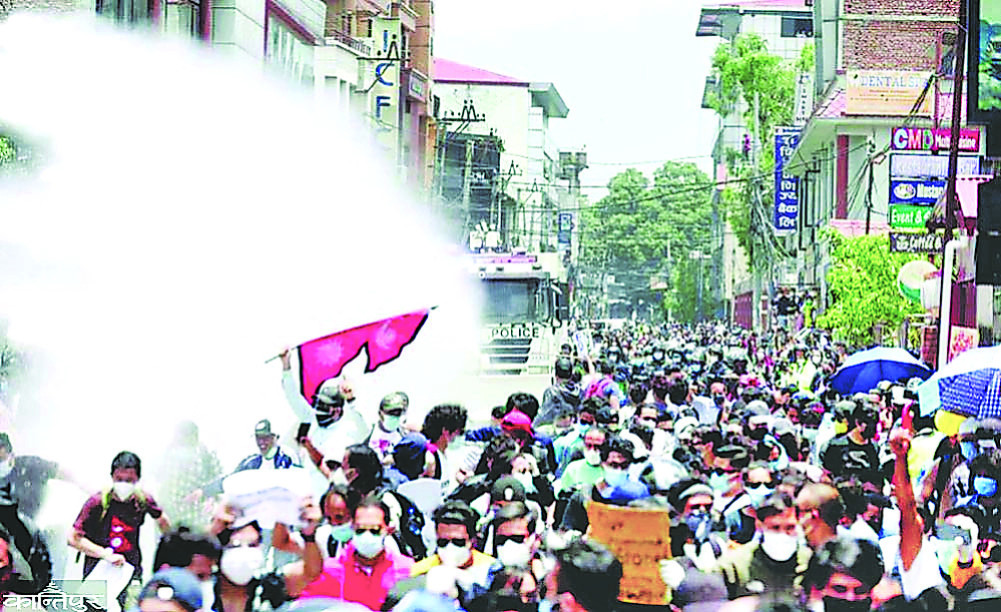
Conscious citizens have always been agitating for the progressive political agenda that stirs up the national politics itself. Therefore, aware citizens should not remain silent against the unrest and chaos in the country.
We use Google Cloud Translation Services. Google requires we provide the following disclaimer relating to use of this service:
This service may contain translations powered by Google. Google disclaims all warranties related to the translations, expressed or implied, including any warranties of accuracy, reliability, and any implied warranties of merchantability, fitness for a particular purpose, and noninfringement.
The decade after 2052 was a time when the Nepali people made great sacrifices, sacrifices and dedication for the radical political change of the country. Basically, thousands of people sacrificed themselves in the people's war, which was conducted by the then CPN (Maoist) with the vision of ending the feudal economic-political system and building a state based on justice and equality.
Thousands have lost family members, a large number have been injured, and a large number of people are forced to live with the trauma of war. Such great sacrifices and sacrifices for the radical transformation or restructuring of the state have rarely happened in the past. The People's War essentially broke down the feudal oppression, patriarchy and caste system in the rural areas. On the other hand, the people's war caused huge financial loss, people had to face a tragic situation. However, the Nepali people had made such great sacrifices with the expectation of establishing a democracy based on national independence, justice and equality. At that time, it was a decade of sacrifices made by the Nepali people for the construction of 'New Nepal'.
After the people's movement of 2062/63 and the Comprehensive Peace Agreement, the Nepalese people expected peace, democracy with social justice and socio-political changes that the people would feel. The Nepali people had a desire that the Constitution to be formed by the Constituent Assembly would address the people's expectations. They expected not only structural transformation from the Constituent Assembly elected by the people, but transformation that the people would feel. Therefore, different castes, communities and stakeholders continued to struggle to include their hopes and expectations in the new constitution. A decade of constitution making was a decade of struggle and expectation for Nepali people.
After the new constitution was promulgated and the practice of federalism began, a level of hope was awakened in the Nepalese people. A truly inclusive democracy, good governance and tyranny will come to an end as the government structure transforms into a new form. The state will strive to provide basic rights such as free quality and practical education, convenient healthcare, opportunities for a self-sustaining economy and employment. It was expected that the criminal discrimination and violence in the society would end and an environment would be prepared for the people to experience a comfortable life. At a time when science and technology are developing rapidly, people expect economic and social development of the country at the same speed. However, the attention of the political parties and the state did not go towards addressing such important questions of the people. It is becoming difficult to dream of a bright future due to political dishonesty over the great hopes and expectations of the people. This is causing intense disappointment, dissatisfaction and anger among the Nepalese people. Eventually, the anger generated by the state's inaction, helplessness and incompetence will accumulate and explode at some point.
multifaceted crisis
The political party and the state play the main role in creating a situation of increasing dissatisfaction, frustration and anger among the people. The state and political parties also have the responsibility to address the hopes and expectations of the people and to create a situation where they can be optimistic about the future. For this they must be accountable and responsible to the people. However, only a responsible political party can identify, analyze and find ways to solve the country's multifaceted crisis.
Democratic system is being formally practiced in Nepal. The practice of electing representatives by the people and the governance of the people's representatives is going on. However, the main work of the Parliament is focused on making and breaking the government. So much so that due to changes in the federal government, the state government is also unstable. It is a reality that we have been seeing and experiencing for a long time that the family that reaches the government and works for the benefit of various interest groups. The government, which is formed from the game of arithmetic, neither has the desire to understand the frustration and anger of the people, nor does it have any roadmap or plan to take the entire country forward. Irresponsible political leadership at the helm of state power is the main force to frustrate the people.
The mechanisms of the state are basically operated on the basis of political views. For example, it is possible to operate a democratic political system in a country with a political party that theoretically embraces democracy. Other mechanisms of the state are established and run on the basis of those political views. However, due to excessive partisanship, there is a danger that important state bodies such as: Courts, Commission for Investigation of Abuse of Authority, Commission for Asset Laundering, educational institutions, health sector, etc. will come under the control of a certain party, person or group. The situation has become such that it is difficult for people who do not belong to any party or have access to public services. It has become a situation where the people have to broker a party or work on bribes and commissions.
On the other hand, the country is becoming economically poorer day by day. Due to the consumerist market economy, Nepal is transforming into a country that runs on importing goods. The state is forcing a large number of young people to go abroad as migrant workers. However, the state has no plan to create opportunities for the youth within the country and lead them towards economic self-sufficiency. The government is running on more than 25 billion in debt, both internal and external. According to the government's data, a debt of 86 thousand 510 rupees has been imposed on each Nepali. The government is not addressing the basic needs of the people, but on the other hand, it is intent on piling up huge debts. Thus, the loans taken by the government have not been invested in the production sector, nor in job creation. Ironically, the political leadership has taken high commissions and bribes from the borrowed funds. Not only this, migrant workers from Nepal send remittances after shedding blood and sweat in the Gulf and Malaysia. Remittances have played a huge role in the country's economy. The government makes policies in favor of middlemen and brokers. Migrant workers also misuse remittances. Nepal is ranked 108th in the list of corrupt countries in the world, but the rulers are not ashamed. Such irresponsible political trends are making people more frustrated and angry.
No matter which party leads the government in Nepal, the slogan of good governance and transparency is heard a lot. Most of the political leadership and staff members mock the governance and transparency of the government. People have to face many problems when they reach the government office as a normal customer. Employees who are receiving salaries from people's taxes are transformed into the role of burdening and causing suffering rather than solving people's problems. Such irresponsible personnel administration is a source of public anger. If the state wants to, it can free the people from such despair, but it is not possible for a state that is mired in misrule to make radical changes easily.
There is still widespread discrimination and violence in Nepali society. The country cannot move forward until such violence and oppression on the basis of gender or sexual identity, caste and community ends. The right to live in a society with social justice and self-respect has not yet been practically implemented. Ending sexual harassment and violence, caste-based violence and injustice is an important aspect of social transformation. It is also the right of oppressed communities to have meaningful proportional representation in all organs of the state. But the state is systematically bent on suppressing the rights of the oppressed communities and protecting the monopolistic power. Therefore, along with the state power, the dominant class is also trying to create an anti-inclusion commentary. Such anti-social justice actions are also creating more anger among the people. However, the state does not seem to be in favor of addressing such serious issues.
The responsibility of conscious citizens
Due to the state's irresponsibility and incompetence, the frustration and anger of the people is increasing. Therefore, there is a need for conscious and aware citizens to keep raising their voices against the irresponsibility of the state and political parties. Civil movement has played a very big role in all the historical political changes of Nepal. Conscious citizens have always been agitating for the progressive political agenda that stirs up the national politics itself. Therefore, aware citizens should not remain silent against the unrest and chaos in the country. Naturally, anger and passion are manifested in various ways. Planned resistance is needed to hold the state and political parties accountable as responsible citizens, not just through criticism, abuse and outrage. As a
, there are some protests against state corruption, chaos and anarchy. Campaigns are also being conducted against the atrocities committed by the state against the identity of the tribal tribes, while campaigns are also being conducted against the actions of the state to seize land and make squatters in the name of development. There are occasional protests against the violence and oppression of women and marginalized communities, and the protests of co-operatives, meter-busters, etc. However, the state is not willing to listen to the voices of such protests. Therefore, conscious citizens should intervene from all sides to force the state and political parties to solve the multifaceted crisis seen in Nepali state and society. In order to strengthen the internal democratization within the political party and advance the state in a democratic rhythm, it is necessary for the honest, conscious and accountable leadership within the party to intervene within the party. On the one hand, the education sector is going into the hands of businessmen and brokers with privatization and on the other hand, it is in turmoil due to extreme party politicization. Therefore, for the radical transformation of the educational sector, a wide intervention of the conscious and conscious group is necessary. Only responsible employees who understand the broad problems within the personnel administration should conduct the transformation campaign of this sector. Citizens need to consciously fight against corruption, commissarism and brokering. If conscious and aware citizens, politicians, professional and academic sectors etc. do not intervene in a planned and strong way, then the country will have to face more crisis. A crisis-oriented society and political transformation is not possible with abuse, criticism and comments alone, so conscious and aware citizens must resist strongly for the transformation of the state and political system. It is also the responsibility of conscious citizens.
@JBBiswokmara