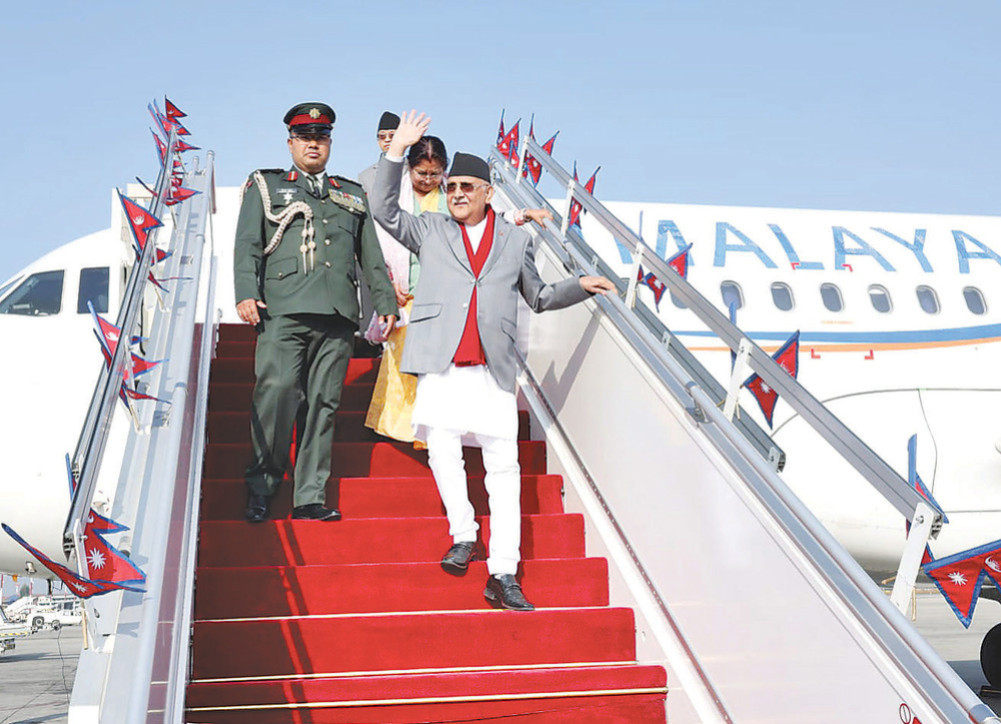
If China tried to 'reunify' Taiwan not only peacefully but violently, would Nepal strongly support it?
We use Google Cloud Translation Services. Google requires we provide the following disclaimer relating to use of this service:
This service may contain translations powered by Google. Google disclaims all warranties related to the translations, expressed or implied, including any warranties of accuracy, reliability, and any implied warranties of merchantability, fitness for a particular purpose, and noninfringement.
Nepal has been adopting a non-aligned foreign policy for a long time. The Federal Democratic Republic of Nepal was established through the Constituent Assembly after the peace process was completed amid violent conflict and continued political instability.
Nepali Congress has been playing a liberal, coordinating and leadership role in providing a new momentum to Nepal's politics while maintaining balanced foreign relations in accordance with the constitution. Being a priority of the big powers in the changing world environment and emerging in the economic, diplomatic and strategic fields, Nepal, located between neighboring friendly countries India and China, is very sensitive from a geopolitical point of view. For Nepal, its sovereignty, political stability, economic development and foreign policy are very important and the foreign policies taken by the Nepali Congress have a far-reaching impact on the country.
It seems that Nepal's internal politics, economic situation and social structures are becoming sensitive due to the changing international and regional geopolitical and military activities created by Russia's attack on Ukraine, increasing violence in the Middle East, and the American election. Among these challenges, Nepal has to expand and strengthen its foreign relations carefully, taking into account the interests of neighboring countries and friendly countries in not harming Nepal without affecting its geographical integrity, universal freedom, national independence and social harmony.
China's Belt and Road Initiative (BRI), which has been debated in Nepal for a long time after the US grant support MCC, gets a discussion once again when the leadership of the Nepalese government and high-ranking people visit friendly country China. During this visit, the working group of the ruling party also did thorough homework to make the BRI as acceptable as the MCC. The Nepali Congress also said in its resolution for the 2079 election that it would increase foreign aid, investment and market access through economic diplomacy while adopting a policy of benefiting from the development of neighboring countries India and China. In line with this, the joint statement made during the visit to China and the agreement on the 'Framework for Belt and Road Cooperation' have been traditionally said, some of which are of mutual benefit and some of which have been discussed for the development of Nepal. The agreement in these documents aims to further strengthen the relationship between Nepal and China. However, it seems that the Nepali Congress should hold a thorough discussion and make it clear to the common people about the three issues mentioned in these two documents regarding the visit of the Prime Minister and the Minister of Foreign Affairs.
First, in the sixth point of the joint statement issued during the visit of Prime Minister Pushpa Kamal Dahal Prachanda, who also participated in the Nepali Congress last year, it was said that Nepal will adopt the one China policy. In other words, policy was replaced by theory. However, there was not much discussion in Nepal. In the previous joint statement, it was mentioned that Taiwan is an inalienable part of China's territory and the Nepali side is against "Taiwan independence". But in the joint statement this time, the amended language states that Taiwan is an inalienable part of China's territory and Nepal strongly supports China's efforts to achieve its national reunification and opposes 'Taiwan independence'.
The question arises here, if China tries to 'reunify' Taiwan not only peacefully but also violently, will Nepal strongly support it? Why this is a serious issue for Nepal is that the strategic and diplomatic tension has increased in East Asia and there are no signs of easing after the US election. Rather, it is suspected to increase. Why was this controversial issue put in a joint statement when the power partner Congress held the Ministry of Foreign Affairs? What will be its geopolitical impact? Nepali Congress should think seriously. Because, Nepali Congress in its General Committee document has said that 'Nepal's nationality, national unity, geographical integrity, universal freedom, independence, national security, non-alignment, the principle of Panchsheel, the Charter of the United Nations are the guiding principles of international relations and foreign policy that have been accepted since the founding of the party'. . What is the official strategy of the party or not? If not, a comprehensive discussion among the leadership seems necessary.
Secondly, after Tibet was annexed by China in 1951, in the joint statement to be issued during the next visit, the Nepali side has been repeating that the Tibet issue is an internal matter of China and that no separatist activities against China will be allowed on the land of Nepal. But this time, in that part of the joint statement, instead of saying Tibet, Tibet is mentioned as 'Sijang'. After independence from colonialism, the names of cities in many countries have been retained and continue to be so. But even after the annexation of Tibet to China, the identity of Tibetans has not been lost. Tibetans are Chinese citizens but Tibet is culturally a part of China with its own identity. Why did Nepal agree to keep the Chinese name 'Sijang' instead of Tibet to erase the identity of Tibetans this time? Did Nepal agree to the possible strategy behind this and include it in the statement or was it unknowingly trapped?
Thirdly, in the resolution of the federal and state elections, the Nepali Congress, although it did not mention BRI explicitly, mentioned that concessional or unconditional grants would be preferred over commercial loans when taking foreign loans. This part is important. Because, Nepal cannot develop without borrowing and repay debt without borrowing due to declining economic activity and increasing wasteful expenditure. There is a gap of about 8 trillion in the budget of the country that collects less than 11 trillion in revenue. It seems that in order to achieve the goal of sustainable development, Nepal has to spend twice the revenue it currently collects in the context of the lack of encouraging domestic and foreign investment in the private sector. The goal of sustainable development can be achieved only by investing about 13 trillion annually in infrastructure alone. Therefore, it is clear that Nepal should take subsidized loans and invest in areas that increase revenue collection and production and employment opportunities. However, the Nepali Congress had decided in the month of July from the Central Committee that it would not take a loan from BRI, but only a grant. Nepal's public debt has reached 43 percent of the gross domestic product and the Congress has taken this decision in view of the need to borrow to pay the debt. Even before Prime Minister KP Sharma Oli's visit, the office bearers' meeting had said that they would only take grants from BRI. However, after 2013, Nepal has not been able to spend the 100 billion grant that the Chinese government has promised at various times. Similarly, the 10 billion rupees given by the Indian government for the reconstruction of the Jajarkot earthquake has not yet been spent. Nepal has not been able to effectively spend the concessional loans pledged by multinational banks and various countries. Nepal's capacity to effectively spend on infrastructure and other development projects is very low.
Surprisingly, contrary to the official opinion of the Nepali Congress, in the fourth point of the 'Framework for Belt and Road Cooperation' signed by both sides during the visit to China, it is said that the Chinese side will provide technical and financial support to Nepal's development efforts under the framework of jointly building the Belt and Road. It is also said that both sides will work through technical assistance and financial assistance modalities (ad financing modalities) to suit the needs of both sides for sovereignly initiated projects. Financial assistance modalities in diplomatic parlance include both grants and loans.
Thus, according to this cooperation framework, Nepal has theoretically accepted to take a loan from BRI and has opened the door for loans. However, in which project, how much, under which conditions to borrow or not is a matter to be decided only after the preparation of the project/projects under BRI. The Nepali Congress has reiterated that it will not take loans even after the signing of this cooperation. However, the Nepali Congress has also stated in its official documents that it will follow international laws, conventions, conventions and agreements to which Nepal is a party as basic principles. So the 'Framework for BRI Cooperation' is also an agreement, which should be followed in principle after signing, if financial assistance from China is to be sought. Again, after this agreement between the two countries, in a country with a multi-party system, political ethics does not allow Nepali Congress to take a loan from BRI when other parties come to government tomorrow. He can then only question the terms of the loan agreement and the project to be selected.
There was a dubious debate in the Nepali society about the Indo-Pacific Strategy (IPS) which was included in the discussion during the American aid MCC, which established the tradition of debating and making the foreign aid transparent in Nepal. The MCC was an aid program given by the US House of Representatives to strengthen relations with poor countries. Similarly, BRI is a Chinese initiative to strengthen relations with other countries through its influence, market and expanded infrastructure, cultural, strategic network.
Therefore, understanding the environment of world politics, which is now rapidly moving, Nepali Congress should keep nationalism and democracy at the center and consult with the large experienced and intelligent class connected to the party line, so as not to harm the self-esteem of the country and its people. It is necessary to make only mature diplomats as ambassadors and to increase the diplomatic capacity of the structure and human resources of the Ministry of Foreign Affairs without looking at factions and personal benefits within the party. Otherwise, it is easy to take the leadership of the party, MPs, ministers and the reins of power based on mathematical games, but superficial, immature and unstable foreign policy and diplomacy for personal interests may cause trouble for the country. Many countries have lost their integrity, sovereignty, independence and self-respect due to unstable and wrong foreign policy and diplomacy. In last year's General Committee, the Nepali Congress proudly remembered the historical fact that the government of founding leader Jan Nayak BP Koirala established Nepal as a free, sovereign, independent, democratic and peace-loving country before the world community by promoting Nepal's sovereignty, independent and balanced foreign policy and expanding and diversifying diplomatic relations with the international community. had done Therefore, without being blind to the weaknesses of the current leadership, without slavish silence, amidst the current increasing global complexity, Nepali Congress has an important responsibility to give suggestions to the party with broad interest in the foreign policy to be embraced by the Nepali Congress.