Nepal should present good practices such as forest protection, investment in clean energy and hydropower promotion more widely at the international level. It is important to call on developed countries to meet their commitments to damage and loss funding, as well as to strengthen small countries' access to climate finance for adaptation.
We use Google Cloud Translation Services. Google requires we provide the following disclaimer relating to use of this service:
This service may contain translations powered by Google. Google disclaims all warranties related to the translations, expressed or implied, including any warranties of accuracy, reliability, and any implied warranties of merchantability, fitness for a particular purpose, and noninfringement.
It has been a long time since climate change and its effects have been discussed as a matter of concern and interest to the entire planet. In this context, the 29th Conference of Parties to the United Nations Framework Convention on Climate Change (COP-29) has concluded in Baku, Azerbaijan.
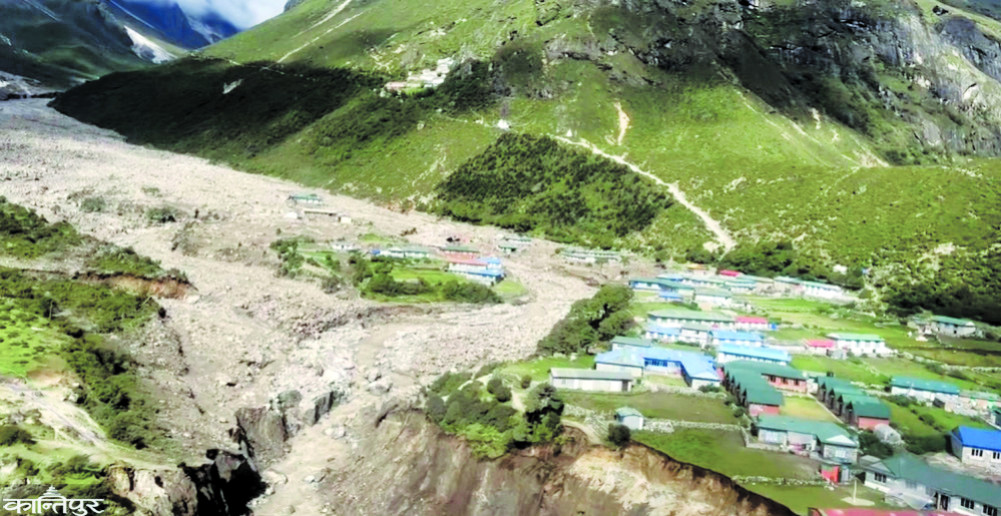
Due to the negative impact of climate change, Nepal is forced to face high risk and huge loss of human wealth every year, it is even more important to raise the issue in a concrete and strong manner. Every year, Nepal has been suffering irreparable damage from melting glaciers, floods, landslides and inundation due to excessive rainfall. This year, the unseasonal rains and floods and landslides on October 10-12 caused huge loss of life even in the federal capital Kathmandu Valley. It is really ironic for Nepal that despite being the country that emits the least carbon, it is suffering the serious negative effects of climate change. In this context, Kop is the appropriate place to raise the problems and needs of Nepal.
Most of the land is occupied by Himalayan and hilly parts of countries like Nepal are facing more risks due to climate change. Effects such as melting of mountains, excessive rainfall, floods, landslides and temperature fluctuations are negatively affecting people's lives and economy. In Nepal, a country rich in biological diversity and natural resources, the risk is increasing day by day due to climate change. In this context, Nepal demanded climate justice in COP-29 and asked the international community to
has called for their suffering to be heard. President Ramchandra Paudel has asked the world community to pay attention to the fact that the protection of the mountains means the protection of the earth in COP-29. Addressing a high-level session of world leaders, he expressed concern that the process of turning the white mountains of mountain countries into black mountains could put not only those countries in crisis, but also low-lying coastal countries. He demanded that the loss-damage fund established to help developing countries facing climate risks should be put into operation quickly and emphasis should be placed on the evaluation and compensation of the contribution of countries like Nepal that contribute to the protection of mountains, clean water and biological diversity. Nepal has succeeded in telling the world community about the reality it has to face, but the issue of justice and compensation that Nepal should get is still in confusion. Presentations, negotiations and diplomatic initiatives on the world stage like
coups require long and deep experience, ingenuity and continuous effort. This issue is not becoming easy for Nepal. Realizing that this year's preparations for COP-29 were insufficient, we discussed climate change in action with parliamentarians. Before going to participate in the COP, we made a written request to meet the President for the issues to be raised, the President has also included some issues in the Baku address. But it is not enough for a country like Nepal, which is facing climate crisis at a high level. The present government did not take its priority and importance seriously and prepared for it.
Government is an unbroken succession institution. The current government could not continue the work done by the previous government with special priority in this area. The experience of COP-28 held in Dubai last year should be recalled. Nepal's previous diplomatic efforts had taken a positive direction. On COP-28, then Prime Minister Pushpa Kamal Dahal Prachanda addressed the conference on behalf of Nepal. He organized a high-level roundtable meeting to explore the issues of the Himalayan country. He drew the world's attention to Nepal by raising the issue of Nepal's zero contribution to climate change and the fact that Nepalis have to suffer its devastating effects and have to endure the unjust effects of serious consequences such as floods, landslides, fires, and avalanches. As
issues were effectively and objectively presented, an environment was created to include Nepal in the list of priority countries. The first meeting organized by Nepal during the United Nations Climate Change Conference drew the world's attention to Nepal. Not only that, UN Secretary General Antonio Guterres visited Nepal last year at the invitation of Prime Minister Prachanda. The visit and observation of the Himalayan region, Everest base camp and Annapurna base camp, which are suffering due to climate change, conveyed a special message to the world. Secretary General Guterres said the federal
He addressed the Joint House of Parliament. The then Prime Minister Prachanda's government held the 'Himal, Man and Climate Change: International Dialogue of Experts' in Chandragiri on June 9 and 10, 2081 and drew more attention to the world community.
No matter which party or parties lead the government in Nepal, it is important to be consistent in raising the issue of climate change and its effects. In the Federal Parliament, there have been many debates on the creation of a permanent mechanism to discuss climate change issues and to hold views on this issue.
Among the major issues that Nepal should emphasize at the international level, the topic of cooperation for the allocation of mountain-focused climate finance is prominent. Another urgent issue is to build a permanent and multilateral negotiating team under the leadership of the representative of the Government of Nepal, while improving the weakness in the formation and capacity of Nepal's negotiating team at the Climate Conference. Nepal is entering a developing country. In that situation, it is necessary to update the collaboration for climate justice and to make the strategic discussion about increasing access to climate finance effective.
About 45 percent of the total area of Nepal is covered by forests. With this, the country has made a great contribution to the world. It has been contributing to the balance of biodiversity and other ecosystems. But it may be in crisis due to climate change. Nepal needs to focus the world's attention on the issue of mountains, people and climate change in every international forum like COP.
Adequate climate finance, technology and capacity development are needed to address the crises caused by climate change. However, there is a challenge in the implementation of the plan due to the lack of financial support currently available. It is important to always maintain consistency on the issue that this financial assistance should be provided in the form of assistance and compensation and not as a loan. The Paris Agreement calls for urgent and ambitious climate action to limit global warming to 1.5°C. The commitment to double the funds available for climate adaptation should be implemented, with special attention to contribute to the social and economic improvement of women, youth and indigenous peoples. Also, issues such as global targets on adaptation, reviews, new collective targets on climate finance and the mobilization of climate finance need to be strongly raised.
Nepal should present good practices such as forest protection, investment in clean energy and hydropower promotion more widely at the international level. It is important to call on developed countries to meet their commitments to damage and loss funding, as well as to strengthen access to climate finance for small countries for adaptation. It seems that Nepal should encourage investment and technology transfer in hydropower and solar energy, which will contribute to clean energy production and help create jobs. To reduce carbon emissions, Nepal should emphasize that all nations should apply more ambitious targets and especially developed countries should be responsible.