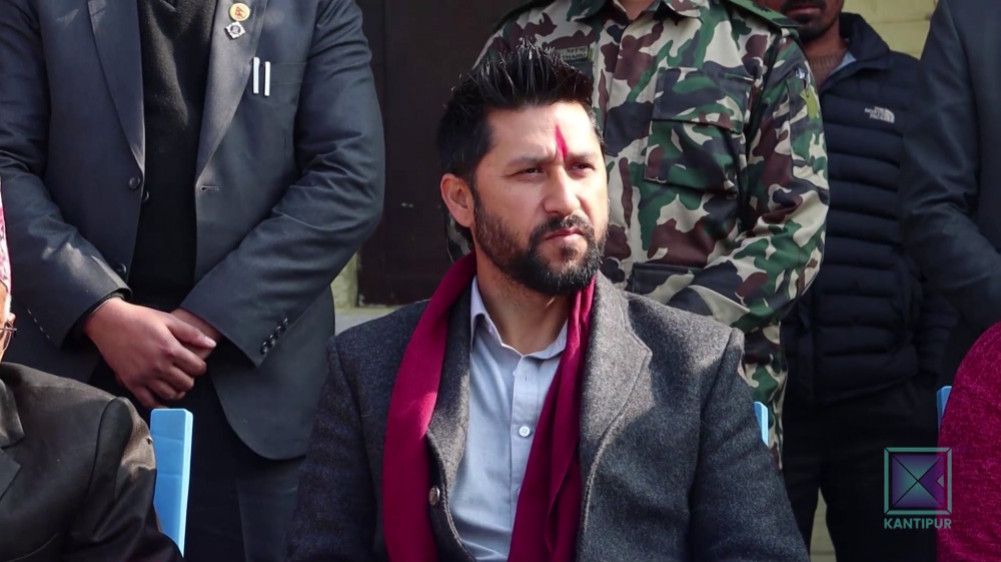
If the supporters of RSVP are pro-democracy, it is too late to establish that Ravi and National Independent Party are different 'entities'.
We use Google Cloud Translation Services. Google requires we provide the following disclaimer relating to use of this service:
This service may contain translations powered by Google. Google disclaims all warranties related to the translations, expressed or implied, including any warranties of accuracy, reliability, and any implied warranties of merchantability, fitness for a particular purpose, and noninfringement.
Since some time before the federal and state elections of 2079, anti-party commentary has been gaining widespread popularity. Some new independent candidates, including Balen, won through the local elections held before that. They adopted an electoral strategy focused on youth voters.
Ravi Lamichhane, who jumped into politics after seeing that success, said that the big parties like Congress, UML, Maoist and others were old, useless, failed to establish development, good governance and justice according to people's expectations, so a new party was needed. Even now, the Balens are engrossed in work, while working, references to differences with the larger party also surfaced in some cases. In case of
style of work and political differences, they seem to be challenging the big parties. However, the big parties don't seem to be walking around with a daily life called Nikamma. In terms of Balen and others, the main parties are neither particularly positive nor negative, that is, there is a general relationship and understanding between both groups. On the other hand, there is Ravi and the National Independent Party led by him, which is being frequently used by the main parties, especially the two big left parties. But while doing this, the question has arisen that they are not becoming weak. In this article, I have tried to discuss the situation and the reasons why Ravi Lamichhane's scandals keep coming out one after the other, yet the society is divided about him.
Ravi Lamichhane's third trial with the legal structures of the government of Nepal, including the courts and the police, when he entered politics. Before becoming an MP for the first time, he was detained by the Chitwan police on charges of instigating the suicide of his colleague. The media and mass campaigning that took place after the same detention established Chitwan as an election region. He also became an MP after winning the election from there. Soon the issue of dual citizenship came to the surface. He was found guilty and consequently the position of MP was vacated. But even from that situation he managed to escape in an unexpected and strange way.
In the by-elections held there again, he won as a candidate of RSVP. There is no reasonable debate in the Nepali society on the question of how Ravi suddenly stood up for re-election in a situation where the case was filed and the MP position was vacant and why the people voted more than before. Therefore, even now, there is a difference of opinion among social activists, journalists and politicians in the society that Ravi is not right. As a result, the Nepali state structure is repeatedly ridiculed, the state apparatus and its components are becoming more and more weak.
It does not seem that the intention of the state structure about Ravi is wrong. Instead, there is an attempt to prevent the state structure from functioning freely in Nepal. It is not unusual for Udyat Ravi to make a comment that old or big parties are wrong. But because Ravi has provided leadership to the state structure for a long time, the main leadership of the main political party also became the main character to lead Ravi's line. It is said that if the Nepali state structure had been able to work regularly without interference, Ravi would not have been able to fight in the by-election. When it was swallowed up by the then Attorney General, the CDO office in Kathmandu went a step further and tried to be popular by granting another citizenship within hours.
The 'soft corner' of Maoist, the ruling party at the time, worked in all those works. At that time, the Congress leadership did not raise any objections about this situation, as the others who were sitting quietly so that the stronghold of the Congress would not be destroyed, also ignored it. In this way, KP Oli, who is considered to be an expert in stunts like Ravikai, who is close to the wrists of big parties and leaders, was waiting and watching. Because he had hope and confidence in his art of making people forget.
He also felt that Ravi could be useful in his quest for power and future political maneuvers and that he would be able to use Ravi as a weapon against others. An example of this was the loyalty that Ravi started as a true well-wisher of Oli by standing like a soldier in the Baluwatar march after the election, and Oli's resistance when the Congress was demanding a committee in the parliament was an example of this. The continuation of such behavior seen until a few days ago was broken only after Ravi's latest arrest. Now it seems that Oli-Ravi relationship has turned into a politics of revenge between each other.
Misunderstanding about the parliamentary committee
When there was a lot of talk about the parliamentary committee in the parliament, there were different understandings about it. In fact, the reference to the parliamentary committee sought by the Congress was based on the situation at that time. That basis was that Ravi was the Home Minister at that time, the basis for the case against him, the police could not register the complaint of the victim, even the police who were supposed to investigate, were forced to say that there was no complaint against the Home Minister and there was no such evidence. When the role of the police is being undermined by the influence of the Home Minister, the right of the common people to get justice is curtailed, so the Congress demanded the formation of a parliamentary committee so that the elected parliament should take up matters that have arisen at the people's level and are related to thousands of people and moral pressure should also be put on the Home Minister Ravi.
While doing so, the Congress must have known that such a committee is not a judicial body, it is not in a position to decide whether it is guilty or innocent. This work is done by the decision that comes after the judicial process that proceeds through the investigation and collection of evidence by the police. In other words, the Congress not only pushed for the formation of a parliamentary committee, but also succeeded in forming it. There was a big tussle in the parliament for this. A parliamentary committee was finally formed amid good resistance from the leftists, especially the UML led by Oli. Congress, especially the two general ministers and the current home minister, had to experience victory while reaching an agreement to form the committee. Because it was their demand. The UML and the Ravi decided how to make the committee under their control. As a result, UML MP Surya Thapa, known as Oli's confidant, was made coordinator. In other words, Thapa was made the coordinator because of the search for a character who would work devotedly on the Ravi Bahmene Oli line.
The scenes at that time say that if the Congress-UML was in power like it is now, the committee led by Surya Thapa would not have been formed. While preparing the report, Thapa became so obsessed that the report itself was as if he was alone. When the power equation changed, so did Thapa's role. Answering every question was considered a responsibility. After the report, he continued to participate in the debate of guilt or innocence in the media as if in a court decision.
While doing so, Thapa did not want to tell about the background of the parliamentary committee, the context in which it was needed at that time and the judicial and administrative limits of that committee. In other words, considering Rabi as the Home Minister as a combination and majority committee, it was both an opportunity and a challenge for the Congress to bring to the public the fact that the committee formation, its limits, the reason for its formation, and now the issue is established not by the current political system, but by the police and administration.
In fact, the day Ravi Lamichhane stepped down as Home Minister, the rationale and necessity of the parliamentary committee had weakened. He was not in a position to prevent the victim from filing a complaint against him when he was not in charge of the house. Therefore, it was especially necessary at that time to register all the complaints and take them to the legal process. This work could be done automatically by the relevant judicial and regulatory bodies. But the public was waiting for the report of the committee. Which was not procedurally correct in itself. The tendency of the government was to wait for the report of the parliamentary committee and to implement it after it came, instead of providing adequate support to the police and judicial administration to work on the complaint. Which in itself was unnecessary and immature.
RASWPA and Ravi
It was seen that RASWPA used this serial weakness. The RSVP, which seems to understand the arrogant role of the police administration in court proceedings and law enforcement, and the crisis of public trust in them, took the strategy of weakening the actual legal process by resorting to the same committee and its report that it tried to stop with great force while in Ravi House. Ever since the
report was prepared, his strategy has been to assert that Ravi Sahakari is innocent in the case of misappropriation of funds, and for that he has resorted to the parliamentary committee report and Surya Thapa's fragmented and incomplete statements. Our committee came to the conclusion that the documents received by us have said enough that he is involved in one way or another, and the report should focus on where and how the police and judicial investigation is needed. It can be said that it was like giving strength. In the early days, the then ruling party leaders and the current Prime Minister Oli, who were forced to fight in the well of Parliament in defense of Ravi, and the police chief who stated in Parliament that no complaint had been registered against Ravi, have now faced a moral crisis, so it is clear that the parliamentary committee must remain a lifetime witness to this wrong conclusion.
timeline This topic has taken another turn. Even though they were happy to make the legal issue a matter of political manipulation, eventually this issue has to be dealt with by the Oli-led government. Although the legal basis had already been created, this report came during Oli's tenure and the law and legal bodies worked against the complaints of the common people. Even after establishing the seriousness of the issue, the Congress General Ministers seem to be in the mood of how much they will be affected due to the fact that they have become the victims of many scandals. Today, this issue has become the most complicated for Oli and UML.
The choice of words used by the activists against Gagan Thapa is not and was not hidden that the RSVP tried to show him as the main responsible for the arrest of Ravi. But with regard to Prime Minister Oli, it can be said that when the RSVP's voice is suddenly turning into a vociferous one, they are still hoping that Ravi will be saved by Oli. But since Ravi's rise is the target of the current big parties, the so-called old ones, this face-to-face situation was inevitable at some point, it was not possible to avoid it.
There is no need to hesitate to say that the street farce of the RSVP itself is a crowd that weakens the government system when the person who admitted that the same money was in his account was caught in the government scandal which became such a topic in the parliament and on the streets. The support shown in favor of Ravi, who has repeatedly been brought to the police court amid scandals, and the public support for questioning the investigations and investigations carried out by the police and legal circles, has become a difficult question for Nepal, which wants to see a democracy with good governance.
If the supporters of RSVP are pro-democracy, it is too late to establish that Ravi and the National Independent Party are different 'entities'. Ravi who is involved in wrongdoing is taken to court, instead of going there and crying, if he is guilty, it seems preferable to help the administration and start the process of democratizing the party to take action against Ravi. Because even though that party was formed under the leadership of Ravi, in the meantime, the sweat and labor of many good and well-educated people has been wasted.
This party, which enjoys the votes of the country's youth and especially those who want change, cannot remain in the clutches of a leadership whose morals and financial strength are weak. Looking at Ravi's past, even when he entered politics, he is on a weaker moral ground than the current leaders. At the time of entry, the leaders of the current main party, who had a sound moral ground and a high morale of social change, forgot their contribution to the construction and development of political culture and culture in order to reach the power of the party and the state. A good role cannot be expected from Ravi who came from a different path in such a Nepali society. And now, there is no excuse for the RSVP and its leaders to continue the sati of Ravi.