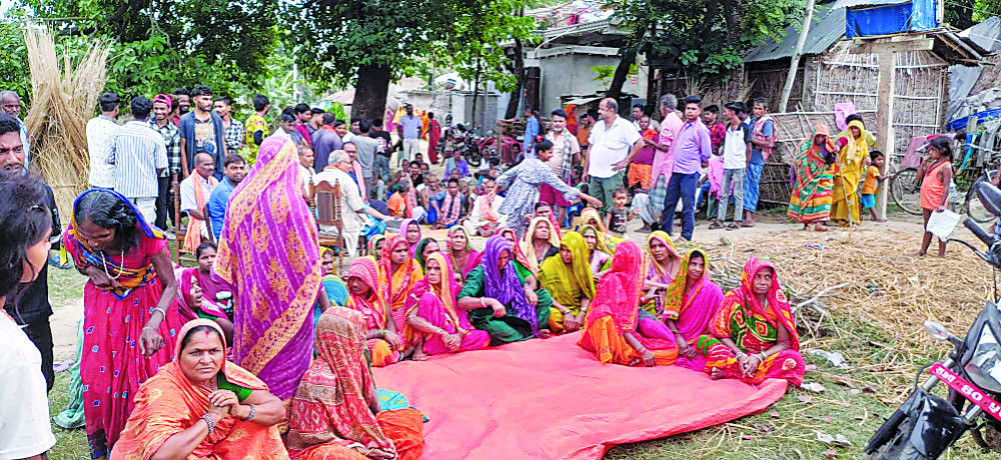
Nepal has passed the time of demographic dividend, which is interpreted as a once in a lifetime opportunity, for about 32 years. But looking at the data, Madhesh is gradually entering the phase of taking demographic advantage. If there is a policy to make good use of this manpower, the foundation of Madhesh's prosperity will be this young population.
We use Google Cloud Translation Services. Google requires we provide the following disclaimer relating to use of this service:
This service may contain translations powered by Google. Google disclaims all warranties related to the translations, expressed or implied, including any warranties of accuracy, reliability, and any implied warranties of merchantability, fitness for a particular purpose, and noninfringement.
Rajeshman Singh, head of Birgunj Metropolitan Municipality, complained that the population of Birgunj was small in the 2078 census. As a result, the subsidy received by the metropolis from the federal government decreased. Some time ago, in a conversation with Rowekar, he said - 'No matter which ministry you go to, you don't have a population, how can you send a big budget? The population of our metropolis is not only 2,72,382. A large part of the population has been left unaccounted for.
Chief Singh's statement indicates that the densely populated Madhesh province is still not satisfied with the size of its population. Singh claims that Madhesh still has the capacity to absorb more population. Looking at the regional demographic distribution, the population of Madhesh is 61,14,600. Wagmati State, which is the federal capital, is the state with the largest population. The population of this state is 61,16,866. The population of Madhesh is 2,266 less than that of Wagmati. Madhesh leaders claim that Madhesh is the province with the largest population in Nepal. These 8 districts have the largest share of the total population. Therefore, the program and budget that Madhesh gets should be more than other provinces.
There are two types of population supply in Madhesh. One, the traditional migration from the north, which has contributed to the population growth here. Another, the importation of population through the open borders of the south. Madhesh is becoming a densely populated province due to people coming from other places and from their own geography. The fertility rate of women in Madhesh is also high compared to other provinces. Therefore, the volume of population here is also increasing due to natural population supply. Nepal's average fertility rate is 1.94. This means that a woman has not given birth to even 2 children in her lifetime. However, Madhesh women have a fertility rate of 2.85, meaning they give birth to about 3 children. While the policy makers are worried about the declining fertility rate, it is not seen in Madhesh. Because the fertility rate is still high there. To confirm this data, the size of the family is larger in Madhesh than in other provinces. On average, the number of families in Nepal is 4.3 people per family, while in Madhesh it is 5.29.
When dividing districts based on population, Madhesh includes districts from seventh to eleventh category. Among them are Dhanusha, Sarlahi, Rautahat, Bara and Sirha. Nepal has an average population density of 198 people per square kilometer, but Madhesh is the most densely populated province in the country. In the previous decade, the population density was 559 square meters, but now it has reached 633.
In this context, one more data of Madhesh should be seen. That is sex ratio and sex ratio at birth. Sex ratio is the number of males per 100 females.
The number of women in Nepal's population is 6,57,476 more than men. 51.3 percent of the total population is female while 48.9 percent is male. But there are more men than women in Madhesh. Moreover, there are significant numbers of men in Birgunj metropolis and Janakpur sub-metropolitan city of this province which have a dense population. In Birgunj and Janakpur, the male share is 52.2 and 51.3 respectively. After all, it is said that the village drives men, the city sustains them. For that reason, the density of men in these two big cities of Madhesh may have increased. It can be said that these cities are keeping men employed. Symbolically correct but it has presented the picture of Madhesh in a different and positive way than the picture of the country as a whole.
Nepal's sex ratio is 95.5. Madhesh has 100.55. This is a good sign in terms of gender balance. The message of this data is that only a small number of Madhesh men have gone abroad for employment. The reason why a large number of men from Madhesh did not go abroad is that when job opportunities are available in the local area, they do not leave their families and go abroad. This is a positive part of the population of Madhesh.
is decreasing in Madhesh, daughter
Although the average sex ratio in Madhesh looks good, the gap in the sex ratio at birth looks fatal. In Nepal itself, this data is becoming unacceptable. In Nepal, 112 boys were born while 100 girls were born. From a regional point of view, the sex ratio at birth in Madhesh is 118. Moreover, the gap in the sex ratio at birth in some districts here is shocking.
The gender ratio of Dhanusha, the position of the state government, is 134. The sex ratio in the neighboring districts of Sirha and Saptari is up to 124. How did this happen? A new type of violence has emerged in Madhesh, which has a high graph of violence against women. In the decade 2068-2078, 96,557 boys were born in this province, while 52,334 girls were born. This data says that 44,223 fewer daughters than sons were born in a decade. According to reproductive health experts, naturally more sons are born than daughters. This ratio can be up to 106. But due to the natural immunity of daughters compared to sons, the death rate of sons is higher and after some time the balance of male and female population is maintained. Let's look at the infant mortality rate (age group 0-1) of the census to further argue this fact. The results of the census showed that the male infant mortality rate of this age group was 17 per thousand. But the mortality rate of male infants is 19 and the mortality rate of female infants is only 15. In Madhesh, this ratio is even higher than other provinces. The average infant mortality rate here is 21, while the male infant mortality rate is 23 and the female infant mortality rate is only 18.
How did the disease of losing a daughter in the womb spread in Madhesh? There are various arguments for this. The first argument, using the facilities provided by the civil law, the process of aborting female fetuses in the womb has increased in the country, more so in Madhesh. It seems that the Madhesh government and the organizations working on this issue should resolve it. Until the reason why the number of sons is not being born is found and resolved, this disease will continue to spread throughout the country, but in Madhesh it seems that it will spread like wildfire. Rani Tiwari, Minister of Education and Culture of Madhesh Province, calls the new trend of missing daughters in Madhesh a new form of violence against women. According to him, when people wanted fewer children, the importance of sons increased and the importance of daughters decreased. In which modern medicine and technology were misused. Kuchlan, who checks the gender of the fetus in the womb and discards it if it is a girl, has raised questions about the legal arrangements regarding abortion. Tiwari has come to the conclusion that the topic of gender equality should be kept in the school curriculum not superficially but deeply. I am shocked to see and hear the sex ratio at birth. Where is the society, where are we politicians. Our politics does not consider such issues as core issues. This issue should be the core issue of every party's women's organization. "I am ready to teach how the society is distorted when a daughter is not born," he said.
Even though Madhesh is a geographically very accessible province, the maternal mortality rate is not comparatively low. Here, 140 mothers die every year due to pregnancy. In last year's policy program, the Madhesh government declared a completely safe motherhood province, a fully vaccinated province and a malnutrition-free province. It seems that only through the effective implementation of the said program, achievements in maternal, infant and child mortality rate will be achieved.
Geographical accessibility, low literacy
Despite many accessibility, the literacy rate of Madhesh has not been able to rise. The total literacy rate is 76.2 while that of Madhesh is only 63.2. In that too, female literacy is only 54.7. However, the literacy rate of the Musahar caste, which is the majority population in this province, has increased significantly. The literacy rate of Mushar has increased from 21 percent in the previous decade to 38 percent in this decade. Rautahat, Mahottari and Sarlahi are the three districts of Madhesh among the five districts of the country with low literacy.
The movement, which is the mother of federalism, raised the activism, empowerment and self-strength of Madhesh. But even that has not been able to eradicate the inequality and discrimination that has existed for years. The dependency ratio of Madhesh is high compared to the dependency ratio of other provinces. Here, every 100 able-bodied people (aged 15-64) have to support 65 children and senior citizens. The dependent ratio of districts like Rautahat, Mahottari, Dhanusha is much higher than the average. The dependency ratio of Rautahat is 74.06 percent.
unsafe housing
Madhesh's housing system is still unsafe. According to the results of the census, only 11.7 percent of the houses made of bamboo materials in Nepal are 37.7 percent in Madhesh. What is clear from this is that the large population of this province is in need of safe housing. Health and drinking water are another problem in Madhesh. 71 percent of the people here still depend on covered wells and wells for water. More than half of the residents still have to use firewood for cooking. 58 percent of the population here uses firewood for cooking. In Madhesh, 97 percent of the population uses electricity to light the lamp, but only 0.03 percent of the population uses electricity to cook food. The practice of using toilets has a positive effect on health here. However, 4.5 percent of households in the country do not have toilets, three times more than the national average in Madhesh. 12 percent (1,38,805) families here still do not have toilets.
Moreover, the social indicators of Madhesh have improved compared to the previous decade. Its effect is seen in the average life expectancy. While the average life expectancy of Nepali is 71.3 years, it is 71.8 years in Madhesh province. The life expectancy of men in this province is 69.9 years and 73.2 years for women. But Madhesh seems to be suffering from poverty despite being a fertile land, a mine of possibilities, an industrial province, and a granary that sustains the federal capital. According to the Nepal Living Standards Survey 2079/080, 20.27 percent of the population in Nepal is below the poverty line. However, this rate is above 25 percent in Madhesh. It seems that this province should pay special attention to social indicators such as good governance, social security, employment, and technical education to lift its citizens from poverty.
The silver lining in the dark cloud
Looking at many indicators, it seems that there is still a dark cloud in the social sky of Madhesh. But due to the vision of the political leadership and the changes in the common people over time, this cloud is gradually breaking. The main reason for this is the growing youth population in Madhesh. The largest part of the population in Madhesh is 5-9 years old. The population of this age group is 14.12 percent. The population in the age group of 10-14 years is 13.45 percent. The significant population of this age group shows that Madhesh can get a long-term demographic benefit (population dividend). For this, especially Madhesh and the local government, it is necessary to study these data and figures and create a program to achieve prosperity by making use of the demographic dividend. To break the story, even now Madhesh is in a state of demographic advantage. 56.75 percent of the total population is in the age group of 15-64 years. Nepal has passed the time of demographic dividend, which is interpreted as a once in a lifetime opportunity, for about 32 years. But looking at the data, Madhesh is gradually entering the phase of taking demographic advantage. If there is a policy to make good use of this manpower, the foundation of Madhesh's prosperity will be this young population.