In the context of adding countries of the same size and economic status as BRICS as Nepal's partners, Nepal should not delay to take a diplomatic account of its involvement and participation possibilities with the two neighbors and beyond the two neighbors.
We use Google Cloud Translation Services. Google requires we provide the following disclaimer relating to use of this service:
This service may contain translations powered by Google. Google disclaims all warranties related to the translations, expressed or implied, including any warranties of accuracy, reliability, and any implied warranties of merchantability, fitness for a particular purpose, and noninfringement.
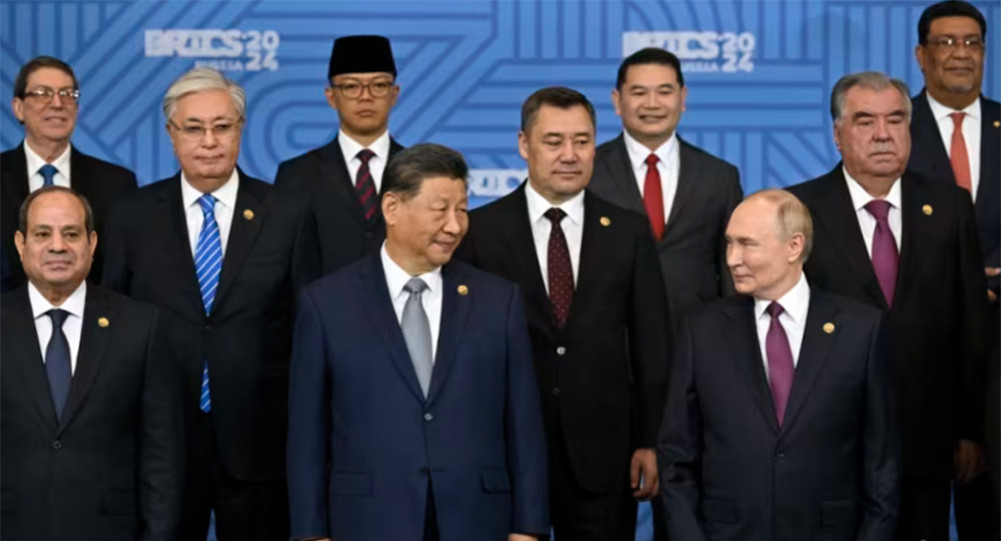
The 16th summit of the BRICS countries was held last Thursday in Kazan, Russia. In the beginning, Brazil, Russia, India and China, and later added South Africa, were used to understand the 'BRICS', now the process of adding partner countries has accelerated. Currently, BRICS countries account for half of the world's population, 40 percent of global oil production, and nearly 25 percent of commodity export trade.
The fifteenth conference held in South Africa last year added Argentina, Egypt, Ethiopia, Iran, Saudi Arabia and the United Arab Emirates as members. Later, Argentina decided to join the group. This year's sixteenth summit decided to include thirteen more countries - Algeria, Belarus, Bolivia, Cuba, Indonesia, Kazakhstan, Malaysia, Nigeria, Thailand, Turkey, Uganda, Uzbekistan and Vietnam as partner countries. Now the number of countries directly 'partnering' under this group has reached two dozen.
Lately, BRICS presence and its influence on world diplomacy seems to be increasing. BRICS has mainly taken to establishing three interpretations successively— 1. South-South cooperation, 2. Radical reforms in multilateral organizations such as the United Nations, the International Monetary Fund and the World Bank, especially for equitable representation of 'Emerging Market and Developing Countries (EMDCs)' and, 3. De-dollarization is proposed to reduce the current monopolistic dominance of the US dollar in international transactions. These plans are being watched with interest all over the world, especially the third world. The attraction of these countries towards these agendas is also the reason for the increasing number of partner countries in BRICS. The 33-page, 134-point "Kazan Manifesto" covers these issues.
Economist Jim O'Neill, who named the group of four countries "BRICS" in 2001, does not agree with the current transformation and politicization of this group. He said that behind envisioning the group of Brazil, Russia, India and China was to highlight the potential of these emerging market economies with large populations in the world economy by 2050. Recently, it has been pointed out that the risk of BRICS developing as a tool to reduce the influence of the "developed West" and mainly to strengthen anti-American diplomacy has increased. With the entry of Cuba, Iran and Turkey into the group of powerful countries that are America's long-time rivals, such as Russia and China, the anti-American voice of this group will be louder.
Russia's success
Russian President Vladimir Putin, the organizer of the conference, made a great effort to disprove the US claim that "Russia is isolated from the world" after the attack on Ukraine. 36 countries invited by Russia to the summit represented their leaders. Despite Ukraine's opposition, UN Secretary-General Antonio Guterres also attended the summit. It was heralded as a major success by the Russian diplomatic apparatus and media. It seems that promoting the interests of Russia and China is also important in the decision to add
partner countries. Countries like Cuba and Vietnam with communist regimes are added to this group. President of Venezuela Nicolás Maduro, whom the United States has designated as a villain, was specially invited by Putin to the conference. An indirect factor in the expansion of this group is the desire to exploit the sense of insecurity created in the countries of the Muslim world against Israel's attacks on Palestine and Iran.
Russian and Chinese leaders have adopted a strategy to include large Muslim-majority countries, including Turkey and Indonesia. A country with a democratic system like India has a very good relationship with Iran, but the relationship with Turkey is not trustworthy. Iran's ties with China are equally deep. Both India and China are good friends of Russia. China has gradually improved its strained relations with Russia. The common interest of both countries to challenge America on the world stage is becoming the key to improving relations. India, on the other hand, is trying to balance its relationship with the US by reducing the traditional Russia-defeat. But not left with Russia.
'Empowering Multinationalism for Just Global Development and Security' as the main theme of this summit also covers the issues of climate change and the peaceful resolution of ongoing conflicts in different parts of the world. Attempting to evolve as a new 'trading bloc', BRICS has attempted to establish a rationale with explanations for the need for reform of the World Trade Organization (WTO). The ninth point of the
declaration states, "We emphasize the importance of reforming the WTO and strengthening the developmental dimension in its work." We are committed to engaging constructively within the WTO structure to achieve the goal of establishing a comprehensive and well-functioning two-tier WTO binding dispute settlement system accessible to all by 2024. And we are in favor of the selection of new members to the Appellate Body of the WTO without further delay.'' The formal talks between Indian Prime Minister Narendra Modi and Chinese President Xi Jinping and the agreement to end the escalating military tension on the border of the two countries over the past four years are significant. Putin also said that this negotiation is possible on Russian soil.
has been publicized in the state media as a success of his private efforts. The opportunities for creative diplomacy thus created certainly help to justify the annual gathering of BRICS, which has not taken the shape of a formal organization.
India-China relations
After the Modi-C meeting held during the BRICS conference, there is an expectation in diplomatic circles that there will be visible improvement in the bitter relationship between these two countries. This will not only help to make the BRICS group more productive, but all the colors and dimensions that will develop in this relationship are of special interest and importance for Nepal, which only shares a border with these two countries and is right in the middle. The commitment to resolve the border dispute as a basis for reducing the military tension between these two countries can be expected to be helpful in resolving the border dispute in Serofero on the western trilateral border of Nepal. In addition, the normalization of relations between these two countries will automatically increase trade, investment and economic exchanges in the subcontinent. The question of how Nepal will become a sharer of the benefits from it is important for us.
On the eve of Indian Prime Minister Modi's flight to Russia (October 21), India and China agreed to only patrol the disputed border to end the four-year military standoff. It helped create an environment for bilateral negotiations in Russia. There are now optimistic comments and analyzes in both the Indian and Chinese media on the prospect of improved relations. However, the pace of improvement in all dimensions of the relationship has not been smooth.
Before the end of the Modi-C talks, on October 23, India has imposed an anti-dumping duty on five Chinese goods for five years to protect domestic producers by 'stopping cheap imports' from China. These items include isopropyl alcohol, sulfur black, cellophane transparent film, thermoplastic polyurethane, unframed glass (mirror) etc. India has a trade deficit of US$ 85 billion with China in FY 2023-24.
Where is Nepali diplomacy?
Nepal has not developed and included any formal concept in its foreign policy regarding BRICS. A diplomatic presence at the forum, which both its neighbors and largest economic trading partners, China and India, cooperated with would have helped bring some positive results.
This platform involving both countries may prove to be relatively suitable for neutral diplomacy for Nepal, even from the point of view of geo-political sensitivity. In addition, South-South cooperation and the BRICS concept of 'development justice' even for the least developed countries is a positive aspect of Nepal's foreign policy. However, no meaningful debate has been initiated at the policy-making level on many other important issues such as the benefits and harms of Nepal participating in BRICS or not.
Nepal-India-China tripartite diplomacy is the only thing that has not been updated and a clear diplomatic action plan has not been formed on how Nepal can and should protect and promote its national interests amid the ups and downs of India-China relations. The traditional parroting of a 'balanced foreign policy' has stopped yielding results. The direct proof of this is the widening trade deficit with both countries, non-increasing financial aid and declining diplomatic status of Nepal in international forums. Separate and specialized policies and action plans for the strategic, strategic and economic aspects of Nepal's diplomacy have now become indispensable.
The inability to work on the means (channel) and action plan to benefit from the rapid economic and infrastructural development of both neighboring countries is indicative of our diplomatic ad hocism. It is often heard that Nepal can become an economic bridge between the two countries. However, it has been too late to identify the potential blueprint of such a bridge or bridge and the areas and 'channels' that will contribute to Nepal's economy. Because, both these neighboring economies have advanced a lot in terms of economic growth, building infrastructure networks. Nepal is being limited to the role of an amused spectator. If Nepal itself does not move forward, no one will wait for us.
The mere role of a bridge to facilitate the products of India or China to reach each other's markets using the short route of Nepal does not bring any significant benefit to Nepal's economy. Production of goods, value addition and market access is an indispensable part of the overall supply network of the Nepali economy, only if it can create jobs and increase economic productivity in Nepal.
The most important aspect, only if the mistrust between India and China can be removed, Nepal can get huge economic benefits. For example, in the pretext of Chinese involvement in the construction of a new airport in Nepal, it is also important to put an end to the situation where airplanes entering Nepal do not get an 'air route', and it is difficult to export the products of industries such as electricity produced with Chinese investment and cement with Chinese joint investment to India.
Creating an environment in which both countries treat Nepal as a common industrial production and processing network should be a long-term priority of economic diplomacy. In the context of adding countries of the same size and economic status as BRICS as Nepal's partners, Nepal should not delay to do a diplomatic accounting of its involvement and participation possibilities with the two neighbors and beyond the two neighbors.