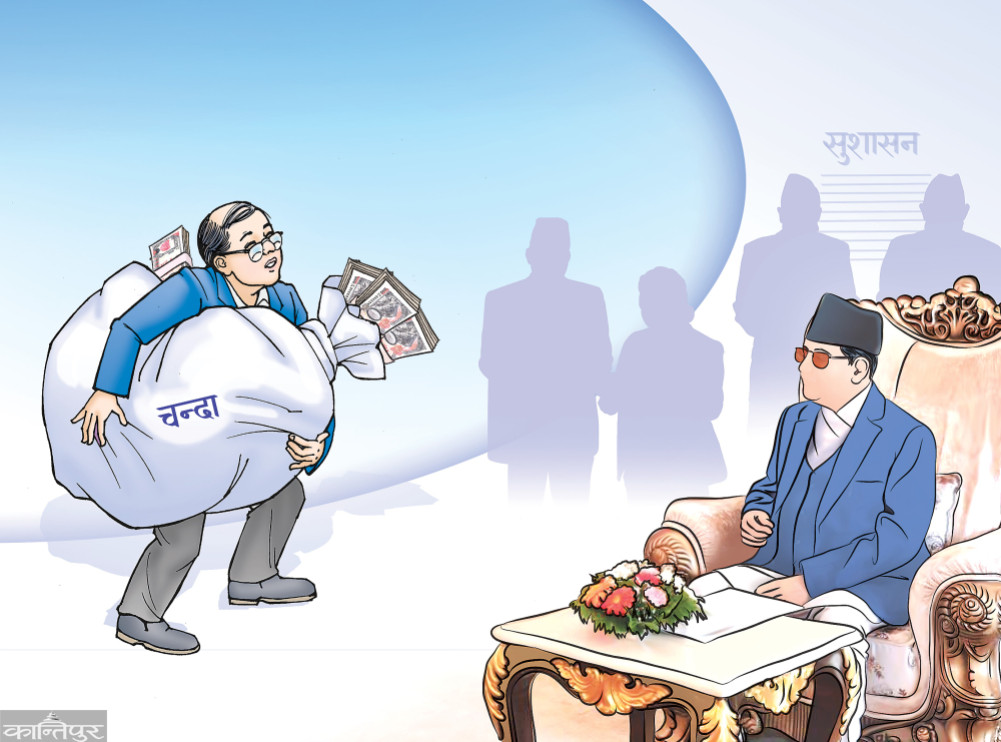
How can a positive message be conveyed when the main leader of the major party is involved in corruption or taking unnatural 'donations' from rich people who have not been cleared of financial irregularities, embezzlement or tax evasion?
We use Google Cloud Translation Services. Google requires we provide the following disclaimer relating to use of this service:
This service may contain translations powered by Google. Google disclaims all warranties related to the translations, expressed or implied, including any warranties of accuracy, reliability, and any implied warranties of merchantability, fitness for a particular purpose, and noninfringement.
Coincidentally, Gautama Buddha and the great Western Greek philosopher Socrates were contemporaries (600-500 BC). Gautama Buddha preached non-violence and compassion. He showed people the path of freedom from suffering and parinirvana. Philosopher Socrates advocated truth for individuals, societies and nations. He also expressed many philosophical expressions about good governance and good governance. They are just as relevant today.
In fact, the origin of the word "democracy" is the country of Socrates in Yunnan (Greek). Socrates did not accept democracy unconditionally. He presented the basis and conditions for the justification of democracy. He said that statesmen should be honest, moral, intelligent and philosophical. Voters should also be prudent, conscious and intelligent to elect such people. Then the rule of 'demos' i.e. ordinary citizens will be justified - he said. As he pointed out, although the perfect ideal state seems like a fantasy, in the past and present, especially in European and other countries, many elected rulers have been seen as honest, simple, intelligent, prudent and moral. Socrates supported the public welfare ideal state system based on ethics and not religion.
Within the democratic system, eventually economists like Adam Smith took the side of capitalism. Marx, Engels led the collectivization of the means of production and the state power established under the leadership of the proletariat such as farmers and workers, and leaders including Lohia of India and BP of Nepal led socialism with a democratic system, that is, democratic socialism or the third strand.
Nepal has been located between countries with a population of about one and a half billion, which are on opposite sides politically. But neither the North could achieve prosperity with poverty eradication, nor could the South achieve the expected progress through stability under the democratic system. Small population, geographic location and geography cannot be blamed for backwardness. Where would not only the Israelis but also the Europeans have taken this country if they had natural resources with land like Nepal? Today grain has to be imported, there is no solid road connecting the federal capital. While the country has a resource that can be connected by vehicles powered by electric energy.
By keeping all the country's citizens (one billion and 40 million) under 'surveillance', China has made it easy to control not only the infection of diseases like Covid but also anti-government political activities. But despite the restriction on opposition politics, there are some economic policies of the communist regime, including economic liberalization, which flourished amid economic control, surveillance and strictness against corruption. By maintaining it, it is claimed that the leadership of the all-powerful communist leader Xi Jinping has been successful in eliminating the poverty of a large percentage (meeting basic needs such as education, health, housing, and food). It is said that a few decades ago, when the economic situation was the same as that of Nepal, many cities including Beijing, the capital of China, where bicycles are the main means of transport, have overtaken America, New York, Tokyo, Japan, etc.
India, which has a parliamentary democratic republic system like Nepal, has succeeded in transforming itself into industrial and agricultural production while maintaining political stability. He is taking leaps and bounds in science and technology beyond Earth. Unlike Nepal, it has the same external security challenge. In the 1960s, India was led by Nehru, who was leaning towards socialist thinking, and Mao, a staunch communist, was leading in China. In Nepal, King Mahendra deposed the elected Prime Minister BP, who embraced democratic socialism, and formulated the Panchayat system.
It was not possible for King Mahendra to put an end to multi-partyism and claim sovereignty of the country, protect self-respect and bring prosperity to the country under his own active leadership. During his reign, roads, transport, development of settlements on the border of India, industrialization, national independence, although there were some signs of self-reliance, he could not gain much momentum after his death. Later, a kind of immobility remained in the country. It must be accepted, King Birendra could neither establish a strict regime like his father nor democratize the country in time.
During the Panchayat period, there used to be a Singha Darbar, but there was another Rajdarbar above it. A powerful administrator lived in the district. Anchal-anchal was occupied by Achaladheesh appointed by the royal court. In villages, districts, and districts, there were people's representatives in name only. It was hard not being able to say what I wanted to say. A police report was required not only to get a permanent government job within the country but also to get a permit to go abroad. Ever since the people's movement of 046 put an end to the active monarchy and established the multi-party system, except for a few years, the old communist parties that held the reins of power have been holding the reins of power.
The traditional monarchy in Nepal has come to an end. It has a democratic system with an inclusive character which is considered to be the most progressive in the world. There are a total of 781 governments including 1 federal, 7 provincial and 753 local governments. The high rate of tax or revenue collected from people or organizations that do not or cannot evade taxes is enough to cover the salaries of the country's national service employees, army/police and all elected public representatives.
The foreign currency accumulated in the country's national treasury is not from the export of goods produced in a country, but the earnings of Nepalis who work abroad by taking risks. What should the government be proud of that currency reserves? It has not been able to invest in productive and energy sectors. The government is happy with the view tower worth billions, while the private sector is focusing on expensive cable cars that provide entertainment by climbing mountains. The development of the areas where entertainment and unnecessary waste can be spent is very much. Profitable financial institutions are added. Interests of political parties and leaders are intertwined in all areas.
The 250-year-old monarchy ended, but instead of a king and a royal family, many powerful families in Nepal repeatedly interfered illegally and vertically in government decisions. A government appointment made to one on the basis of seniority at 10 am is overturned by a vertical order from the residence of the respective party chief in the evening.
Under the pressure of the family of the party leader in the diplomatic, health, science, academic, research, and technology positions, unrelated people get appointments based on financial transactions, personal philanthropy, regionalism, and kinship ties and destroy the organization itself. The leaders of the new and young generation, who appear to be genuine and combative in their expressions, are trying to teach how to give positions even if it is to one or two people close to them, even if it is the voice of disagreement at the beginning. It becomes their obligation to do so.
Even though the national budget gives special priority, i.e. even though the budget is allocated proportionally, there is no significant progress in the areas of public education, health, agriculture, and transportation in the districts of party leaders who have succeeded in becoming prime minister many times. Instead, there is a tendency to take financial benefits even if they get the development construction contract and compromise on the quality. Financial corruption will exceed the limit as huge amount of money will be spent even to win the election within the party.
It is thought that instead of winning the hearts of the people through development and prosperity, cash should be spent on elections. Therefore, there is a tendency to rely on the financial support of successful billionaires in the party to dominate the party, even if it is through legitimate or illegal measures or tax evasion. Since the political leadership promotes corruption, even the constitutional regulatory bodies of the country continue to be infected.
Baluwatar than Singhdarbar, sometimes Budhanilkanth, sometimes Balkot and sometimes Khumaltar's allies become more powerful than Baluwatar. Since no one party has a majority and another party and leader is likely to change the power equation and come to power at any time, all the parties are not the opposition but are in favor of the ruling party. The major leaders themselves publicly express their gratitude for bringing them to power through coalitions. With the exception of
, Nepal's high-ranking bureaucrats are indulging in vested interests by pleasing the ever-changing political leadership. After retirement, the political leadership has been persuaded for political and diplomatic appointments. Even after retiring from government service, most of the high-ranking officials have made arrangements with their family members to enjoy the wealth accumulated abroad in the name of their relatives. Due to widespread opposition, the government was forced to withdraw the bill on the 5-year limitation of corruption, which was coming due to the efforts of party leaders with vested interests.
In Nepal during the Panchayat period, the car parade seen only in the official ride of a king is seen in the rides of many leaders. What is the fear of the public, the police car that swallows expensive diesel and petrol seems to be driving behind many people. They are also a factor in increasing traffic congestion on narrow roads directly, indirectly. Also, the mayor's car of the federal capital Kathmandu is sometimes seen with a lot of pomp and show.
In a country that relies heavily on remittances and taxes paid by limited honest taxpayers, the country's representatives and leaders spend huge amounts of revenue. How much money is spent on the repair and construction of the road, which is torn up and destroyed every year, except during the election? Is it accounted for? Not only roads, transportation, but also the condition of public services like education and health has not improved at all.
From party leaders to spending on government schools where even the children of government employees do not study, to government hospital buildings where leaders do not go for treatment when they fall ill, the high price and quality of contracts for the purchase of equipment and medicines have never been investigated by related experts. How much ease will Mahavir Pun's Innovation Center get in repairing the expensive equipment of the government hospital that has been delayed and deliberately damaged in a big financial scam?
Disappointment has arisen in the short term due to the main leader of the new party, which succeeded in instilling hope through expression in the people who were disappointed with the old party. By the year 2084, the public support obtained in the year 2079 is likely to decrease even more. Even the new party established on the basis of developed hatred towards the old party got significant votes in the last general election and the main leadership got the opportunity to hold important ministries.
But whatever emergent trends and characters are seen, it is not necessary to mention them here. As the great Socrates said, it is better to expose the tendency than the individual. How can a positive message be conveyed when the main leader of the major party himself is involved in corruption or the parties receive unnatural donations from rich people who have not been freed from allegations of financial irregularities, embezzlement or tax evasion? How is good governance maintained?
The new party that stands in the election also makes waves for some time and makes waves. In 2074, the common prudent party, like the RSVP in 2079, which new party will make waves again in 2084? Not only the old ones but also the new party leaders and young leaders who have become frustrated in a short period of time, the distortion of democracy is increasing. When will the end of this frustration caused by everyone responsible?