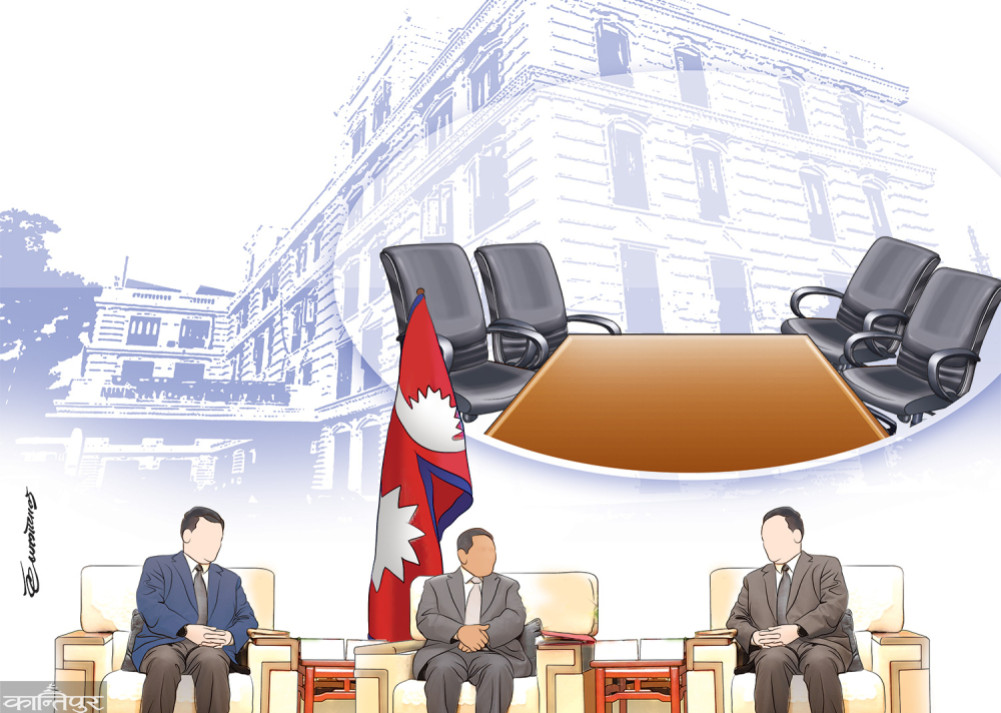
While not much can be expected when diplomatic appointments are dominated by kinship and donors, even a minimum of dignity in meetings can prevent the country from being further disgraced.
We use Google Cloud Translation Services. Google requires we provide the following disclaimer relating to use of this service:
This service may contain translations powered by Google. Google disclaims all warranties related to the translations, expressed or implied, including any warranties of accuracy, reliability, and any implied warranties of merchantability, fitness for a particular purpose, and noninfringement.
Recently (August, 11-12, 2024), Indian Foreign Secretary Bikram Mishri, who visited Nepal, did not miss to meet any of the main officials of Nepal. It is said that he came to Kathmandu for two days at the invitation of his Nepali counterpart, Seva Lamsal, and spent an hour in completing the formalities of talks at the level of the Foreign Secretary in Nepal, while the rest of the time was spent in meeting with government officials including the President, Prime Minister, Foreign Minister, Finance Minister, Urban Development Minister, Home Minister, as well as opposition party leaders, former Prime Ministers, etc. did
Similarly, Chinese Deputy Foreign Minister (Secretary) Sun Weidong, who visited Nepal on June 24-26, 2024, also met various ministers and leaders including the President, Prime Minister, and Foreign Minister. Richard Burma, US Deputy Secretary of State for Management and Resources, who visited Nepal on August 16, 2024, did not miss anyone. Not only did that meet, but after organizing a dinner, the remaining people were not left to meet together at the hotel.
These are scenes that keep repeating in Nepal's diplomatic practice. Once the discussion happens, it can be postponed until the next time and the same sequence continues again. When the foreign minister of a country comes, he queues up and goes to the hotel where he is staying to meet the former prime ministers, which is rarely seen anywhere else except Nepal. Due to the fact that there is no code of conduct as to who should meet which foreigner and why, there is a competition between foreign countries to meet high officials of Nepal. If one meets, the other will raise the question why I can't meet, and the practice of meeting whoever wants, whenever they want, continues. From the point of view of the representatives of the foreign countries concerned, if this is their success, it is a matter of shame for us.
There is no diplomatic code of conduct in Nepal, and there is no standard of who can meet or not. Once Narayankaji Shrestha, when he was the foreign minister, asked for a truckload of goods from the embassy during the diplomatic code of conduct earthquake in 2011 and asked him not to publicize it (Ranjit Ray, Kathmandu Dilemma) along with his 'diplomacy'. Since then, no one has bothered to raise that much trouble. In other words, the Government of Nepal has no information about the intention, record and agenda of the diplomatic meeting.
There is a Ministry of Foreign Affairs to 'deal' with foreigners, there are various divisions/branches. They have some sort of institutional memory. However, every day we have some ministers meeting foreign envoys. If we talk about the nature of the ministry's work, in a country like ours where foreign projects are scattered, there is no ministry that does not involve foreign affairs in one way or another.
The organization structure has been created so that the Ministry of Foreign Affairs has to coordinate all of them in an integrated manner. It can be considered natural that issues such as financial support, loans, subsidies are directly connected and work on them, and that discussions and consultations with the Ministry of Finance take place. Apart from that, there is no need for the rest of the ministry to talk to foreign envoys themselves. For example, if the Minister of Home, Physical Planning, Urban Development, Tourism or Forest meets the foreign ambassador and talks directly, what is left of the Ministry of Foreign Affairs? There is no reason for ministers other than the foreign minister to meet foreigners except if the foreign minister has come for the same subject or there is a program of the ministry.
The smallness in us is also expressed by the competition in meeting foreigners. Nowhere else is the practice of a staff-level official directly meeting the President of any country. Here, ambassadors meet the president regularly, and preferred ambassadors have direct access to the prime minister. On the one hand, this sends a message about where Nepal's level as a nation is reaching, and on the other hand, it also shows how relaxed our high-ranking officials are. At least the President and the Prime Minister do not decide which level of official to meet, the country's diplomatic dignity is under attack.
Our embassies abroad also organize events from time to time. Let's leave aside the matter of one of the ministerial level, if the guest of the state minister level comes, our officers are excited to tell about their success. In Nepal, there should be a national day or celebration of a country, the ministers think. Even if it is tried to establish the custom of making the Vice President the chief guest, there is no difference in the case of the rest. If no one has received an invitation, it is sometimes heard that the ministers themselves have called me and asked why I was not invited this year. Such functions are becoming an opportunity to showcase the power of foreign missions in Kathmandu. Moreover, the queues of high-ranking civil servants, police and army officers attending such functions help to understand what the embassies in Kathmandu are doing in Nepal and what their focus is.
Nepal has missions abroad, and ambassadors of various shapes and colors continue to change rapidly. Everyone has the feeling of how long they have to wait to submit the certificate of status. If he meets the President only once throughout his tenure, he will not have the opportunity to have a formal meeting with the Prime Minister. Even if there is a meeting with the foreign minister, it is not a matter of regularity. Recently, Bishnupukar Shrestha, who was recently recalled by the Chinese ambassador, was happy to receive a written letter from Foreign Minister Wang Yi without even meeting him. Such scenes must give some education to those who sit in the government, make policies and implement them.
protocol cannot be said to be everything in itself. However, as a state, it has certain norms, which must be followed. Rank order is also determined by power. Recently (August 29, 2024), when US national security advisor Jack Sullivan arrived in Beijing, Chinese President Xi Jinping did not meet Chinese President himself, but rather the importance of China-US relations.
Nepal also does not work by talking about a lot of dignity, but definitely does not draw some boundaries. For example, at least who the president will meet can be decided. The President is the symbol of our republic, the number one person of the nation of Nepal. Though figurative, the government of the country runs in the name of the President, the decisions of the nation get final legitimacy from the name of the President. How will the dignity of the country be maintained if such an institution is made cheap so that anyone can visit it whenever they want? A few years ago, it was heard that the package for tourists from China to visit Nepal included the opportunity to meet and take pictures with the Vice President.
is not limited to today's diplomatic government levels. Many countries are following the concept of public diplomacy. In other words, the practice of extending diplomacy not only between states but also to the common people through social organizations, individuals or groups is going on. This work has been done a lot in Nepal. There is no record, let alone monitoring, of the cooperation and collaboration of the associations/organizations with the foreign missions. Our state does not know who's agenda is and how the seeds are being planted in the society. If a country doesn't even have a counter-espionage organization, it can be understood from this, how far can those who can do it in Nepal? The state is not liberal, Nepal is not liberal at all.
However, generosity does not mean being naked. It is not magnanimity to allow others to do everything when they cannot do anything themselves. Even the powerful nations who have adopted liberalism, are living with the contract of democracy, are leading world peace and are not ready to make concessions on the smallest things in diplomacy. There are examples of India's frequent diplomatic spats and employee expulsions with Canada, Britain and the US, which have good relations and embrace a liberal system. It is too late for us to bring the minimum standard of diplomatic decorum to save our existence in the current world where the principles propounded by old scholars like Chanakya and Machiavelli have been adopted in the name of 'national interest'.
A small country's greatest weapon is effective diplomacy. However, the organizational and functional condition of the Ministry of Foreign Affairs, the mechanism that conducts that diplomacy, is pathetic. Abroad, we have 40 missions including seven consulates, three permanent missions and 30 embassies. The number of employees working in them is very less.
There are a total of 292 posts under the Ministry of Foreign Affairs, while the same number of employees are in some departments. Making them skilled by providing them with training, training and opportunities and conducting the diplomacy of the country through them, by making people from 'engaged in various professions and businesses' and 'contributing to the movement' as ambassadors, the overall diplomacy is being shed light. While not much can be expected when diplomatic appointments are dominated by kinship and donors, even a minimum of dignity in meetings can prevent the country from being further disgraced.