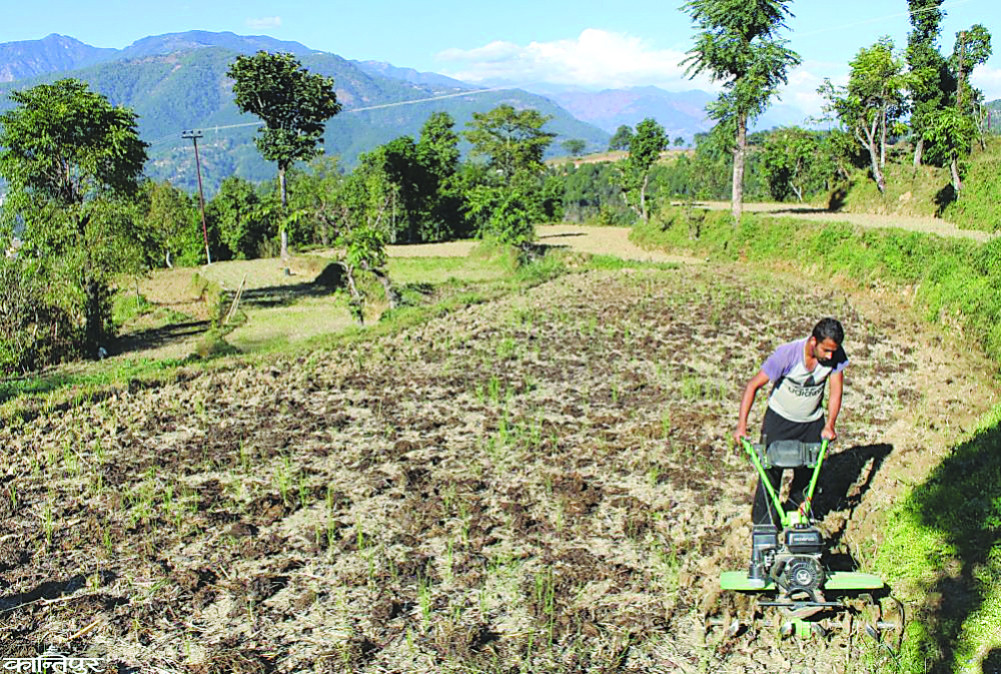
Can't you farm on government land? Can't private land left barren be taken on 'lease'? Can't the municipality mediate between giving and taking land on lease? Shouldn't the local craftsman make the tools needed for farming? By doing this, the land of every municipality will not remain barren. Those who make a living in agriculture see the potential here.
We use Google Cloud Translation Services. Google requires we provide the following disclaimer relating to use of this service:
This service may contain translations powered by Google. Google disclaims all warranties related to the translations, expressed or implied, including any warranties of accuracy, reliability, and any implied warranties of merchantability, fitness for a particular purpose, and noninfringement.
Those who do not even earn a living need employment to feed themselves. The breadwinner needs employment to meet the occasional storm. Employment to earn more for both livelihood and poverty. Employment for mental health, as David Bluetin calls the wealthy. Employment to fulfill the desired desire of the aspirant.
Looking at it like this, we have all been looking for employment. Some people want to fill their stomachs, some people want to lose weight, some people want to earn more, some people want to be mentally healthy. To fulfill someone's expected desire. Is this how we planners think? Have we employers thought this way? Is that what we job seekers say? Is this how activists have thought to connect education with employment? That's why we have 10.92 percent unemployed.
What kind of unemployed are we?
According to the 4th Nepal Living Standard Survey, there is 12.6 percent poverty in Nepal. Poverty is increasing at a rate of 1.2 percent per year. But how did poverty increase? Can't make a living? Do you have to avoid thunder? Need to earn more? Looking for employment for mental health? Expected wish fulfillment? Have we planners thought about these things? On the contrary, we are confused about imported cyclical (cyclical) unemployment, frictional (frictional) unemployment and structural (structural) unemployment.
The cyclical unemployed are the bitterly unemployed, those looking for a place where employment is sweet. Frictional unemployed are like seasonal vegetables, torn between where to go and what to do. The structurally unemployed are those who do not have the required skills. Is the nature of the non-earner cyclical or frictional, or is it like the structural nature of the unemployed? Those who need to avoid stress, those who seek to earn more, those who seek employment for mental health, expected What about the unemployed who want to fulfill their
desire? How to recognize the vocabulary of economists or planners? How to match the language of the government? Are economists aware of this? Does our plan know the floor? Do our unemployment relief programs reduce unemployment?
The measures to reduce unemployment are correct?
The National Planning Commission has said that there are 9 lakh unemployed youth in 2023. By 2029, that number will be reduced to 3 lakh. This means providing employment to 100,000 youth every year. Newspaper information says - 2044 people emigrate every day. Every day there are 1200 youths returning home. About 5 lakh youth enter the labor market every year. The credit of the private sector has not increased. The government has given 79 days of employment in a year. It seems that a total of 64,766 people got employment from the Prime Minister's Self-Employment Fund. Are those who get jobs are not going to make a living? Is it a thunderbolt? Those who need to earn more? Mental health workers? Is it necessary to fulfill the desired desire? Who are they?
Municipalities are only distributors. The center is a remittance only. Those who take the money are just hustlers — to build a road, plant a plant or two. Will unemployment decrease in this way? How does he live? Thunderstorm? Will you earn more? Is mental health good? Will the expected desire be fulfilled?
Despite following the western thinking of unemployment, what did the municipalities do for the cyclical unemployed? What is done for frictional or structural unemployment? Does the answer lie with economists or planners? If not, what can be the alternative to the circular practice of reducing unemployment? Will there be a scandal about this?
We talked about increasing demand to eliminate cyclical unemployment. market demand. Manpower demand. Nepali reality says that the domestic market demand is small. Foreign demand seeks quality goods. Neither we could make high-quality materials like the Americans nor did we produce goods according to economic status like China. In this situation our market did not expand. Therefore, there were not many jobs. In terms of supply, we got a cheaper option - from China. From India. From a two-digit market. We did not increase the industry either - in agriculture. in tourism. In export enterprises. The ten export industries also did not seek manpower. Searched for the machine. That is, we indulged in the trading industry. The 5.65 percent contribution of the industrial sector to the domestic product proves this point. The fact that only 61.53 percent of the industry's capacity has been used also gives a boost to this.
Frictional unemployment provides information on the potential location of employment. Gives necessary advice. Allowance is given when there is no work. Gives necessary grants. Is there such a system in our municipality? Has the Planning Commission considered this? This skepticism says that we are not real in this way either. To eliminate structural unemployment, the municipality or employers provide information on the skills that the market is looking for. Provides digital and non-digital platforms for learning related skills. They inform that the market has changed. Changes in monetary policy. Makes the tax system people-friendly. In this way, arrangements are made to provide employment to the unemployed. Do we have such an arrangement?
What does Nepalese soil look for?
Nepalese statistics say that 20 percent of employment is in agriculture. 17 and a half percent is in industry and trade. Construction accounted for 13.6 percent of employment. The informal sector provided 62.2 percent of employment. Analysis of data and youth practice shows that youth did not go into farming. Industry and trade did not flourish in the country. The skills sought by the informal sector remained menial.
The youth did not choose farming for honor and happiness. He did not see much potential in industry and trade. The culture born of caste responsibility did not allow him to engage in manual work. That is, our level thinking did not collapse. As a result, we were ready to go to Romania and tear down the bush. We were ready to go to Saudi Arabia and graze sheep and camels. We were ready to go to Israel and work in the fields. We considered culture an obstacle to shake hands in the country. We sought revolutionary transformation. We did not break the culturally held hand-wringing mentality.
What did other countries do to create jobs?
America mobilizes manpower to expand physical facilities—in new construction. in repair. In domestic workers. In the import industry. Construction and maintenance of roads, bridges, drinking water etc. Arranged training in the field sought by the employer — online. In open mode. At periodic meetings.
Saudi Arabia plans to displace oil-dependent jobs by 2030. China's trade liberalization created jobs—through small private enterprises. Through farms such as youth agriculture, health. Through imported industries. Similarly, a government job search campaign was also launched. Once the work is recognized, it is placed on the digital platform. In which sector will India grow? Who will invest in that growth? How to do it? Where to do it? What skills to develop? For the social sector, for the service sector, for the human labor seeking sector, for the skill provider sector.
Scandinavian countries explore what the source is. Identified what skills are needed to use that resource. Analyzed what are the job opportunities in that field. Accounted for what training is required for those jobs. Find out who the training provider is. What could be the new job? What can be done by restructuring the existing work? What can be done to increase production? What is the market for the goods earned from that work? Israel identified what could be done at the local level.
thus created a dashboard to search for potential jobs. Everyone gave their opinion on it. Officials discussed the same idea at the local level. The scope of work was decided during the discussion. Sources of investment identified. A roster of people with the required skills is prepared. Digital and non-digital methods were also found to provide the necessary training. Nepal's Planning Commission and political leadership said that there are jobs in the fields of agriculture, tourism, water resources, forestry and fisheries.
Learning about job creation
The first task is to find out what the livelihood of Nepalis is. Leased land is needed for Nepalese who seek livelihood in agriculture. Hydroponic farming knowledge, skills and investment required. Knowledge, skills and techniques of making organic fertilizers are required. Seed production skills required. Research is needed on what alternative farming could be. Gallamandi wanted to buy manufactured goods. Need a shop that can sell itself. An industry based on unsold items is needed. Like the cooperatives that Israel has built in every kibbutz. such as industry. like a shop. Various methods are needed to collect investment at the local level. Government, private, share investment or foreign investment.
Is it not possible to create a culture of thinking like this in every municipality? Can't you farm on government land? Can't private land left barren be taken on 'lease'? Can't the municipality mediate between giving and taking land on 'lease'? Shouldn't the local craftsman make the tools needed for farming? By doing this, the land of every municipality will not remain barren. Those who make a living in agriculture see potential here. Even those trying to earn a living. Even those who seek to avert thunder. Even those who want to earn more. Also job seekers for mental health. Aspirants too. In this process, many jobs come out. Those works are born there through dialogue at the local level. The solution is also found there.
If this is done, jobs can be created at the local level in all areas that the government has said. Moreover, new employment areas based on local expertise are also created there. The municipality itself becomes a place to provide employment. It can employ the manpower of other municipalities in areas that it does not have. As Canada has done, it can lead others into areas it does not want. Should the municipality be oriented towards it and become a local government or will it continue to be an administrative unit that distributes the money given by the center? Ask the provincial government what will happen?
If the federal government is to take charge of the development, it should pay attention to three things. How to develop the Himalayan region? How to develop hilly areas? How to develop Madhesh or Terai? Let's find a common answer to these three questions. Modern technology should be used for this. In order to gather ideas, one should ask the natives, non-resident Nepalis, interested foreigners about investment and market.
The golf club built at the highest place in the world at Mustang in Nepal is an example. That's where golfers go. want a hotel want food need a way Similarly, the development of Alonknife in Canada is another example. The government came to know that there is a gold mine there. For that, the indigenous people were invited. Foreigners looking to get rich quick were sent there. As a result, the place where 6 months of day and 6 months of night was developed. Learning from this exercise, we will build a station of Himalayan observation? Whether to create jobs in areas such as station construction, skiing, skating, rock climbing, bee farming?
The experience of the hilly region says that there have been successful trials of cultivation such as dragonfruit, ground apple, apple, avocado, timmur, tea, coffee, cashew. The practice of informal circuit visits to temples, monasteries etc. has been started. Viewing the waterfalls and mountains has become a ritual. If these practices are expanded, employment will be born there.
The work of decorating a pond has started in Madhesh. Makhana has been cultivated in it. Ducks and fish are cultivated in paddy fields. There has also been a practice of collective farming by collecting private farms and taking proportional dividends. Industries have run. In these and similar tasks there can be guaranteed employment.
Conclusion
is a worldwide practice of creating jobs by tapping into whatever resources are available. What is the local value of that resource? What are national values? What is the international price? It should be searched for. Investments should be sought on the spot. You have to find a market. There is a need for a website, portal or dashboard to collect the thoughts of Nepali people there, in the country and abroad. Ideas should be collected in that.
As in Israeli agriculture, production, cooperatives, industry and markets are needed together. To guide education in this direction? For this, teachers, professors, businessmen, entrepreneurs, government etc. should walk together? If this is done, employment will be created in the country. Youth migration will stop. The
question is — to do or not to do? Between the doers and the don'ts, find answers, test and move on. The era is ours. We are all thinkers.