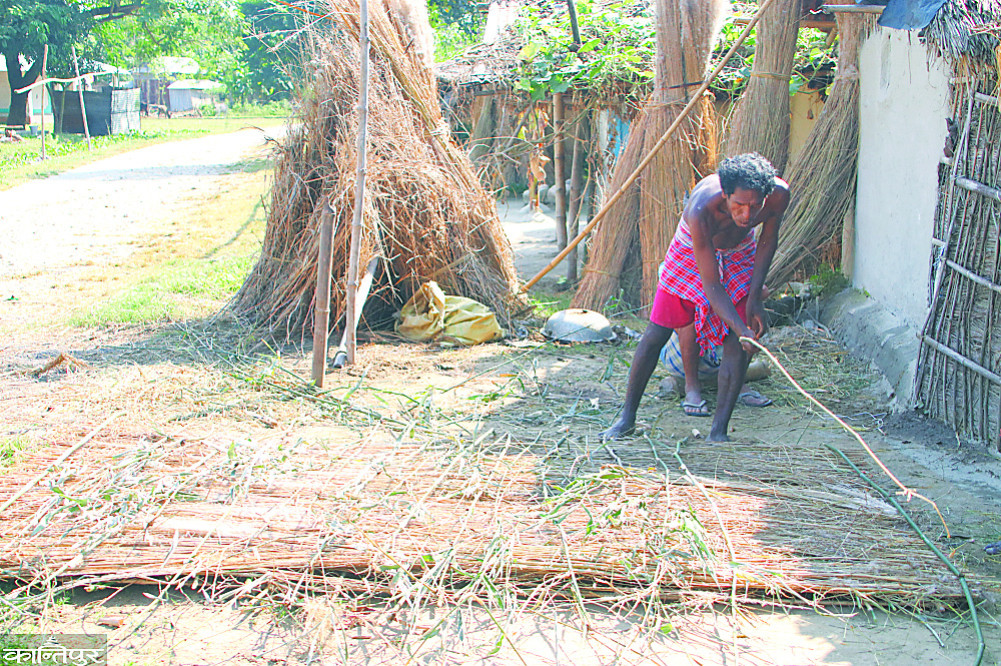
It is against the law for the local government, forest office, etc. to resettle the landless people who are in the process of solving the problem. Since this is a political issue of a serious nature, its solution should also be sought at the political level.
We use Google Cloud Translation Services. Google requires we provide the following disclaimer relating to use of this service:
This service may contain translations powered by Google. Google disclaims all warranties related to the translations, expressed or implied, including any warranties of accuracy, reliability, and any implied warranties of merchantability, fitness for a particular purpose, and noninfringement.
The Division Forest Office installed a dozer in the flood-affected and landless slums living in Bhajani Municipality-1 and 9 of Kailali and razed the slums. On June 11, the dozer of the forest office suddenly entered the settlement and destroyed 500 families. On top of such a scorching summer, the Utibasa work carried out during the rainy season has had a great impact on the livelihood of the landless.
Gijra Basti located in Khajura Rural Municipality-6 of Banke is also under pressure to live there. Most of the 2500 households living there are landless. They are worried after repeated pressure to resettle the landless people who have been living since 2045 from Surkhet, Jumla, Dailekh, Humla, Jajarkot and other districts. There, 180 bighas of land were in the name of Jigra Khansari Mills Pvt Ltd, 33 bighas in the name of Tandon family and remaining 287 bighas in the name of bull rearing. Under the guise of access and power, the land has been registered by various land mafias.
The land mafia is creating a scenario of collecting huge sums of money from the landless. Landless families who are earning two shillings from wage laborers are not in a position to remit money. The victims are complaining that they are constantly harassing and threatening them saying, "Go for the money for the land or vacate the settlement". The victims had submitted a petition to the then Home Minister Ravi Lamichhane on June 20 asking them to stop the uprising and get peace and security.
Dhangadhi sub-metropolitan city of Kailali ward no. In Shantinagar settlement located at the old airport of 1, on June 9, 10 houses of landless people were evicted by using dozers. Children, senior citizens, pregnant women and disabled citizens of the slums have suffered. On the other hand, a terrible incident happened on 25th of May last in Barju rural municipality-1 Musahari village of Sunsari. Local youths suddenly started demolishing the house of local Kashinath Rishidev who was living in Ailani land.
Harilal Rishidev, who was trying to make the environment easier, was beaten to death by the youths who came with bata, lathi, sickles, axes, shovels and suddenly started destroying the house. The injured Harilal died before reaching Koshi Hospital. His house is in Ailani Jagga near Jhora Khola Sandhai. He is also landless. The farm of Jageshwar Yadav, a local landowner, is connected with this land. Earlier, Jageshwar had repeatedly threatened to get the people to live on why he had built a house on the border of his farm. These are some representative cases. Land issues and related conflicts are all over the country. The landless are losing their lives in the name of security.
In a republican country, all citizens are envisioned to have equal status and conditions. This is what it should be. But here there is a wide gap in the treatment of those who have and those who have not. This is the state where the big families, traders are allowed to enjoy large lands under different names. Restrictions are exempted. On the contrary, policies are made according to them. However, the landless family has lived on this soil for many generations without owning even an ana of land throughout their lives. Their voices are not heard.
The last time Ravi Lamichhane became the Minister of Home Affairs, after the Ministry of Home Affairs issued a circular to the district administration offices on 9 February 2080 regarding the protection of public land, the incidents of squatting on landless settlements in various districts started to increase. In the name of protecting public land, the local government and the forest office are trying to force the Nepalese who have been living there for generations to resettle, while the police administration is helping these agencies. On the other hand, if we carefully study the existing laws, there are some good legal provisions for farmers who are facing problems related to land, including landless squatters, landless Dalits, unorganized settlers.
Article 37 of the fundamental rights in the constitution guarantees that 'every citizen has the right to suitable housing'. Article 40 also guarantees that 'the state will provide land to landless Dalits once as per law' and 'arrange housing for Dalits without housing'. Clause (2) of the right to social justice in Article 42 states that "the citizens of economically disadvantaged and endangered communities shall have the right to receive special opportunities and benefits in education, health, housing, employment, food and social security for the protection, upliftment, empowerment and development". The Eighth Amendment and Regulations of the Land Act, 2021 have also been made to implement the fundamental rights. Meanwhile, Land Commission has been formed twice. According to the revised Act and Regulations, the main responsibility for land registration and land management of landless Dalits, landless squatters and unorganized residents lies with the local level.
Local Government Operation Act, Section 11 of 2074 clearly mentions the work, duties and rights of the local level in sub-section 4 Jh (1) 'Squatter identification and record management' and point (2) 'Squatter-related livelihood and residence management' has been done In sub-section 5 a of the same act, point (3) also mentions the issue of managing disorderly residence at the local level. On the other hand, the National Land Policy, 2075 has been approved by the Council of Ministers on 7th Chait. In the approved land policy, it is said that proper accommodation will be arranged for the landless poor families. It is also mentioned that the person or family to be rehabilitated will be properly managed, landless and indigent families whose land has been used in a disorderly manner will be managed in such a way that they will have specific rights to use land in appropriate places. Looking at the
, the laws are good. If it is properly implemented, it seems that most of the landless people's problems will be solved. However, looking at the events of uprisings and injustice happening all over the country, such policies and laws are flouting even the rule of law. Even those who have been living there for generations are being evicted in the name of forests and parks and government and public lands. If studied properly, various laws and policies came only much later. Community Forests and National Parks are the areas that have been inhabited by humans since long before the creation of forests and parks. It is not fair to evict them without any choice.
If you look at the history of forest protection, the National Forest Plan was created in 2033. The Forest Act appears to have been made later in 2049 and the Regulations only in 2051. Even the Forest Act, which was amended in 2076, did not talk about the management of landless, squatters and unorganized residents who have been living there for generations. On the contrary, informal residents within the forest area are called illegal settlements or encroachments. In the name of forest protection, it is not fair to wrongly define the family, who have been protecting the same forest, and whose livelihood and residence are connected with the same forest, and to forcibly evict them.
It is a deplorable act to evict a slum where people are living without any alternative. Also the excesses and injustice done by the state agencies on the landless people. Currently, the landless families across the country have submitted their application to the National Land Commission. As the Supreme Court is staying the continuation of the commission or the formation of a new commission, the process of petitions is only stopped. The new government is drafting the terms of reference for the formation of the Land Commission. The situation is stopped only by the interim order of the court.
It is against the law to resettle the landless people who are in the process of solving the problem by the state agencies, local government, forest office etc. Instead, these agencies should coordinate with the taluk and subordinate agencies and immediately form a land commission to facilitate and coordinate the work of finding a permanent solution to the problem of all the landless. Since the issue of the landless is a political issue of a serious nature, it is necessary to find its solution from the political level. It seems that the political leadership should pay serious attention to this issue.