It is necessary to change the negative comments towards Nepal. 2000 people go out every day is more talked about. But it is not heard anywhere that more than 1200 people return home every day. There is no shortage of people returning to the airport.
We use Google Cloud Translation Services. Google requires we provide the following disclaimer relating to use of this service:
This service may contain translations powered by Google. Google disclaims all warranties related to the translations, expressed or implied, including any warranties of accuracy, reliability, and any implied warranties of merchantability, fitness for a particular purpose, and noninfringement.
After the United Nations declared 1985 as the International Year of Youth, global debate and lobbying on youth issues began. At the World Youth Forum held in Vienna, Austria in 1991, the participants raised a strong voice about the concept and need for International Youth Day.
Then, on August 8-12, 1998, a World Conference was held in Lisbon, Portugal under the coordination of the United Nations, with the participation of Ministers of Youth Affairs from 140 countries. Coincidentally, the Prime Minister of Portugal at that time was the current Secretary General of the United Nations, António Guterres. The conference issued an 88-point Liswan Declaration with a shared commitment to formulate
national youth policies in their respective countries. The conference proposed to celebrate International Youth Day on August 12 every year. After the resolution was approved by the 54th General Assembly of the United Nations on December 17, 1999, August 12 began to be celebrated as International Youth Day from the year 2000.
Establishment of Youth Council
Nepal also started celebrating International Youth Day around 2004 in governmental and non-governmental ways. At the same time, intensive discussions about the rights and interests of the youth, awakening and policies began. The need for a separate ministry, policy and structure for the youth began to be felt. The Ministry of Youth and Sports was established in 2065. Prior to this, a limited structure in a small room of the Ministry of Education as the Youth Development Division expanded into a ministry.
National Youth Policy was passed for the first time in the year 2066 under the leadership of the Ministry of Youth and the activism of political, social and civic associations/organizations active in the field of youth. This policy established the need to establish a National Youth Council for youth empowerment in Nepal.
Based on the National Youth Policy drafted in 2066, with the participation of multilateral stakeholders, the National Youth Policy 2072 was passed by the Council of Ministers in a more comprehensive and extended manner. On the basis of this policy, the National Youth Council was formed on February 19 of the same year after the Parliament passed the National Youth Council Act 2072 for youth development and empowerment. Its first executive vice president was Madhav Prasad Dhungel.
According to the National Youth Policy 2072, the 16-40 age group is considered youth in Nepal. According to the census of 2078, the youth population in Nepal is 42.56 percent, i.e. 1 crore 24 lakh 12 thousand 173. It is a time of high youth population. Also, the number of people aged 15 to 59 is 61.9 percent. The time of the demographic dividend is when the active population that can earn more than the dependent population that has to rely on the earnings of others. But experts believe that due to the increasing emigration of young people abroad, the decreasing population growth rate and the increasing life expectancy, the time of the dividend will not last beyond the next two decades.
Based on various indices of youth development and empowerment, Nepal is ranked 108th in the 2023 World Youth Development Index Report. The report is prepared based on criteria such as education, health, employment, opportunities, political and civic participation for the youth.
The Asian country Singapore is number one in the youth development index in the world. The rest of the top 10 countries on the list are all European countries. Denmark is in second, Portugal in third, Iceland in fourth, Slovenia in fifth, Norway in sixth, Ireland in seventh, Spain in eighth, Malta in ninth and Switzerland in tenth. According to the index, Sri Lanka is leading in South Asia with 51st position. Similarly, Maldives is 58th, Bhutan 63rd, India 121st, Pakistan 161st and Afghanistan 183rd.
Youth Structure and Policy
With the release of the National Youth Policy, various structures are being formed to work for the youth. At the federal level, the Ministry of Youth and Sports is the guardian of the youth. Bodies such as National Youth Council, National Sports Council, Youth and Small Business Self-Employment Fund, Nepal Scout are active as autonomous bodies, acting as liaison ministries to the Ministry of Youth.
According to the National Youth Council Act, the secretaries of seven ministries including youth, finance, labor employment, education, agriculture, industry and health and the secretary of the Planning Commission will be ex-officio members on the council's board with the intention of working in a coordinated manner on youth issues. There is a provision to have other youths from different fields on the board of the council. Apart from this, various ministries of the federal level also conduct youth-oriented programs according to the subject. The District Youth Committees, which have been working under the Federal Council since their inception, are in debate as to how to bring them into a new context with the state restructuring.
With the country moving towards federalism, the policies and structures of youth are also expanding at the provincial level. So far, provincial youth councils have been formed in Wagmati, Sudurpaschim and Lumbini provinces along with provincial youth policies. Efforts are being made to form Provincial Youth Councils through Provincial Youth Policy in other four provinces as well. In addition, the Ministry of Social Development of all seven provinces (in some cases, a separate Ministry of Youth Affairs) is promoting youth work. Youth development divisions within the ministry are leading it directly. In the latest phase, youth structures are being formed at the local level through the Union, Provinces, according to the belief that wherever there is an executive government, there is a youth structure. Local youth councils, city youth councils or village youth councils have passed an act in the name of city councils or village councils.
As we celebrate the twenty-fifth International Youth Day, we are currently in the final stages of issuing the new National Youth Policy 2081. Although the old policy is supposed to be replaced by a new one every five years, there has been some delay due to various reasons. Under the leadership of the Ministry of Youth, phased discussions and debates are being held with the participation of the National Youth Council and other relevant agencies and organizations active in the field of youth. After more intensive and meaningful discussions with the youth of all parties and sectors, there should be no delay in finalizing it. In this debate, the issues of youth entrepreneurship and self-employment are prominently raised from the new needs and challenges of the youth. Along with this, it is time to review Youth Vision 2025 and ten-year strategic plan for the implementation of youth policy.
The youth are not only the leaders of the future, but also the stakeholders of the present. Their participation should be ensured from the policy making level to the implementation level. In the most recent local elections, 41.14 percent of youth under the age of 40 were elected. This is a very positive step in youth development. Maximum youth friendly local governance can be expected from this. But compared to this, there is only 20 percent youth presence in the Provincial Assembly and 12 percent in the Representative Assembly. From this, it seems that relatively young people have not been able to participate in the policy-making level.
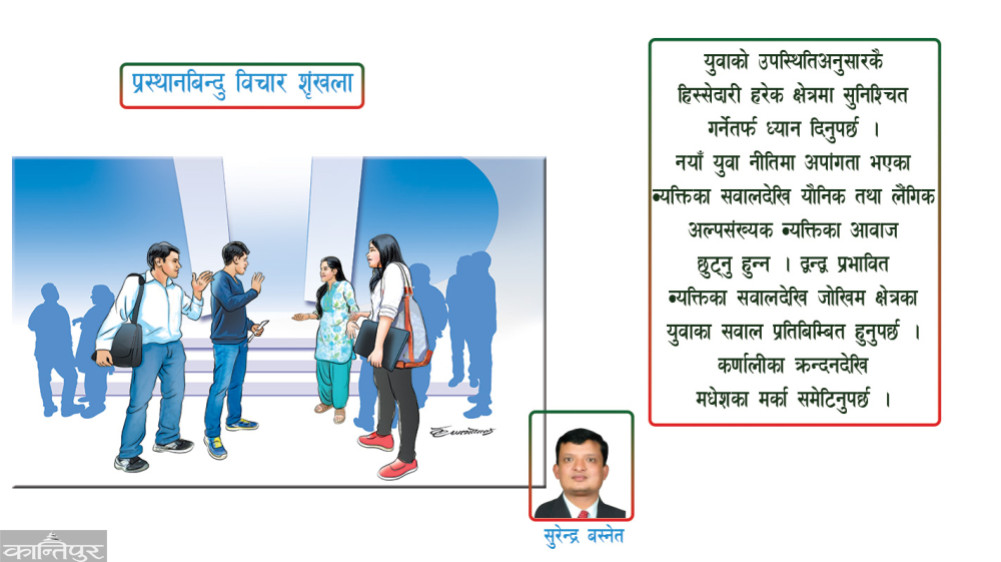
Proper attention should be paid to ensuring the participation of youth in every sector. In the new youth policy, the voices of people with disabilities should be voiced. In order to ensure lasting peace, the concerns of conflict-affected people and youth in vulnerable areas must be reflected. The new youth policy should include Karnali's Karnali to Madhesh's Marka. The voices of all minority, marginalized and backward communities should not be left out of the struggle for women and Dalits.
Age debate
Age debate is also becoming an important topic in the new youth policy. In the existing policy, the age group 16-40 was defined as youth. However, it is divided into two sections. Youth Vision 2025 defines the age of 16-24 as basically the age of learning, teaching and the age of 25-40 as the age of implementation. In the new youth policy, there are suggestions to keep 16-3, 18-35 or the old 16-40.
Nepal's major political party-affiliated youth associations/organizations have set an age limit of 16-40 for membership in their organizations. Some believe that 16-40, established when the average life expectancy was 57 years, is more suitable for those who now have an average life expectancy of 71 years. The argument that
should be reduced based on international practice is different. Among the South Asian countries, the age group of 15-29 in India, 18-35 in Bangladesh, 15-29 in Sri Lanka, and 18-34 in the Maldives seems to be kept young. We should define the age debate through the discussion and participation of all stakeholders in a way that suits Nepali soil and climate.
The path of entrepreneurship
Statistics show that about seven lakh young people go abroad every year. This is a very scary picture. Only by instilling hope, trust and confidence in the youth through entrepreneurship and self-employment within the country can this tension be reduced. A problem cannot be solved just by saying a poem or making a speech. Concretely, the atmosphere and environment for the youth to stay in the country should be created. For this, effective steps should be taken to promote concessional loans, start-ups and entrepreneurship.
For example, information technology seems to have brought an unprecedented revolution in the rapid economic development of Nepal. A study conducted by the Institute for Integrated Development Studies (IIDS) has shown that more than 67 billion rupees are being earned annually through about 66,500 IT personnel who are exporting information technology services to foreigners in Nepal. In 2022, information technology service exports contributed 1.4 percent to the country's gross domestic product and 5.5 percent to foreign exchange reserves. Considering its huge potential, the state should facilitate, simplify and increase investment in this sector with special priority. A solid and effective plan should be developed to give meaning to the concept of the IT decade put forward in the budget statement of the current financial year.
It is necessary to change the negative commentary towards Nepal. 2000 people go out every day is more talked about. But it is not heard anywhere that more than 1200 people return home every day. There is no shortage of people returning to the airport. But since their systematic record keeping system has not been developed, official data is not available. However, the state should create a separate returnee youth entrepreneurship policy to mobilize the knowledge, skills, technology and capital acquired by the youth who have returned from abroad.
The overall development of the youth should be the priority now, keeping the sustainable development goals at the center. A solid foundation and policy for youth mobilization, participation and empowerment should be ensured by the government at the same level. By making the Nepali youth strong, capable, competitive and self-reliant, they should join in building a modern, just and prosperous Nepal through their meaningful participation and leadership.
– Basnet is the Executive Vice President of National Youth Council.