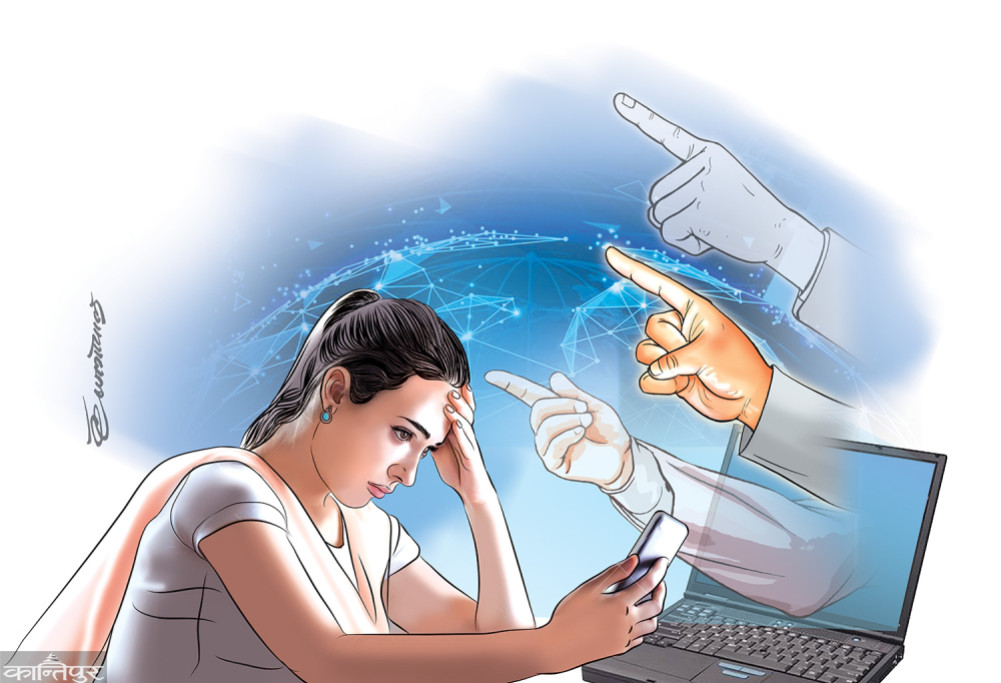
From challenging authoritarian political leadership to promoting justice movements, media such as social media and digital space are being used, which is a very positive thing.
We use Google Cloud Translation Services. Google requires we provide the following disclaimer relating to use of this service:
This service may contain translations powered by Google. Google disclaims all warranties related to the translations, expressed or implied, including any warranties of accuracy, reliability, and any implied warranties of merchantability, fitness for a particular purpose, and noninfringement.
With the development of technology, online or digital space has become an important means of economic politics in the world. It has had a great impact on politics, market economy, consumerist culture and cultural sector. It has both positive and negative effects on individuals, society, politics and culture.
According to a recent data, about 67.1 percent of the world or 5.45 billion people have access to the Internet. In Nepal, about 52 percent of people have access to internet services. More than 41 percent of Nepalis are connected to different types of social networks. Not only this, information, knowledge and resources around the world are also easily available in digital format. In this way, people are using digital space as the most effective means.
The development of the Internet and digital media has transformed the traditional information system of the world. Individuals are able to freely enjoy freedom of thought and expression without any censors, gags or restrictions. Not only free speech, social media has become an effective medium for getting information and brainstorming or discussion. In the past, people had to rely on some formal media to share their thoughts and views. Moreover, such formal media used to be dominated by the classes and communities in political and economic power. With the prevalence of social media, the marginalized communities have also started to raise their voice strongly and its impact has also reached the mainstream media. Social media has played a role in bringing out the incidents of discrimination, atrocities, violence etc. and making the state accountable.
is used or misused by groups in power all over the world. Being in political power does not mean not to use social media and digital space. Especially during the election, the former President of the United States, Donald Trump, employed thousands of people to campaign in his favor, and is still doing so. The Bharatiya Janata Party not only during the election, but since the government started under his leadership, used the digital space to oppress the Muslims of India in a big way. However, there are many examples of political propaganda being challenged through the use of social media. One of them is YouTuber Dhruv Rathi's presentation on Indian elections. Rathi's role was very effective in breaking the propaganda of Bharatiya Janata Party and Modi during the election campaign. This means that the effective use of social media can provide a strong challenge to authoritarian rulers.
Similarly, social media is also being used in favor of the justice movement. In May 2020, the American police killed George Floyd, a black man, by strangulation. After that, there was a movement around the world against the killing of George Floyd with the slogan 'I can't breathe'. If the video of Floyd's murder had not surfaced on social media or digital media, there would not have been such a large demonstration against apartheid. The role played by social media in creating public opinion in favor of his justice and putting pressure on the state is very important.
Even in the context of Nepal, the role played by social media and media against the murder of 6 youths including Navraj Vishwakarma in Rukum Paschim Soti is very important. A very effective campaign was conducted in the digital space along with the street struggle in favor of justice for the youth including Navraj. This could also increase the pressure on the victims and to some extent in terms of establishing justice for the families of the murdered. From this point of view, media like social media and digital space are being used to promote the movement of justice from challenging the authoritarian political leadership, which is a very positive thing. However, due to social media, people have to face many problems and challenges in their daily life.
Promotion of discrimination, hatred and malice
With the development and use of new technology, its negative effects and effects also appear naturally. With the increase in people's access to social media, the freedom of expression as well as the means of communicating their ideas has increased. On the other hand, these social networks are also developing as another means for powerful groups to attack the weak. India's Modi-led party's repression of Muslims is an example of this. Not only this, there is constant pressure, threats and hate speech on individuals or groups who question the ruling class and state power. Especially women and marginalized communities are more likely to experience pressure and threats based on what they write on social media. When questioning the discriminatory and exclusionary state power, especially the dominant sections of the state and society create panic. This has forced some to self-censor when writing on social media. As a result, freedom of thought and expression has been suppressed.
Social media is turning into another place to discriminate and oppress marginalized communities. There are misogynistic, racist and communal attacks, especially against women and oppressed communities. If we look at it in the context of Nepal, a very large group appeared on social media not only to stand strongly on the side of the rapist, but also to do more violence on the victims of violence. Similarly, when the tribals, Dalits, Muslims, Tharu or other communities question the state power, the Jilagna group is also very strong. There are many examples of caste and community abuse, spreading hatred and communalism on social media. That is, the dominant classes and a part of the community in socio-economic and political power are constantly using social media against the oppressed and excluded communities.
Similarly, using social media and digital space, there is continuous violence against women and the marginalized. In some cases, there are examples of people committing suicide due to misuse of social media in Nepali society. On the other hand, the Internet has become an important vehicle for promoting capitalist consumerist culture. Digital space is being widely used not only for capitalist products, goods or materials, but also for expanding consumerist culture. Due to the fact that they cannot compete with capitalists in production and distribution, countries with weak economic status have become more and more weak. It is also promoting discrimination and inequality.
Social media is evolving as a place where cultural pluralism and diversity are constantly challenged. There are many examples of MPs who do not speak Khas Nepali as their mother tongue being insulted by 'trolls' because they did not speak clear Khas Nepali while addressing Parliament or the state assembly. Social media should be developed as a space that respects the linguistic-cultural diversity of Nepal, only then can social media become a space that represents suppressed voices. Overall, social media and digital space in Nepal is developing as a space that promotes discrimination, exclusion and hatred by the dominant class, gender and community. Such spaces should be used to promote social justice and equality.
The debate over social media regulation
The debate on the regulation of social media has started in Nepal. The state has prepared the Social Media (Use and Regulation) Bill, 2080. Not only this, in 2080 it has also released a guide to manage social networks. It seems that the state is trying to make a legal arrangement with the aim of making the use of social media dignified, safe and orderly. From the perspective of marginalized communities, this bill should address these aspects.
Freedom of expression is a natural human right. In Nepal, the constitution and laws guarantee freedom of thought and expression. Therefore, freedom of speech should not be curtailed under any pretext. Social media is one of the means by which marginalized communities can raise their voices to hold the state and responsible agencies accountable for issues such as discriminatory polity and socio-cultural atrocities. Therefore, freedom of expression should not be curtailed to weaken the voice of oppressed classes and communities.
Social media has become another space to discriminate against oppressed communities including women, Dalits, tribals, Madheshi, Muslims, Tharu. Attacks on the views of these groups, promoting gender and racial violence, insulting and sometimes threatening. People or communities who hold critical views or views are subjected to pseudonymous threats and mental torture on social media. If the state is going to regulate social media by making a law, then there should be provisions to end violence and discriminatory abuse on social media, to get justice for the affected people and to take action against the perpetrators.
The constitution guarantees the right of privacy of the individual. People and society have had a negative impact due to the games on the privacy of individuals on social media. Internet service providers or social media companies are at risk of misusing personal information. Therefore, the right to privacy and data protection of individuals should be ensured. Social media is not a threat to users, there is a need for an environment to use it with respect.