In order to reduce the number of students who go abroad, the argument that strict control measures should be adopted is sometimes expressed by the political and educational leadership. However, what needs to be understood is that measures such as stricting the process of going abroad or giving permission only for studying certain subjects will be futile.
We use Google Cloud Translation Services. Google requires we provide the following disclaimer relating to use of this service:
This service may contain translations powered by Google. Google disclaims all warranties related to the translations, expressed or implied, including any warranties of accuracy, reliability, and any implied warranties of merchantability, fitness for a particular purpose, and noninfringement.
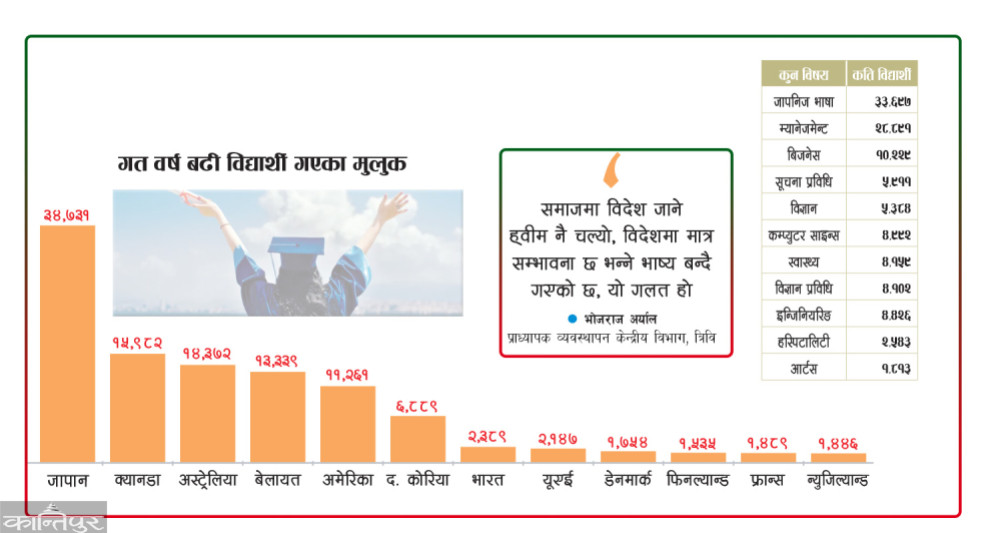
In the last one decade, the number of students going abroad for studies has increased four times. In the financial year 2070/71, this number was around 28,000 and in 2080/81, it exceeded 112,000. Although this number was around 30,000 annually throughout the Covid period, it has started to exceed 10,000,000 in the following financial years. There is no stopping that. There does not seem to be any initiative to stop it.
Whether for reading or other contexts, moving from one country to another is a natural process. It is a continuation of the migration that started with human civilization. It is everyone's tendency to gravitate to new places and seek to reach a place where their living is comfortable. A conscious person always strives for greater opportunities. While staying there, they continue to explore where they can enhance their learning, maximize their potential and ensure financial viability.
In countries where students can study while working, it seems that students are more interested in academic achievement as well as economic development. From this also the latest psychology of the student class can be known. It is not unusual for those who can assess their future to go abroad if they look for a promising place in their own country. It is an extended form of the process of coming to Kathmandu from a distant village to study - even going abroad.
In addition to the positive environment and potential opportunities found abroad, another aspect that motivates students to go abroad is the home environment. As the environment of the foreign country is pulling the students, similarly the environment of the home country is playing a direct/indirect role in pushing. Here, the analysis of the teaching process and the subject matter that is not attracting the students is being made public on a regular basis. Those who are studying here, have not been able to get an effective educational environment. Universities have been reeling from the effects of partisanship. Due to the fact that the exams are not held on time and the results are not published, the students are suffering. Many other malpractices in the education sector that frustrate students and stakeholders are coming to light over a period of time. It is a matter of concern that students think that studying here is just a waste of time.
The political daily life here has not given hope for a better future for the teenagers living here. Perhaps by realizing it, many high-ranking officials in the political or administrative sector are sending their children abroad and are raising their feet to go too. In such a situation, the children of the common people are not in favor of spending creative time in the hope that the educational quality will increase, then employment and professional environment will be created, and they will use their abilities to raise their economic and social status in the country. It is an unfortunate situation that society seems to have almost agreed that this country will not be built. On the other hand, family member going abroad seems to be a matter of pride for the concerned family and relatives. It is also pushing students abroad.
There is no need to express displeasure towards students who go abroad thinking about their interests. Instead, it is necessary to be serious about the message that is being expressed by it. Need to think. As long as students go abroad for academic and economic advancement, there is no need to worry about it. Instead, we should create an environment where they can return to Nepal in the form of educated and skilled manpower. Or, the Nepalis abroad should also be used as capital. If there is an effective presence of Nepalis in various fields and institutions in the country and abroad, then the trust towards Nepal will increase. A strong diaspora will also benefit the country. Its condition is that the country itself
should be able to connect its citizens with itself. No matter where the citizens go, they should be empowered to use them for the good of the country. However, if the message spread by those who are in the country or those who have gone abroad is that the country is doomed, the political or educational future is not good, it is better to leave the country as soon as possible, then we are in a state of concern. It is necessary for the leaders of political, educational and public organizations to be aware of where we have reached and what to do next.
In order to reduce the number of students going abroad, the argument that strict control measures should be adopted is sometimes expressed by the political and educational leadership. However, what needs to be understood is that measures such as stricting the process of going abroad or giving permission only for studying certain subjects will be futile. You can't get anywhere by walking the wrong way. The time spent brainstorming for control could be better spent improving the educational and political climate here and expanding employment opportunities.