The good faith of the leaders/workers within the party will be in place. Based on that, the justification for returning to party politics cannot be established.
We use Google Cloud Translation Services. Google requires we provide the following disclaimer relating to use of this service:
This service may contain translations powered by Google. Google disclaims all warranties related to the translations, expressed or implied, including any warranties of accuracy, reliability, and any implied warranties of merchantability, fitness for a particular purpose, and noninfringement.
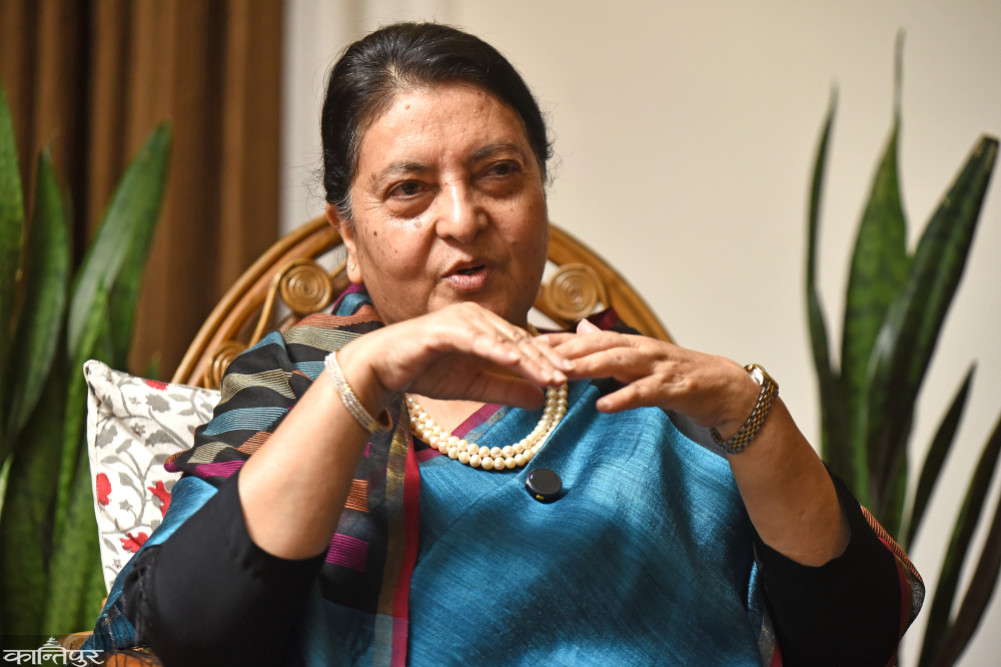
Party President Bidya Devi Bhandari created history by becoming the first woman President of the country. As much as she was in the limelight when she was elected president for the first time in 2072, she is still in the limelight. The country, which has made a leap from a traditional patriarchal monarchy to a republic, had a country-wide enthusiasm for having a woman as its second president. But the latest discussion is tinged with skepticism and concern. He
It has been seen that he is focusing his mind, words and actions towards party politics again. It is revealed from the interview given to Kantipur daily a few weeks ago that he is moving towards becoming active in UML again. The leaders/activists within the UML should reduce their own emphasis on his latest move. They have their own selfish ideas. But that situation does not seem natural to the sincere thinkers of the constitutional system. Rather, it disappoints many, especially in the light of the recent development of the republican system that is shifting to the left.
16 years have passed since the establishment of the republic in Nepal. Even though the current constitution has been issued by the Constituent Assembly, it is not long to reach the decade. The institution that came into existence as the most important product of the Republic is the 'President'. The development and maintenance of this nascent institution should be an important agenda for the advocates of the Republic. It is a matter of evaluation how much vision has been reached. In a democracy, no institution is absolutely powerful. They have their limits. Relatively all institutions exercise constitutional powers. Presidential institutions also have natural limits. But it is not a fictional organization as it is being discussed outside. It has been entrusted with intensive duties by the Constitution.
Article 61 of the Constitution assigns Nepal the duty of 'promoting national unity'. The prime duty of the President is to 'uphold and protect' the Constitution. The traditional powers of a non-executive president under a constitutional monarchy or parliamentary system (consulting, advising and informing) are inherent. It is expected to play a constructive role in building constitutionalism by stopping the abuse of executive and legislative powers, including law-making, ordinances, crises, impasses, pardons, dissolution of parliament, constitutional appointments, etc. The right to be consulted and to seek information can be seen reflected in Article 81. The President under this bill,
may ask for information on cabinet decisions, current affairs and foreign relations. The Prime Minister should give such information. Article 95 provides that the meeting of any house of the federal parliament or a joint meeting of both houses can be addressed. It is not a matter of reciting the policy and programs prepared by the government, but it seems that an opportunity has been created to give suggestions and advice to the government through a planned address.
Article 113 provides that if it is necessary to reconsider a bill other than money, it can be sent back to the relevant house with a message within fifteen days without verification. In such a bill sent back with a message, both houses should reconsider and send it in the same form or with amendments. The President does not have the right to stop the validation of the bill that has come back in that way. However, the objective of enhancing compliance with the Constitution in lawmaking through the judicious exercise of this right lies in it. Similarly, according to Article 114, before promulgating an ordinance on the recommendation of the Council of Ministers, it seems that one can have the necessary interest and concern about the proposed ordinance to be sure about the justification and necessity of the ordinance.
The duty of promoting national unity is no less important. This is not abstract. Not a hollow concept. Our society is diverse. There is linguistic, ethnic, religious, cultural, geographical and regional diversity. It seeks an inclusive, equitable and just unity of the country. Only such unity paves the way for lasting peace and prosperity. The slogan of national unity on the foundation of inequality, inequality and injustice proves futile. Whether promoting national unity or upholding and protecting the Constitution, it seeks an impartial and neutral role. Seeks dedication to constitutionalism.
seeks to end party oaths taken in the past and loyalty to such and such a party. Seeks equality and equanimity towards all. It seeks the role of making the government responsible for the problems faced by the country. The President's oath is to the Constitution. Loyalty is towards the country and the people. It is not possible to fulfill the duty of promoting national unity and observing and protecting the Constitution when it is mixed with it. This profound duty is possible only from a person who can deeply understand the sensibility, dignity, ooze and prestige of the presidency. Directly or indirectly running under the party, maintaining loyalty to the party, returning to party politics after the end of the term of the president.
It is not possible for someone who sees his future to play the role mentioned. But parties do not seem to be honest about it. It cannot be said that factors such as party political compatibility, convenience of power equation, and proximity to top leaders did not play a greater role in the selection of presidential candidates. There were acts of abusing the presidency to fulfill vested political interests, ignoring the dignity and dignity of the highest office, making unrestrained comments and dragging in controversy. Attempts were also made to make the post unnecessary feudal. Due to his own unusual actions and behavior, the presidency has been dragged into controversy in some respects. Failed to gain public and social legitimacy.
First President Dr. For Ramvaran Yadav there was naturally a lack of experience. At that time, there were more transitional challenges. He must have suffered the natural consequences of that. The 'vulnerability' was naturally more in the absence of presidential institutions. However, the way he works by forming a group of professional advisers and adopting a consultative approach to difficult issues should be considered positive. The second president had an opportunity to learn from the strengths and weaknesses of the first president's tenure and do better.
However, during Ramvaran's time, there was no control and balance exercise between the President and the Prime Minister. It is often commented that the President has limited himself to a mechanical and figurative role. After the cycle of dissolution of Parliament was judicially broken, the change in the power equation did not mean that the President did not play a constructive role. However, it was seen by many as an exercise of proportional-relative selective power rather than a constitutionally-expected role for the president. In terms of gender equality, the relevant messages given in the Citizenship Bill were ignored by the ruling party.
Stakeholders have also started evaluating the working style and performance of the current president. The President seems to have gained some ground due to his appreciation of the people's wishes on the retail issues (such as vehicle management). The fact that the Citizenship Bill, which had refused to be verified in the past, was verified in a specific context and environment has become a subject of criticism. Also, criticism is heard that his speech and behavior are more guided by the Congress-oriented attitude. In some questions (the subject of medical expenses) the speech is one thing and the behavior is another. He has the opportunity to learn from past mistakes and set an example by modifying his work style, habits, behavior and attitude. The quality of the advisory group also makes a big difference in this regard. Our leaders have a tendency to keep their favorite people and take their favorite advice. This tendency puts poor people at risk. It is expected to find a person who can objectively help to fulfill the constitutional responsibility by giving up his attachment to himself.
As the President is a person who is in contact with the exercise of executive and legislative power, the level of understanding of his constitution, his thinking, his lifestyle, whether he considers the interests of the country and the people to be paramount or not, how realistically he thinks, how well-thought-out and informed steps he takes are of special importance. are These things determine the height of his personality. That elevation has a subtle influence on other decision makers including the Prime Minister. The moral strength and courage of the President will be acquired by the tendency to rise above party politics and take steps with the welfare of the country and the people at the center.
Former President Bhandari's project of returning to party politics indicates the opposite progress. This causes cracks in the way the system settles. Such a trend does not promote democratic values. There are those who argue that the constitution does not prevent him from doing party politics. But how to read and understand the constitution has a great significance. The underlying values, principles and philosophy within the letters of the constitution are not visible only with the help of physical eyes. The help of the third eye should be taken. That is the eye of conscience. Until it is raised, constitutional morality cannot be found. There is a shortage of third eyes in politics everywhere now. In order to awaken it, one should be able to rise above party urges and prejudices, personal, factional political ambitions and selfishness. A kind of spiritual awareness and ability is required. It requires a holistic understanding of the Constitution and the ability to critically analyze the values and philosophies it espouses.
One should be able to think that the responsibility of upholding the dignity of the highest office remains unbroken and unbroken even when one is out of office. Constitutional morality does not allow a person who has been elected president twice to think and interpret that the way is open for him to come again through party politics to the position of parliamentarian, minister or prime minister. Failure to do so also undermines the validity of past decisions made as President. The public perception that they were not done freely and impartially, was somehow motivated by partisan urges and prejudices. Not only that, the president's decisions are more likely to be influenced by his future political ambitions or greed. The non-partisan, impartial and neutral role expected by the constitution does not become a situation. Despite playing a fair role, the public opinion is not formed accordingly. Therefore, it is necessary for former, current or presidential aspirants to take care that returning to party politics is prevented by the unspoken limits of the constitution and is not compatible with constitutional ethics. Again, if he has the ambition of party politics, such a person should not agree to the offer of such a position in the beginning. It is better to reject it.
Even established good practices around the world do not support the former president's partisan political journey. Pursuing exceptions in search of exceptions is not worth it. Therefore, it is appropriate for former President Bhandari to put an end to the reverse journey. The good faith of the leader/worker within the party will be in place. Based on that, the justification for returning to party politics cannot be established.
It is not even decent for a person who has carried the responsibility of the President to believe that doing anything that is not prohibited by the constitution and the law can be done. It is preferable to find a place for activism outside of party politics. Politics can be positively influenced from outside the party as well. There are many issues of discrimination, inequality and social injustice that have been marginalized at the political level. He is looking for a high personality. This is also the mainstream practice adopted worldwide. If there is a risk of violation of unspoken limits, then it is necessary to have clear limits, even if it is by amending the constitution. Judicial interpretation may also be another solution.