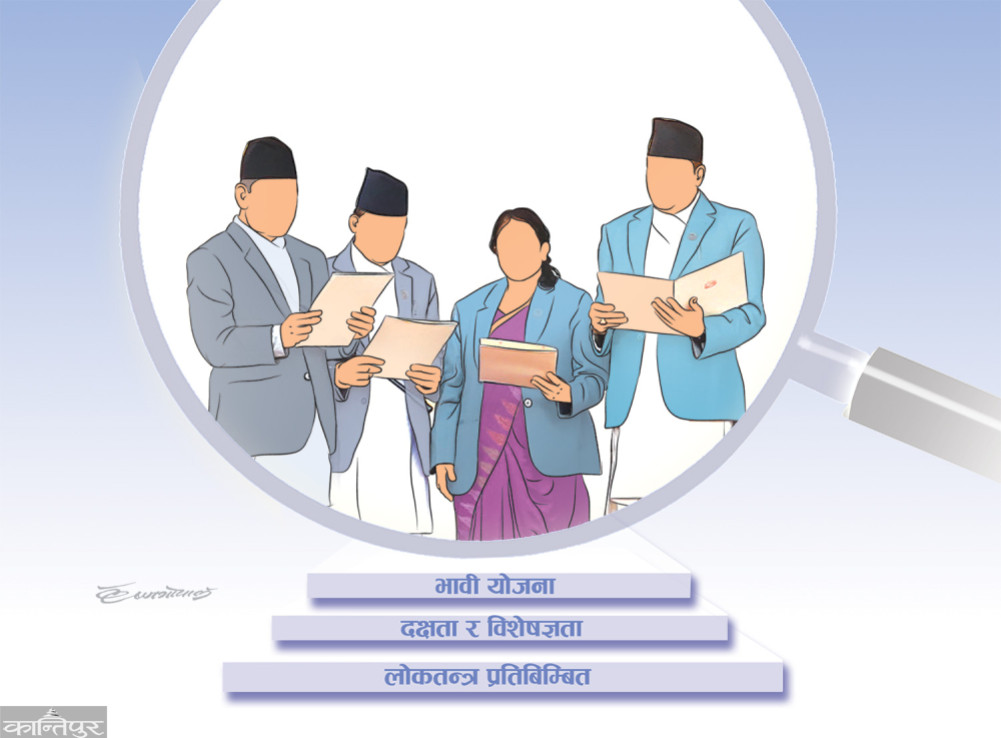
In order not to contaminate the politics further, the leadership should make appropriate criteria for the selection of ministers and should not delay its implementation.
We use Google Cloud Translation Services. Google requires we provide the following disclaimer relating to use of this service:
This service may contain translations powered by Google. Google disclaims all warranties related to the translations, expressed or implied, including any warranties of accuracy, reliability, and any implied warranties of merchantability, fitness for a particular purpose, and noninfringement.
Gandaki Province Physical Infrastructure Minister Rajeev Gurung alias Deepak Manang has been severely criticized for auctioning off official dignity after a picture of him in a semi-naked state in the office went viral on social media. He, who has been a minister for 6 times, has been criticized for drinking alcohol in the office and swearing at employees.
It is natural to be criticized after such actions without considering the minimum standard of official conduct. Moreover, it is not only a matter of criticism, but of action.
But, is the "minister dignity stripped" saved only by criticizing Manange or taking action against him? Isn't it the leader of the big party who gives ministerial positions to people from gangland Nike background repeatedly? Are they not responsible for respecting the dignity of the post like this? These questions have been raised at a time when the provincial governments are forming a grand new cabinet. MPs are in the running to become ministers. And, the leaders are busy producing 'goji-ministers'. State parliamentarians are scouring the top leader's corner in the hope of getting the 'Bhagyodaya Chittha' of the ministerial post. When the top leader is on the right, some people have also been lucky.
Prime Minister KP Sharma Oli took oath on June 30 and formed a 22-member cabinet in one fell swoop. In which most of the old ones won the 'ministerial lottery' while nine new faces proved to be lucky. After the two-party division, more and more people are lucky enough to become ministers in the state government. However, the practice adopted by Congress-UML in the selection of ministers will prove to be unfortunate for the country.
The center's interference in the formation of the state government continues. An example is the formation of Lumbini Provincial Government. In Lumbini, in favor of Prime Minister Oli and UML General Secretary Shankar Pokharel, deputy leader Chetnarayan Acharya was made Chief Minister in place of parliamentary party leader Leela Giri. UML led government in Lumbini and Congress led government in Wagmati. The formation of the cabinet in both the provinces was not without controversy. Vertical interference from the top leadership, internal disaffection and people with criminal backgrounds made it to the cabinet. A 14-member cabinet was formed under the leadership of Bahadur Singh Lama, the Congress leader, among the great people in Bagmati. While the number of ministries is only 13. Lama who divided the ministry for more ministers or kept it without departments has become corrupt. Unable to manage aspirants, Lama had to remove Prabhat Tamang, who was appointed as a minister, before the oath.
Congress is going to participate in the government after the allocation of four ministries in Koshi province. In Karnali province, the Council of Ministers has not been able to finalize the name of the minister. Although the Maoist ministers have resigned, Chief Minister Yamlal Kandel is waiting for the Congress list for cabinet expansion. In the Sudurpaschim Province, a new coalition government has not been formed because the Chief Minister Dilig Sodari (leader of NCPA S) has not resigned. He must either resign or take a vote of confidence by July 18. After that, there was an agreement to form a government under the leadership of the Congress. Congress has joined the government with four ministries including finance, continuing the leadership of the Janmat Party as the chief minister in Madhesh province.
When the number of ministers from the center to the state is increased, the question has been raised: Are these ministers qualified to handle their responsibilities? With the blessings of the top leader and being a minister in the name of faction management, can he overcome the disappointment and guarantee good governance? On what qualifications and criteria are ministers appointed? What should be the qualifications and criteria for appointment while forming an ideal cabinet? This column will focus on these questions raised in political circles.
Mind-blowing criteria
These questions have not only arisen between the Congress-UML now that the new cabinet is being formed. The question of qualifications and criteria for appointing ministers has been alive in Nepali politics for a long time. There are many examples of ministers being selected from the merits of a limited number of leaders, even though they claim to be selected on the basis of merit and contribution. Without going too far, it is clear that the ministers are not chosen based on their merit, but in the name of the interests of the top leaders and factional management. In the appointment of some ministers, there are invisible benefits and manipulation.
Also, the qualification to be a minister is determined by the Constitution of Nepal. According to the constitution, to be a minister, one must be a member of the House of Representatives or the National Assembly. The Prime Minister can appoint a person who is not a member of parliament of both these houses as a minister, but he has to become a member of the House of Representatives or the National Assembly after 6 months. Similarly, another criterion set by the constitution is that the person who becomes a minister must be mentally fit and not convicted of any criminal charges. After the party recommends a person with such qualifications, the way to become a minister opens.
But, are these qualifications enough for minister selection? Does forming a cabinet based on these limited criteria promote democratic character and values? Not at all. There is no room for complacency in the way ministerial selection is being practiced in the interests of factions and limited leaders.
Once upon a time, the entire cabinet was accountable to the king. After the advent of democracy in 2007, the Council of Ministers was formed based on the interim constitution. The said interim law had a provision to the extent that 'the ministers will not be asked in any court whether they have given any advice to the king, and if they have given any advice, what advice they have given'. From this it can be understood that the history of the formation of the cabinet in Nepal started from the background of control and supervision.
During the autocratic Panchayat period, it was customary to have ministers under the supervision of the king. After the restoration of democracy in 2046, a party government was formed. The Constitution of the Dominion of Nepal, 2047 made a provision for the king to appoint ministers from among the members of the parliament as needed on the recommendation of the prime minister. However, even in this period, the councils of ministers could not be people-oriented. Several ministers went to jail for corruption. The country did not get good governance due to jumbo-sized cabinet formation, unstable governments, power struggles between parties and palaces.
Even after another historic political change in 2063, the same old trend prevailed in the formation of the government. Power struggles, factions and nepotism. While fixing the limit on the number of ministers can be considered a positive change, the other trend inconsistencies remain the same. The parties claim, "Ministers are selected by collective decision by the committees within the party by setting certain criteria on the basis of certain qualifications." However, in reality, the method of selecting ministers is extremely undemocratic. Yesterday, ministers were chosen under the king's watch, today they are chosen on the recommendation of some party leaders. To some extent, it has become a tradition to give the responsibility of choosing a minister to a top leader at the party committee meeting. Ministers are chosen in the name of balancing factions and groups within the party. Top leaders make 'Ace Men' as Ministers according to their factions and interests. The next priority is family and relatives.
Let's look at the current cabinet led by Oli. Oli Sarvesarva was seen in the selection of UML ministers. Informally, he seems to have consulted with former President Vidya Bhandari. That too in the background of a group within the party trying to challenge Bhandari's leadership within the party, he may have taken Bhandari into 'confidence' in the selection of ministers. Perhaps this was the essence of his meaningful Bhandari-meeting after the appointment and swearing in of the Prime Minister. Otherwise, he single-handedly chose the minister.
On the other hand, the Congress claimed to have fixed four criteria for the selection of ministers. Contribution, merit, inclusiveness and territorial balance. However, in practice, Deuba remained focused on ensuring the political future of his own family and handed over the important foreign ministry to his controversial wife, Arju Deuba. By sending Prakashman Singh to the government, he paved the way for him to be elected as the chairman in the fourteenth Congress. On the issue of
inclusiveness, Congress-UML made a mockery of it. Therefore, the Oli government, which is known as the cabinet without Dalits, will be asked later, Sharadsingh Bhandari became a minister for the twentieth time in the cabinet without Jeevan Pariyar. Did Bhandari do something memorable when he was a minister 19 times earlier, which gave him the basis to get that opportunity for the 20th time? Those close to him claim, "He has the ability to make financial investments for getting positions, to manage and 'manipulate' the leadership." This and similar abilities are becoming the main basis of ministerial criteria. As these bases become stronger, not only half-naked type ministers will dominate, politics will become more naked. In order not to further contaminate politics, the leadership should not delay the implementation of appropriate criteria for the selection of ministers.
Four formulas of reform
The coalition in the federal government changed four times during one and a half years. The cabinet was expanded dozens of times. The government changed at least two dozen times in all the seven provinces. Meanwhile, hundreds of ministers have been appointed in the union and state, but there is no attraction towards the minister at the public level. Some ministers don't even care about their names.
He has not been able to leave a distinct impression by going to the government. What kind of person got the opportunity before questioning that the minister could not do anything? It is necessary to ponder over the question. The parties are trying to set the criteria by deciding the characters. While making this system people-oriented by strengthening democracy and giving good governance in such a way that the people feel it, the criteria for selecting ministers should be made first.
Some reasonable grounds for ministerial selection may be:
First , there is a practice of practicing shadow government in parliamentary democracy. If the opposition party practices a shadow cabinet, then in a way the struggle over who will be the minister will end. The shadow minister can focus on closely monitoring the work done by the government in the relevant ministry, getting regular updates, asking questions when it cannot be done, finding errors, making future plans for the work to be done when he goes to the government, etc. At least if this can be done, it will help to build qualified political manpower with subject knowledge.
Second , the ministry should be run by a person with thematic competence and expertise. Therefore, when sending to the government or forming a shadow government, the parties should give priority to leaders who are well versed in the subject matter of the ministry. It should not be based on which leader is closer to which group, but based on the knowledge and ability to carry responsibility.
Third , democracy should be reflected in the Council of Ministers. This is an inclusive democracy. When a government is built, its character must be inclusive. Regional, gender, ethnic representation should be ensured in the cabinet.
Fourth , the ministers who ensure good governance to the people should be clean. A standard should be made so that a person who is not involved in corruption or any other moral conduct, who leads a transparent lifestyle, and who has a democratic character, goes to the Council of Ministers. In some countries, there is a practice of appointing ministers after the approval of the parliamentary committee. In our case also, when recommending for a minister within the party, arrangements can be made to approve the proposed name through the Disciplinary Commission or some other mechanism. At the end of the
,
It is necessary to create a 'ministerial code of conduct' that can specify the behavior and working style of the minister. In order to build good governance and good political culture, those who hold public office should be able to demonstrate high level of dignity and ability. Such a code of conduct would help hold ministers accountable.
Prime Ministers/Chief Ministers who are responsible for holding their ministers accountable should take note of this. No, if such capricious practice of ministerial selection is to be continued, the erosion of ministerial dignity of Gandaki province will be repeated elsewhere.