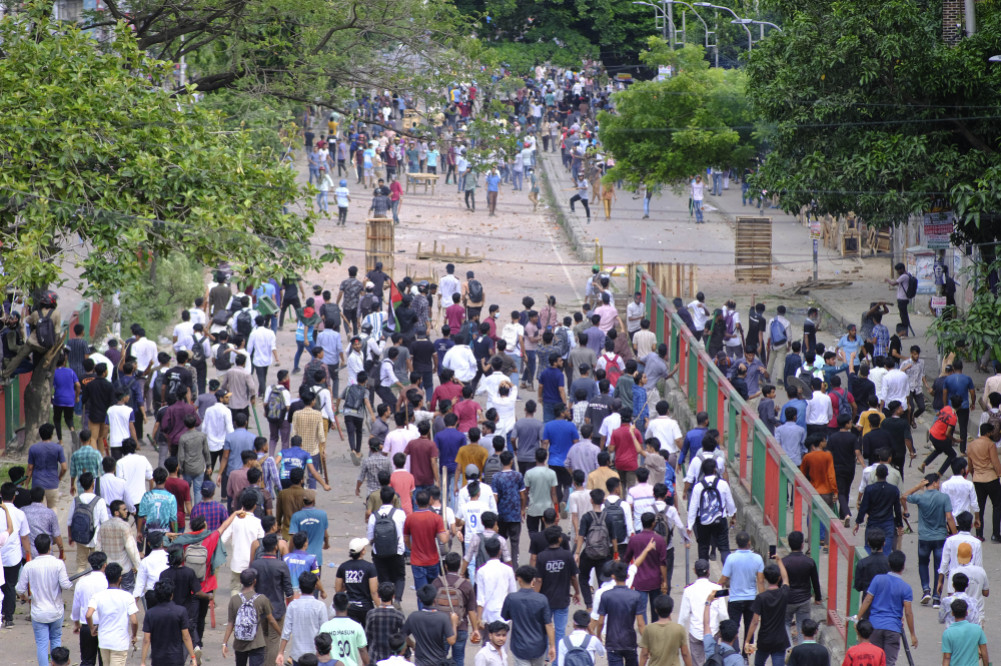
The demonstration is expected to calm down after the Supreme Court order. If that happens, life will return to normal within a few days. Otherwise, the performance may become worse. Amidst the uncertainty of what will happen in the future, the safety of the Nepalese, especially the students, has become a sensitive issue.
We use Google Cloud Translation Services. Google requires we provide the following disclaimer relating to use of this service:
This service may contain translations powered by Google. Google disclaims all warranties related to the translations, expressed or implied, including any warranties of accuracy, reliability, and any implied warranties of merchantability, fitness for a particular purpose, and noninfringement.
Bangladesh is currently in turmoil. Protests started by students of universities and campuses against the special reservation in government services for the children of people who participated in the freedom movement there have turned violent and have led to crisis in many places. There is a curfew across the country.
Telephone and internet services have been shut down. More than 150 people have died during the protests. On Sunday, the Supreme Court overturned the reservation system for most of the government jobs. The protest is expected to calm down after the Supreme Court order. If that happens, life will return to normal within a few days. Otherwise, the performance may become worse. Amidst the uncertainty of what will happen in the future, the safety of the Nepalese, especially the students, has become a sensitive issue.
Bangladesh is considered an attractive destination for Nepali students who want to study medical science. According to the Nepali Embassy, 2400 students are studying the same subject in Bangladesh. Overall, there are more than 3 thousand students. Nepali students are returning home after the movement turned violent. By Sunday, about one-third of the students studying there have returned home by air and foot. Some students have also entered the Indian soil. But still most of the students are there. The government needs to be serious about their security.
The Ministry of Foreign Affairs has said that the government is aware of ensuring the safety and welfare of all students studying in Bangladesh and Nepali students are safe so far. But the issue of security should not be determined by the government's claims, but by the students' constant feelings. There is a situation where communication between students and parents has been cut off as telephone and internet services have been shut down. In such a situation, even if the student is safe, it increases the anxiety of the parents. The letter submitted by the parents of the students to Prime Minister KP Sharma Oli on Saturday makes it clear. Not all parents can come to meet the Prime Minister and give letters. Therefore, the government should become a parent and understand the situation.
It is not certain when such performances change their rhythm. A situation that is already becoming violent may become more complicated in the future. Places that are considered safe now may become unsafe later. Services currently being received may be interrupted later. The current contact may break later. Therefore, the government needs to make effective preparations for the safety and rescue of Nepali students for complex situations. It is important to keep your systems agile.
It is also important for students to keep their situation updated with government agencies and parents through all possible means. The Ministry of Foreign Affairs has published a link and a number for direct contact asking for the necessary information, support and facilitation for Nepalese students who are in trouble and their parents and relatives. It can be used.
The government needs to show the role of the students who have been able to join the contact or not according to their needs. That is, if they say they are safe there and their parents feel that, they can be facilitated to stay there. If they want to go back to their country and their parents want the same, then the return should be facilitated. We should not forget the fact that a larger number are still in Bangladesh than those returning home.
Even though Nepali students can be silent towards the ongoing demonstration there, they should not play an active role or take the initiative to participate in the demonstration itself. Because such activities create security challenges not only for the concerned students but also for other students. There is another point to be debated here. The reservation system adopted by Bangladesh may have its own unique historical reasons.
Since Nepal has also adopted the reservation system for the last few years, it is necessary to seriously observe the demonstrations taking place there. Although the reasons are different, dissatisfaction with the reservation system adopted in Nepal is being expressed in a latent and unorganized manner. Even though this system has benefited the respective community, there is dissatisfaction that certain people in the higher status within that community continue to benefit in their professional field.
On the other hand, there are references where limited individuals from the formerly dominant community are also gaining ground to benefit. Such resentment is not unfounded given the political opportunities some people are taking. Therefore, it is necessary to find ways to benefit the reservation system and make it more prosperous, not only to the concerned community, but also to the target class.