We use Google Cloud Translation Services. Google requires we provide the following disclaimer relating to use of this service:
This service may contain translations powered by Google. Google disclaims all warranties related to the translations, expressed or implied, including any warranties of accuracy, reliability, and any implied warranties of merchantability, fitness for a particular purpose, and noninfringement.
The problem that most of the settlements in the hilly areas are facing is the lack of drinking water. Many families are far from access to clean drinking water even during summer. Even springs dry up during dry season. We have to go through the difficulties of how to use water for cooking and drinking, and irrigation for crops has become something else. Farming is becoming dependent on rainwater.
One of the main reasons for the ever-increasing migration rate in the hilly areas is the scarcity of water. While the water shortage is having a negative impact on the social, economic and demographic conditions of the hilly areas, not enough attention has been paid to resource conservation, nor have reasonable initiatives been taken to make the available water accessible to the maximum number of citizens.
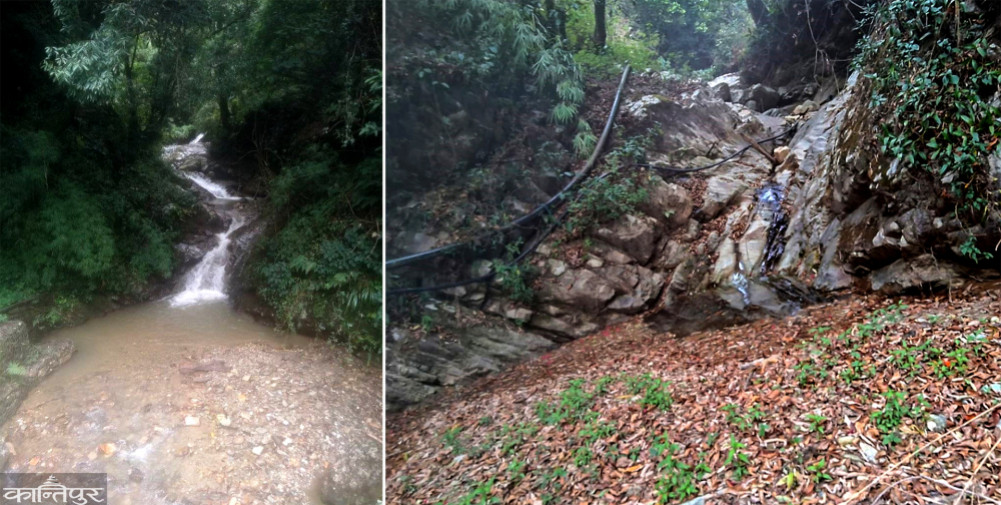
Global temperature is rising as a result of climate change. The snowfall in the Himalayan region is decreasing. Water sources are also drying up. The style of development and construction is also increasing the rate of drying up of water resources. The rampant construction of infrastructure including roads has increased recently. During the construction of the road itself, the underground water channel can be disturbed, machines such as excavators are run on it. In some areas, the earthquake has dried up water sources. Due to lack of water, the productivity in the agricultural sector is decreasing. This year the winter has become even drier. Even after that, it did not rain enough to break the water source. Therefore, there is an acute shortage of drinking water in many areas. The compulsion to run for hours to fetch drinking water, and to wait in line to get water. There is no way to even think about whether the water that is brought in is clean or not. Having to fight for drinking water, they could not pay attention to sanitation. This has increased the risk of causing health problems. Amid the acute water crisis, uncontrolled exploitation of groundwater has also increased. In some places, drinking water has become the cause of conflict between families and villages.
Many settlements have been thinned due to migration due to lack of water. According to the National Census 2078, the population growth rate of 34 districts is negative, most of them are in the districts facing water crisis. There were 27 districts with negative population growth rate in 2068 census. Water supply projects have not been implemented in various areas with the aim of reducing the migration rate. But none of those projects have been repaired after damage, the water source for some projects has dried up. For example, a water supply project costing 300 million rupees was conducted to supply water to the residents of Bharpa in Panchthar. But after 12 years, the source of the project dried up. Now the locals are facing an extreme crisis of drinking water.
Hundreds of water supply projects are under construction all over the country, but sometimes the work is slow, sometimes it is stuck due to lack of financial resources. Due to disputes or financial irregularities in any project, the work could not proceed. In some villages, drinking water facility has been provided to the village even by drawing water from the river through complex technology. But when there are problems like electricity not being regular, machine breaking down, water supply is stopped. As electricity is consumed, such a project is also expensive. Despite the supply of drinking water, people are being forced to migrate after the fields become barren. Experts have pointed out that the main reason for the recent increase in forest fires is the decline in agriculture and the accumulation of dry wood, apples, and saplings. Fires in dry areas are equally difficult to control.
We have limited options to solve the growing problem of water scarcity. Dandapakha is becoming impossible in terms of cost to supply water to isolated houses. Water supply arrangements should be provided as soon as possible through water supply projects in the settlements where possible. The projects under construction should be accelerated. Abandoned projects should also be operated by managing financial resources and maintaining them. Migration to areas without irrigation facilities cannot be stopped even during drought. However, if the water source is properly conserved, the dried roots can become juicy. For this purpose, new ponds should be built in places to collect rainwater, and dry ponds should be restored. The tendency to dig the ground randomly by using big machines should be controlled.