We use Google Cloud Translation Services. Google requires we provide the following disclaimer relating to use of this service:
This service may contain translations powered by Google. Google disclaims all warranties related to the translations, expressed or implied, including any warranties of accuracy, reliability, and any implied warranties of merchantability, fitness for a particular purpose, and noninfringement.
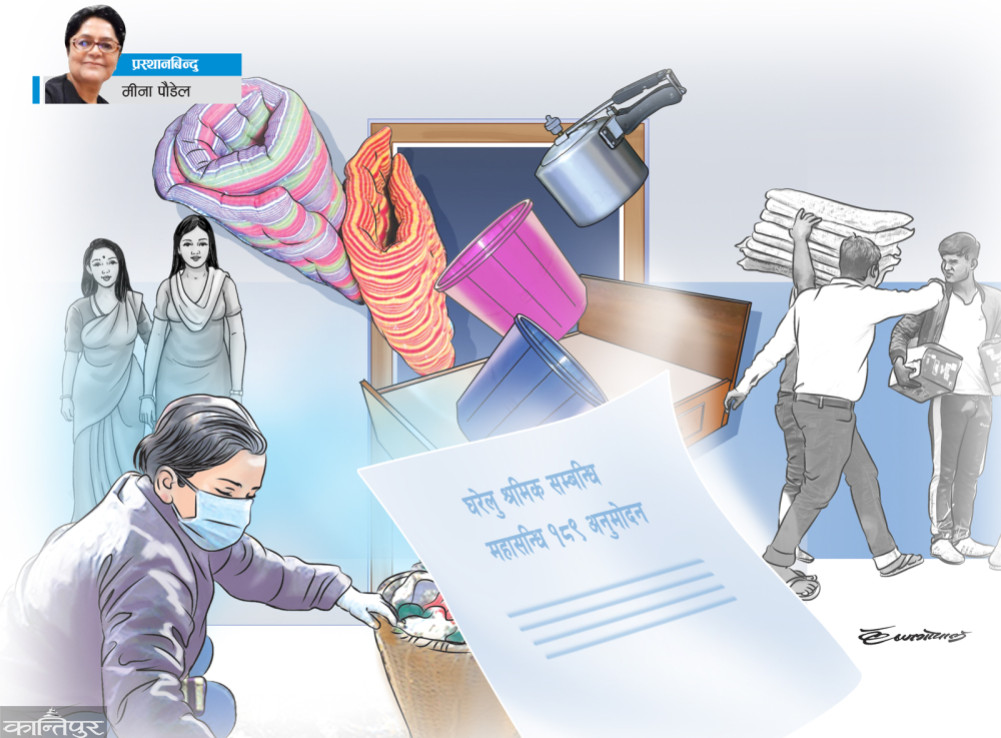
As defined by United Nations Labor Organization Convention 189, domestic workers are workers who are hired to perform work within the employer's home under a labor contract. The need for such workers ranges from neighborhood, national labor market to international labor market.
Domestic workers' sphere of labor is primarily private households rather than the public labor market. The family that provides employment is the employer of that worker. The nature of domestic workers' work is domestic labour. Such as: cleaning the house, caring for children, the sick, the disabled and the elderly, purely family work such as cooking.
According to the latest United Nations data, the estimated number of domestic workers is around 70 million worldwide, of which more than 80 percent are female domestic workers. A detailed analysis of the estimated data shows that 1 out of every 5 female domestic workers is a female migrant worker. According to the latest statistics, Asia and Asia Pacific geographies have employed the highest number of domestic workers. Gulf countries are also the main destinations of domestic workers. Next comes North and South America, while Europe, Russia and Central Asia are among the geographies that have few domestic workers. This data is only for workers above 15 years of age. Children who are younger than that are also workers, who are not counted anywhere. Not only in Nepal, but especially in most societies in Asia and Africa, there are many examples of children being forced into hazardous labor. Our social, cultural and economic strata are everywhere where these uncounted children should be forced to work.
This data covers only 155 countries. What the report admits is that this data itself is not geographically and mathematically complete, it is only approximate. Because it is said that it was not possible to collect the data of some countries that send domestic workers and provide employment due to conflicts and political and diplomatic reasons. Another important reason is that domestic workers are not recognized by their own or destination labor markets, as this work is done within private homes, is highly informal in nature, and is not easily accounted for or accounted for in the broader labor market. Amidst this complex challenge, the amount of data collected and the status of domestic workers assessed is significant in itself. Which helps to set a policy framework to protect workers and make labor dignified and dignified. The reason for not being able to get complete data may be related to society. Gender and socio-cultural aspects may be factors in it. Thus, if we delve into the reason why the number of women in domestic workers is more, it becomes clear that the view of understanding and viewing domestic labor is built on the social structure. Just as the man who is called the housekeeper – the managing member of the household – basically does not account for women's domestic labor and women themselves are reluctant to call their labor labour. Just like that
State mechanisms of origin and destination, policy makers are reluctant to recognize domestic workers as workers. For example, even in Kathmandu, the tradition of bringing low-income marginalized children from villages to teach them can be taken as housekeepers and children's dharalo. It should not be explained that this is a structural difference between the labor market, the labor producing society and the consuming society.
Complicated and unsafe labor
Based on the study and experience of workers, the situation of domestic workers who are an important part of internal and external labor migration is found to be complex and different from other workers. Socio-cultural aspects may be the main factor in this. Another reason is that it is dominated by female workers, and not another public market, but a workplace inside a private home. As women, according to the unequal gender roles set by the society, the work they do at home is the same work they do for the employer's family. Because the work done in their home is not respected as formal labor, it is not considered as dignified, it is not counted, it is not considered as skillful work, so the domestic workers started to be treated normally in the labor market. However, doing the same work at someone else's house earns wages. However, there is also a difference in wages compared to other labor. Due to the limited labor and workers within the home, the state's responsibility is not visible. Left to the individual responsibility of the householder, there is a lack of social justice, legal protection and access to information networks. Exploitation and discrimination are high and sexual exploitation is also common when most of the domestic workers are women. The responsibility of domestic labor is not only on female workers, male workers are also employed as domestic workers, especially in Gulf countries. According to the latest data, the number of male domestic workers is only 0.9 percent and about a quarter of this number, about 23 percent, is consumed in the Gulf labor market.
studies have projected that the demand for external domestic workers is increasing in Latin America, including the Gulf, East Asia, Brazil, and Argentina. Those countries are moving towards upper middle income with economic prosperity. The demand for foreign domestic workers has increased due to the changing lifestyles of the citizens there, the growing senior citizen population and the services they need, and the increasing access of local women to the external labor market. This sequence will become more intense in the next decade. Some internal and mostly external migrant workers will be the ones to fulfill such demand. Analyzing the class and gender character of migration, there are more women from the lower class who have lost their chances in their homeland due to socio-cultural and economic marginalization.
The situation in their own society or family is no less complicated for those who are forced to go into domestic labor. The situation of those who come to Kathmandu and Sahariya labor market from difficult geography and do domestic labor is found to be different in our villages. Domestic laborers traveling to India and other destination countries, including the Gulf, are mostly taken through informal channels, so they are neither included in the state statistics nor within the framework of legal protection. It is a well-known fact that the foreign employment trend of Nepal is that the restrictions imposed on domestic workers under one or the other pretext are forcing people to go to domestic labor and there are human traffickers and trafficking networks.
An opportunity to make it safe and dignified. Through a long and complicated diplomatic process, the United Nations adopted Convention 189 (colloquially ILO C 189) on domestic labor in 2011. It is considered as a milestone in making domestic labor dignified, safe and dignified.
When the United Nations members passed Article 189 of this convention, stakeholders including organizations and networks of migrant workers who have been campaigning for the rights of domestic workers for decades expressed a level of satisfaction. Because ILO C 189 included domestic labor within the definition of labor for the first time. Domestic labor was defined as dignified labor, with the status of domestic workers enjoying the same labor rights as other workers. This is a very big achievement in the context of labor and also in the case of internal and external migrant women workers. As important as world-class blueprints are to organize domestic policy frameworks, to convey awareness of rights to citizens and to ensure social justice, they are fluid and loose if the countries that support them do not approve and implement them for the sake of the safety, respect and dignity of the concerned communities.
The state is not sensitive to the issue of most of the women workers who are from the lower class, marginalized and discriminated against, who have to wander for a living. This is also confirmed in the context of the Domestic Workers Convention 189. Because in the document passed by the organization of which it is a member about a decade and a half ago, only 37 countries have ratified it. Even in Asia, only the Philippines has approved it. The Philippines ratified the Domestic Workers Convention 189 in 2012 and updated the domestic blueprint to some extent. Sends its domestic workers to the internal and external labor market by making them skilled, skilled and aware of their rights. Therefore, in the global labor market, Filipino domestic workers do not suffer the same discrimination as other countries. It has been found that even when the Philippines enters into a labor agreement with the destination country, it is comparatively less differentiated in terms of wages and other facilities.
Nepal is a narrow country regarding domestic workers. Which has taken unstable strategies like restricting and opening up women domestic workers sometimes citing the age limit and sometimes the law of destination. Therefore, it is necessary for Nepal to ratify the Domestic Workers Convention 189. On the one hand, we have not developed a national approach to labor migration and on the other hand, we are not in a position to make practical decisions about domestic workers. Therefore, if we are not able to manage domestic workers, we will force the class and community into the network of human trafficking and trafficking by applying the ban strategy. We have not been able to revise and renew other labor contracts for years as we are unable to withstand the pressure of the demand of domestic workers. Kuwait, Saudi Arabia are the earlier examples, while Malaysia and Qatar are more recent examples, to understand the indifference seen in our labor migration management.
Despite this, Nepal should not delay in ratifying the Domestic Workers Convention 189 in order to protect those who want to and are forced to do domestic labor, to make labor dignified and dignified. The longer we delay, the weaker we are in managing labor migration. Because the destination countries take the workers they need and want in any way, and when there are no opportunities in the home country, the workers are forced to go anyway (through informal routes, smuggling and human trafficking networks). Now, it is more challenging to make regular labor contracts with Malaysia, Saudi, Qatar etc. in a timely manner. Therefore, only by sitting at the negotiating table after proper preparation and approving the relevant criteria, both confidence and strategy to address potential complications will be positive. There is no need to hide the weakness, we are weak in overall diplomacy and have not even developed the concept of labor diplomacy. In this situation, how can our workers get justice in the differential global labor market? Let's not talk about domestic workers, it is a challenge to even count them.
Urgent Ratification Matters
The Domestic Workers Convention 189 is a world-first draft, but it has some weaknesses. But there are some major reasons for a country like ours, which should be approved immediately.
1. The current situation of informal, unrestricted, unsafe and exploitative domestic labor should be included in the formal policy framework and established as safe, dignified and dignified labour.
2. Crimes like human trafficking and trafficking, child labor should be tackled in an effective manner to eradicate them.
3. According to the relevant experiences of the Philippines, Brazil, and South Africa, the challenges of gender discrimination, sexual violence, and other issues within mass labor migration should be addressed in an integrated manner.
4. In order to address the increasing demand of domestic labor on Nepal in a fair manner, timely labor contracts should be facilitated with the labor market of major destinations such as Malaysia, Qatar and Saudi but complex societies.
5. Fairness regarding the selection of foreign employment professionals who facilitate the sending of domestic workers should be monitored and brought into the scope of action.
6. Not only those who are going to do domestic labor in foreign employment, but also those who are domestic workers in the country should be practically included in the social security framework to guarantee the rights set by the labor policy.
7. Domestic workers should be guaranteed equal wages, social security, insurance, contracts. A positive climate must be created for workplace and labor rights, including access to the formal justice system.
Nepal needs to ratify Convention on Domestic Workers 189 without delay. We must not miss the opportunity to lead a welfare nation from the point of view of safety, dignity and respect of domestic workers.