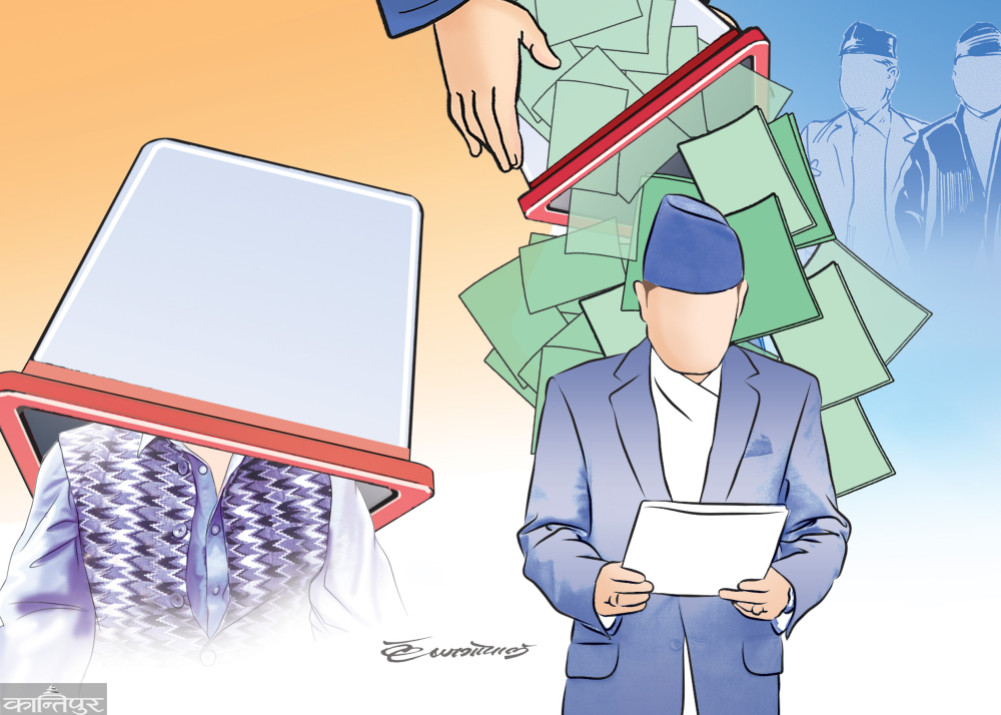
After achieving 100 percent success in the by-elections, will UML stand up to make a fair Goreto a popular way? How successful will the emerging winner Suhang be in making himself the symbol of all minorities, tribals and backward communities?
We use Google Cloud Translation Services. Google requires we provide the following disclaimer relating to use of this service:
This service may contain translations powered by Google. Google disclaims all warranties related to the translations, expressed or implied, including any warranties of accuracy, reliability, and any implied warranties of merchantability, fitness for a particular purpose, and noninfringement.
It's a matter of time. He was a wise man. This story is not about that wise man, it is about that time. In which the wise man remained silent and became wise. A wise man died a century old and the time when he somehow lived was called the Golden Age.'
This short story is written by Kamaljit Choudhary and is titled 'That Time Story'. To be a worker of a political party today is to deprive oneself of logic and facts. Narratives based on party devotion or party fanaticism cannot be held accountable by the test of facts. When someone says that 'this is what I believe' then the matter ends there. There is no point in arguing. A worker who is critical of another party prefers to keep conscience hostage within his own party, because in that he finds an atmosphere of encouragement and prosperity.
The main question of today's Nepal is - after achieving 100 percent success in the by-elections, will the UML stand up to make the just Goreto the way of the people? Does the emerging winner Suhang Nemwang want to make himself a symbol of all those minorities, tribals, backward communities? If so, he should support their struggles, dreams and prospects, who are trying to achieve equal status as citizens. Instead of the politics of appeasement, he crushes those who are on the path of strong federalism and meaningful inclusion? Is there an atmosphere within UML that is serious about the basic demands of the identity struggle and is friendly to the transfer of leadership to the new generation? And what legacy did this by-election carry on the shoulders of UML? No matter how much mridanga is played about the victory in the by-elections, these factors will determine the state and direction of politics in the coming time. Even though a large number of intellectuals are trying to predict the future of the left wing, the wheels of politics are likely to fall on this ground.
Three elections were held a year ago, now they were held in two places. It is a natural process to hold elections in vacant constituencies. But when such an election occurs, the debate gets its direction from the local and national contexts of the time. The results are discussed in a multi-faceted way, letters of message are sent. In Nepali politics, there have been many attempts to write tributes for UML-Congress, but every time he has been defiant with his typical carelessness. These two old parties have their Gods, and their sins to wash away. These should be assessed against self-defined standards and commitments to change.
Identity politics is not just an emotional issue, the personality and background of the leader plays a lot. Identity remains an element in politics, its presence cannot be denied, it will continue. As much as identity politics has flourished, it has also been shrinking. There is also a place to question the poison that makes the identityist movement successful in electoral politics. What identitarians need to understand is not to go for ideals that cannot be put into practice. They should try to do what is extremely doable, what is possible. The issue of
identity may arise more intensively in the days to come, but it must be resolved in a political way. One thing is that identity politics does not always spring up like wildfire. To climb the ladder of success in electoral politics, one should be able to climb the prescribed discipline. It should be managed properly. In democracy, the identity element is also a dimensioning element of politics, there is no denying it. If reliable leadership and reliable organization can be built, identityist politics can have a sustainable future in the hills. The identitarians have not bowed their heads.
Constitution is being attacked. The constitution is still under trial. The test of the constitution is not over. Meanwhile, the idea that a 'liberal dictator' is necessary among the elites of Kathmandu has increased with cheers. But public opinion is not tested by such meetings. Regressive philanthropy can't be popular. In the frenzy of victory, inclusive narrative and space production are equally important. Much work has been done to document the history of contemporary people's movements in Nepal. After forty-six years of the people's struggle, those who saw-suffered-participated and recited their own accounts are still alive among us. People's movements start with dreams that change the future. Input becomes more attractive.
This has always been the case – unlimited power corrupts exclusively. People's warriors of yesterday are not aware of this after they come to power. Even after the people's movement, if the leaders of the people's organizations do not see the dream of bringing about improvement, upliftment, and voluntary control over the individual, it will fall into the ditch. The basic premise is to follow the question of means and ends, to use holy means for welfare. It is an opportunity to practice new relationships from old ones. The simple meaning of the implementation period of the new constitution is to encourage the social contract according to the new law.
The leadership's ambitions have played a role in the parties that have struggled in the past or who want to sell their brand of coolers in the current heated political climate. For a democratic system, the disparity between words and actions should be a matter of concern. But today there is a place to ask this question - when will policy become the basis of our politics? It is also necessary to ask the question, when will opportunism be considered a crime in politics? In its long-term continuity the myth assumes an independent existence and this existence is nothing more than the collective imagination of the citizens. A myth has been created about UML and Congress that they are the two wheels of electoral politics anyway. This myth has a deep impact on the common people. Even today, in remote rural areas, some of the third generation are found, who are involved in or close to the politics of social justice. But the first or second generation of the same family is proud to have signed with the left or democratic forces. It is this adoption that helps these parties produce miracles at the ballot box.
The new emerging powers are not well organized, nor are the resources abundant. But they are not able to explain the concept of social justice. What process can be appropriate and effective for social justice? What is the politics of social justice and how? Is a new vision of equality sought or is a community specifically targeted to create an atmosphere of insecurity and humiliation? Is equality of reward sought or equality of opportunity? The need now is to address the current insecurities in various sections of society so as to minimize future potential conflicts.
Identity politics made stories of hopes brutally trampled in the past, shining a glimmer of hope in the darkness of collective despair. Understanding the identity struggle of the hills is necessary for many reasons to understand Madhesi politics, and in a way the reverse is equally true. Both of these broke the dominance of certain upper castes in politics to a certain extent. The pyramidal position of caste structure in electoral politics has now been reversed. What would have been the result if UML had picked another non-tribal candidate instead of Suhang Nembang? Not hard to guess.
This time, a glimpse of 'Suwas style of politics' was seen in Eelam. That was the beauty of getting along with everyone, attacking the other party in a non-aggressive way, echoing the soft identity. Suhang shouldn't jump too much now.
The UML he is affiliated with is like a businessman in the matter of destroying the utility of the individual. Let's look at the recent past, Rampreet Paswan was pushed ahead in the first presidential election but when there was a favorable opportunity to win, no one remembered him. Bidya Devi gave two chances to Bhandari. Had Subas Nembang been given a second chance, he could have realized his dream of reaching the highest position of the tribal community.
After the by-elections, the clamor for constitutional amendment has started again. A mixed electoral system is being interpreted as a result of political instability. The first political condition for a multiracial society is to devise such a constitutional structure to ensure appropriate and equitable representation in the state structure. Where different cultures, castes, linguistics and socio-cultural groups can minimally partner in the state, is currently being overshadowed. Concerns like proportional representation, sharing of state power, addressing linguistic plurality, affirmative action and federalism are being organized.
Elam's by-elections have shown confidence in the paths drawn by this constitution. Manas who are active against the system by causing nuisance have been rejected by the ballot box. People's faith in democracy cannot be shaken by jokes. While writing these things, it would be hard for the people on the ground to be more riotous, because the UML or the Congress have made themselves synonymous with the status quo. Their importance will increase and the interesting game of power coalition that is being formed and destroyed will continue uninterrupted.