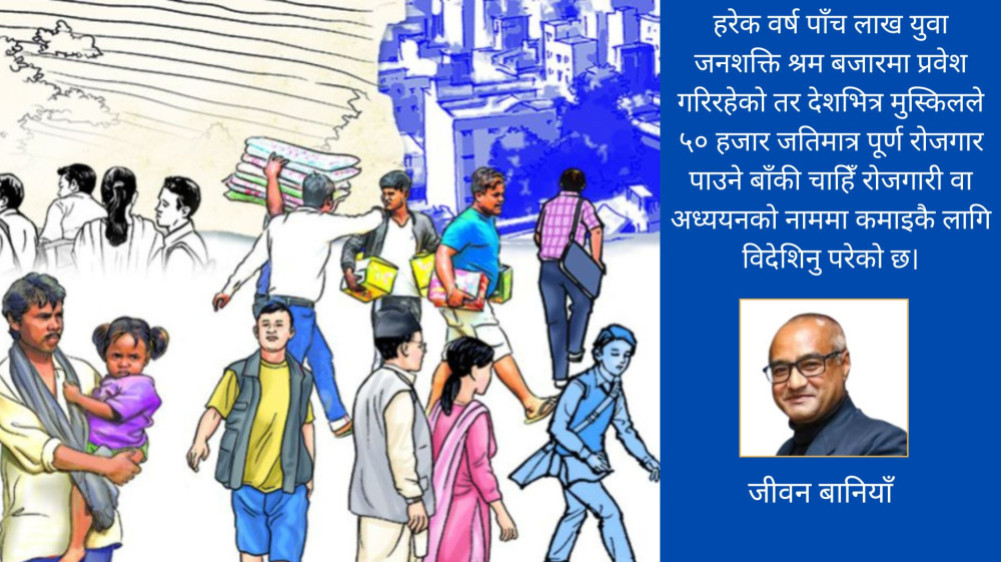
It is a bitter reality that 500,000 young people are entering the labor market every year, but only 50,000 can get full employment within the country, and the rest have to go abroad to earn money in the name of employment or study.
We use Google Cloud Translation Services. Google requires we provide the following disclaimer relating to use of this service:
This service may contain translations powered by Google. Google disclaims all warranties related to the translations, expressed or implied, including any warranties of accuracy, reliability, and any implied warranties of merchantability, fitness for a particular purpose, and noninfringement.
- 'Billions were spent on village development and roads were pitched, but this road has been used for villagers to go abroad or migrate to the city.'-'Our citizens are told that social development is not development without the construction of physical infrastructure. We have done considerable work in the field of education, but they are not counted in development.'
The above are the two statements expressed by the heads of two municipalities in West Nepal in recent months in their interaction with this columnist, which can be understood as a symbolic example of the gap between the priority of development and the migration from Nepal to abroad to a large extent.
Historically, it has become a fact that there is an interdependent relationship between migration and social development. Even in the case of Nepal, migration would not be a new thing . According to the recent national census 2078, about 5 lakh households are vacant. The population growth rate of other districts of the country is negative. Migration is a major reason for this . In recent years, due to the low birth rate in South Korea, enrollment rates in kindergartens, schools, and universities have drastically decreased, either closing down or merging into one another.
Similarly, the condition of schools in most rural areas of Nepal has also increased rapidly due to migration. Annually, about one million young people are going to work in countries including the Gulf, Malaysia and India. Similarly, millions of people are going to the so-called developed countries with high income as students with large investments but mainly with dreams of employment and a golden future and aspirations for permanent residence.
Civil servants, doctors, nurses, engineers, pilots and lab technicians are also going to the UK, America and Canada, Australia, New Zealand, UAE, Qatar, Maldives and other countries in the number of thousands every year.
The doctors and engineers who have been invested by the state for years and studied by investing crores themselves have also gone abroad . The reports of Rashtra Bank have shown that a large amount of foreign currency has been withdrawn from Nepal for the purpose of study. On the other hand, young people who have high income and savings from other countries like South Korea are also eager to go abroad after investing heavily in countries like Europe, Australia, America and Canada, but they are not excited to do self (employment) in the country. That's why the commentary of manpower and capital flight is getting stronger in the public circle.
Of course, no one wants to go abroad. In different times and circumstances, various people migrate due to their own circumstances, desires and reasons including economic, political and climate change, which have positive and negative effects on the condition of individuals, families, society and the country. The summaries of various studies in Nepal have shown that economic reasons are the main factor of foreign employment.
The wishes of improvement of people's livelihood and family happiness have turned into reality through migration, while for some it has not been so beneficial or it has become a curse. Annually, more than 1,300 Nepalese youths have died in connection with foreign employment, while hundreds of them have been injured and have health problems. As a result of
, dependent families have to face financial and mental problems for a long time, and it is clear that this will increase the burden of social security for the state. There are other negative aspects of being imprisoned abroad, missing and psychosocial and suicide and family breakdown.
Compared to the past, most of the country's rural areas are connected by roads and communication networks, and services such as education, health and drinking water have also expanded. The economy is changing from subsistence agriculture to modern industry and services. But some business Although they are involved in farming, most of the young generation are not attracted to agriculture . Manufacturing, Product Trading And job creation in the field of transportation and the price of labor has also increased a little. However, opportunities for good and high income are limited. Job creation from industries and factories is not encouraging. But those job opportunities are concentrated in the informal sector or in areas with low productivity, so there are more challenges in accessing those opportunities, especially for women, due to geographic conditions and other social and gender norms. They are engaged in unpaid household work or agriculture.
The situation of the labor market and labor administration within the country is not encouraging. 17 thousand 300 minimum monthly salary is insufficient for the family, let alone the informal sector, even in some establishments in the formal sector, the minimum salary and social security have not been implemented nor has the state been able to guarantee it. There is a wage gap between women and men. Therefore, in some industries and sectors, the initiative to employ workers from neighboring countries has been encouraged.
Similarly, nurses and engineers who have studied by spending millions have to seek recommendations from leaders and relatives for jobs worth 20-30 thousand, while those who have invested heavily and become doctors, their monthly salary is not more than 50-60 thousand . The huge difference in wages and earnings within Nepal and abroad is another major reason for emigration. There is no doubt that there is no fundamental change in this situation and the youth will continue to go abroad.
That's why either children and old people are found in the village or houses are being emptied. Cultivated land has been barren and forests have expanded. Although the unemployment rate in the country is about 3 percent, 64 percent of the population is below 30 years of age and there is a lot of opportunity to develop the country by making maximum use of demographic benefits.
It is a bitter reality that every year five lakh young people are entering the labor market, but only 50,000 can get full employment within the country, and the rest have to go abroad in the name of employment or study, but mostly for earning.
Even though every citizen's right to employment is written in the constitution, practical This is also proof that there is no material difference in life. Also, the rhetoric of calling the Nepali youth abroad, including stopping the youth from foreign employment, is also heard in the staff, technocrat and political leadership circles . This class has a great desire to send their sons and daughters to the developed countries of the world in order to earn and live a comfortable and modern life.
You don't see youth migration when your children go to developed countries. The rural youth have an ironic mentality that instead of going to work abroad in the Gulf and Malaysia and India, they should work in poverty and scarcity in the country for low wages and protect their land from being barren. Likewise, the comment that the remittances received from the Nepalese youths who had to go to the Gulf and Malaysia after investing heavily in order to earn a living for themselves and their families, for education-health and to pay off loans, is also interesting.
It is certain that forced foreign employment will not end unless those reasons are resolved. However, in the 'Nepal Investment Conference 2024', emphasizing the fact that there is an unlimited possibility of investment in the country, the government of Nepal and the leadership of major parties and Nepali industrialists have appealed for the introduction of foreign capital and technology in IT and information technology.
In the fields of construction, water, tourism, agriculture and industry, including science, technology, information and communication, there is a need to invest in youth-oriented but high-income (self) employment and entrepreneurship and human capital building, especially economically and socially. And guaranteeing family-centered education, health, employment and social security for those at risk is equally important.
Another thing is that there is a need for change in the trend of understanding and explaining that the Ministry of Labour, Employment and Social Security, which has the name of employment, but the budget available is much less than the requirement.
It is a fact that most of the municipalities in the country lack sufficient budget and capital to create and promote a large number of them, but despite the idea that job creation should be given priority in the plans of all ministries at the three levels of the country and (self) employment generation is also development. There needs to be a massive transformation. Since the work of creating more jobs is mainly in the private sector, the state should provide loans and capital, raw materials, fertilizers, seeds, adequate irrigation marketing, and appropriate policy and facilitation for the establishment of large, small and medium-sized but also production and employment-oriented industries and promotion of innovators. A great leap is needed.
The national start-up enterprise policy adopted by the state with the aim of creating (self) employment opportunities by promoting start-up business is also necessary to work towards it so that it is not populist like the interest subsidy related policy for subsidized loans but is not impractical due to procedural complications.
In the same way, especially during economic and natural disasters and epidemics, many people are contributing to the country's development in their own way, but at a time when the physical distance has been reduced by the development of information technology, the social and economic capital including the knowledge and skills of Nepalese who are staying abroad for various reasons are also being brought back to Nepal. A sincere and planned effort is needed to add employment and production. There is no time to contribute physically in the country.
Otherwise, in the future, public welfare state, good governance, social justice and prosperity will be limited to past dreams and election slogans like in the past, so many ways will be pitched across the country for migration.
(Baniyan is a political scientist .)