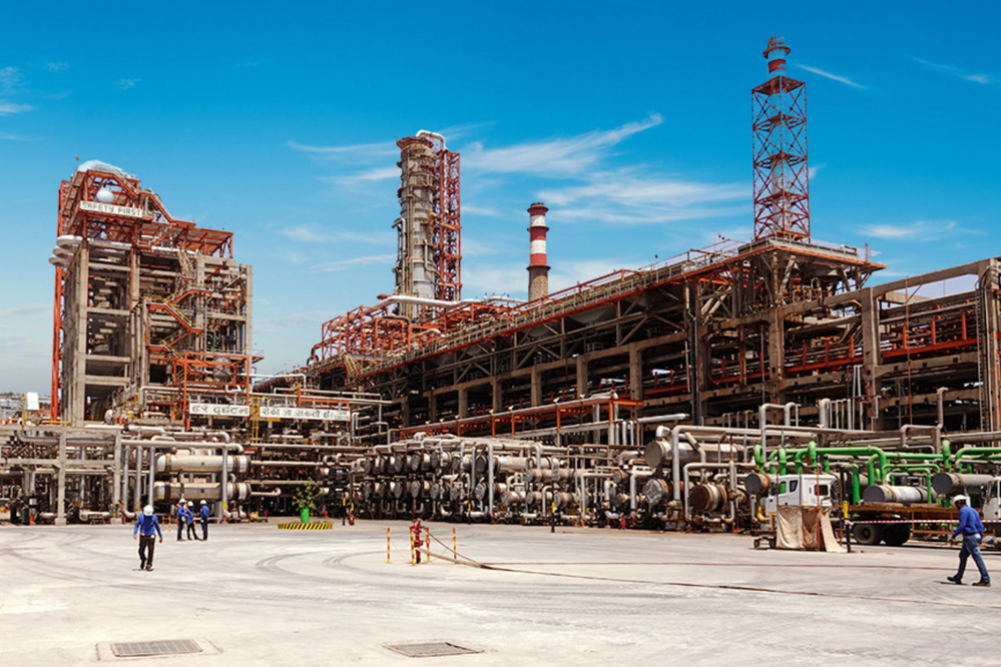
After domestic refining capacity decreased by about 40 percent, Russia has started importing petrol from India for the first time.
We use Google Cloud Translation Services. Google requires we provide the following disclaimer relating to use of this service:
This service may contain translations powered by Google. Google disclaims all warranties related to the translations, expressed or implied, including any warranties of accuracy, reliability, and any implied warranties of merchantability, fitness for a particular purpose, and noninfringement.
Russia is grappling with a fuel shortage after Ukrainian drone attacks damaged major oil refining centers (refineries). With domestic refining capacity reduced by about 40 percent, Russia has begun importing petrol from India for the first time.
According to the Financial Times, a tanker carrying 42,000 tons of petrol shipped from the Vadinar refinery in Gujarat, India, is set to arrive at the Beloye More oil terminal in northern Russia on Sunday. This shipment is considered the largest single petrol import to Russia since the onset of the current fuel crisis.
After refineries were damaged by Ukrainian attacks, Russia is experiencing its most severe fuel crisis since the dissolution of the Soviet Union. In various regions of the country, limits have been imposed on per capita petrol sales, and in some places, people have had to queue for fuel for hours or even days. Around 50 million Russians have been affected by this crisis.
The Russian government formally announced its plan to import petrol in the last week of June. Even before that, long lines had started appearing at petrol stations across the country.
Petrol was loaded onto a ship named 'Agni' from the Vadinar refinery on June 18. Later, on July 6, the fuel was transferred to a tanker named 'Garnet' near the Damietta Light area off the Mediterranean coast of Egypt. By July 22, the ship was heading north along the Norwegian coast.
The Vadinar refinery is owned by India's Nayara Energy, in which Russian state company Rosneft holds a 49 percent stake. According to Kpler, in 2026, more than 90 percent of the crude oil processed at Vadinar came from Russia. Therefore, it is notable that Russian crude oil is being refined in India and then sent back to Russia.
However, Nayara Energy has stated that it has not sold fuel to Russian companies and has no plans to do so. The company has said it is committed to meeting the demands of the Indian market.
Earlier, at the beginning of July, Reuters reported that at least 60,000 tons of petrol had been sent from India to Russia, which is about 60 percent of Russia's daily petrol consumption.
Not only India, but Belarus has also significantly increased its petrol supply to Russia. According to Russia's Price Benchmark Center, in June, Belarus sold 184,000 tons of petrol to Russia, which is three times more than the previous month and 184 times more than the same period last year.
Russia's Deputy Prime Minister overseeing the energy sector, Alexander Novak, confirmed on July 8 that imports of petroleum products had begun.
Russian President Vladimir Putin, speaking at an economic meeting on Wednesday, addressed the fuel crisis, claiming the problem was temporary and would not have a long-term impact on the overall economy.
Analysts have noted that the crisis has somewhat eased due to decreased fuel demand and independent petrol stations raising prices to European levels. As a result, some sales restrictions have been lifted in certain areas, and queues at petrol stations have shortened.
However, local media have reported that in southern cities like Astrakhan and western cities such as Lipetsk and Voronezh, long lines of 50 to more than 100 vehicles are still forming. In Ulyanovsk, on the banks of the Volga River, the situation has reportedly worsened, according to Kluge's analysis.